
The New Glutton or Epicure
Horace Fletcher
THE CLASSIC COLLECTION · 1898
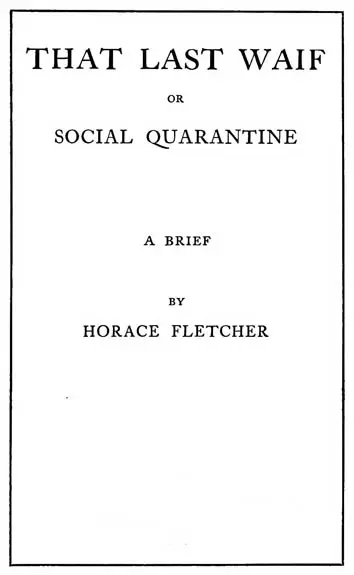
"That Last Waif; or, Social Quarantine" by Horace Fletcher is a social reform treatise written in the early 20th century. The work advocates for improved care and protection for neglected children, arguing that society must enact a "social quarantine" to shield these vulnerable individuals from harmful environments and influences. The author highlights the tragic fate of a young, neglected child he encounters, illustrating the pressing need for systemic change in how society treats its least fortunate members. At the start of the book, the narrative unfolds in the context of heightened patriotism during the Spanish-American War, juxtaposing the fervor for distant humanitarian efforts with the dire conditions faced by the neglected children in urban America. Fletcher shares a poignant encounter with a young boy, a "waif," who pleads for mercy from a policeman, revealing the harsh realities of life on the streets. This incident serves as a catalyst for Fletcher’s call to action, highlighting both the societal neglect faced by children and the potential for a comprehensive reform system that could redeem them and shape them into good citizens. Through his observations and arguments, Fletcher critiques the current societal norms and suggests that a collective, organized effort could address the root causes of neglect and crime, rather than merely treating their symptoms.
Introduction adapted from the source catalogue; source summaries may be automatically generated.
Free to read · English · 34,906 words · No account needed
MAKE TIME FOR A GOOD BOOK
On by default. Untick to stop anonymous reading totals. Each page counts after 10 seconds in view. How this works.
Anonymous counting is on unless you have switched it off.
Transcriber's Note: Minor typographical errors have been corrected without note. Irregularities and inconsistencies in the text have been retained as printed. Words printed in italics are noted with underscores: italics.
THE A.B.-Z. OF OUR OWN NUTRITION.
Thirteenth thousand. 462 pp.
THE NEW MENTICULTURE; OR,
THE A-B-C OF TRUE LIVING. Forty-Eighth thousand. 310 pp.
THE NEW GLUTTON OR EPICURE; OR,
ECONOMIC NUTRITION. Fifteenth thousand. 344 pp.
HAPPINESS AS FOUND IN FORETHOUGHT MINUS FEARTHOUGHT.
Fourteenth thousand. 251 pp.
THAT LAST WAIF; OR,
SOCIAL QUARANTINE. Sixth thousand. 270 pp.
Advocate for the Waifs
Fellow American Association for the Advancement of Science
MATTHEW, xviii; 1, 2 and 14
1. At the same time came the disciples unto Jesus saying, Who is the greatest in the kingdom of heaven?
2. And Jesus called a little child unto him, and set him
in the midst of them.
14. Even so it is not the will of your Father which is in heaven, that one of these little ones should perish?
"It was Juvenal who said, 'The man's character is made at seven; what he then is, he will always be.' This seems a sweeping assertion, but Aristotle, Plato, Lycurgus, Plutarch, Bacon, Locke, and Lord Brougham, all emphasize the same idea, while leading educators of a modern day are all united upon this point." [Sarah B. Cooper, to the National Conference of Charities and Correction of the United States and Canada.]
"This institution was established as the result of a quickened public conscience on the subject of waifs of the State, a comprehensive understanding of the relation of the State to the child, and the demonstrated effect of such institutions in decreasing crime." [The American Journal of Sociology, May, 1898, page 790.]
"Waif," as herein employed, applies to all neglected or abused children, and not especially to those who have lost their parents, or have been abandoned.
While the evidence of the kindergartners may seem extreme as to the possibility of making useful citizens of all children, the unanimity of their enthusiasm must be taken as very strong evidence.
The plea for a social quarantine which shall establish protection for helpless infancy during the period of present neglect, and when the cost is insignificant, is made in the belief that, once attracted to the idea of the possibility of social quarantine, which is nothing if not complete, popular sentiment will demand a continuance of organized protection for each member of society as long as he may be helpless or weak, without reference to an age limit.
Your reading position is saved on this browser. Take it to another device with a library code. Reading pages adapt to text, rather than matching a printed edition.
Horace Fletcher

Horace Fletcher
Horace Fletcher
Horace Fletcher
BEHIND THE BOOK
This eBook is for the use of anyone anywhere in the United States and most other parts of the world at no cost and with almost no restrictions whatsoever. You may copy it, give it away or re-use it under the terms of the Project Gutenberg License included with this eBook or online at www.gutenberg.org. If you are not located in the United States, you will have to check the laws of the country where you are located before using this eBook. Read the source licence.
The original source file, including credits and licence, is retained by this library. Request an original-format copy at no charge. Please include the book title and Project Gutenberg identifier #44997.
KEEP YOUR CURIOSITY GOING
Cécile Tormay

Moritz Busch
John L. Ransom
Frances Wright
Cécile Tormay

Mabel Potter Daggett