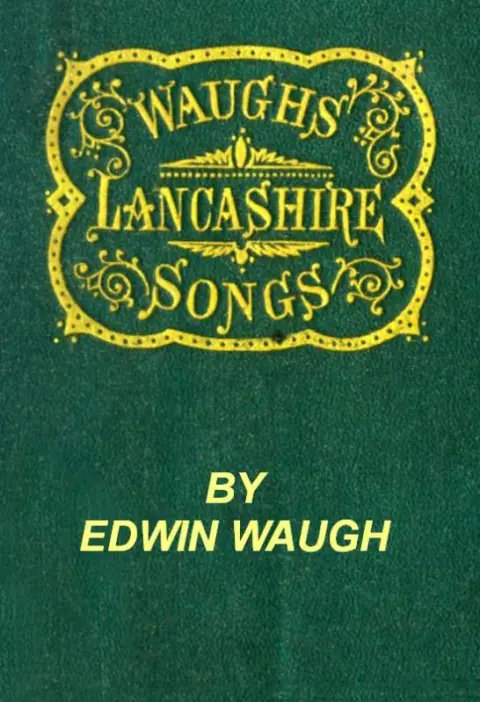
Lancashire Songs
Edwin Waugh
THE CLASSIC COLLECTION · 1864
"Th' Barrel Organ" by Edwin Waugh is a narrative that falls within the genre of regional fiction, likely written in the mid-to-late 19th century, during the Victorian era. The book explores the everyday lives and experiences of working-class characters in a rustic English setting, with a focus on themes of community, humor, and the charm of rural life. The story unfolds through the interactions of various characters, mainly revolving around the arrival of a barrel organ intended for a chapel. The protagonist encounters his friend Sceawter, a moor-end farmer, and shares a series of amusing anecdotes about local life, including a humorous mishap involving a wash machine and the organ itself. As the characters engage in lighthearted banter, Waugh paints a vivid picture of their world, infusing the narrative with gentle humor and a sense of nostalgia. Ultimately, the book serves as a celebration of the quirks and camaraderie of village life, showcasing the strength of community bonds amidst everyday challenges and delightful follies.
Introduction adapted from the source catalogue; source summaries may be automatically generated.
Free to read · English · 6,249 words · No account needed
MAKE TIME FOR A GOOD BOOK
On by default. Untick to stop anonymous reading totals. Each page counts after 10 seconds in view. How this works.
Anonymous counting is on unless you have switched it off.
E-text prepared by Todd Augsburger <[email protected]>
by
Manchester:
John Heywood, 143 Deansgate.
London: Simkin, Marshall & Co.
I came out at Haslingden town-end with my old acquaintance, "Rondle o'th Nab," better known by the name of "Sceawter," a moor-end farmer and cattle dealer. He was telling me a story about a cat that squinted, and grew very fat because--to use his own words--it "catched two mice at one go." When he had finished the tale, he stopped suddenly in the middle of the road, and looking round at the hills, he said, "Nea then. I'se be like to lev yo here. I mun turn off to 'Dick o' Rough-cap's' up Musbury Road. I want to bargain about yon heifer. He's a very fair chap, is Dick,--for a cow-jobber. But yo met as weel go up wi' me, an' then go forrud to our house. We'n some singers comin' to neet."
"Nay," said I, "I think I'll tak up through Horncliffe, an' by th' moor-gate, to't 'Top o'th Hoof.'"
"Well, then," replied he, "yo mun strike off at th' lift hond, about a mile fur on; an' then up th' hill side, an' through th' delph. Fro theer yo mun get upo' th' owd road as weel as yo con; an' when yo'n getten it, keep it. So good day, an' tak care o' yorsel'. Barfoot folk should never walk upo' prickles." He then turned, and walked off. Before he had gone twenty yards he shouted back, "Hey! I say! Dunnot forget th' cat."
It was a fine autumn day; clear and cool. Dead leaves were whirling about the road-side. I toiled slowly up the hill, to the famous Horncliffe Quarries, where the sounds of picks, chisels, and gavelocks, used by the workmen, rose strangely clear amidst the surrounding stillness. From the quarries I got up by an old pack horse road, to a commanding elevation at the top of the moors. Here I sat down on a rude block of mossy stone, upon a bleak point of the hills, overlooking one of the most picturesque parts of the Irwell valley. The country around me was part of the wild tract still known by its ancient name of the Forest of Rossendale. Lodges of water and beautiful reaches of the winding river gleamed in the evening sun, among green holms and patches of woodland, far down the vale; and mills, mansions, farmsteads, churches, and busy hamlets succeeded each other as far as the eye could see. The moorland tops and slopes were all purpled with fading heather, save here and there where a well-defined tract of green showed that cultivation had worked up a little plot of the wilderness into pasture land. About eight miles south, a gray cloud hung over the town of Bury, and nearer, a flying trail of white steam marked the rush of a railway train along the valley. From a lofty perch of the hills, on the north-west, the sounds of Haslingden church bells came sweetly upon the ear, swayed to and fro by the unsettled wind, now soft and low, borne away by the breeze, now full and clear, sweeping by me in a great gush of melody, and dying out upon the moorland wilds behind. Up from the valley came drowsy sounds that tell the wane of day, and please the ear of evening as she draws her curtains over the world. A woman's voice floated up from the pastures of an old farm-house, below where I sat, calling the cattle home. The barking of dogs sounded clear in different parts of the vale, and about scattered hamlets, on the hill sides. I could hear the far-off prattle of a company of girls, mingled with the lazy joltings of a cart, the occasional crack of a whip, and the surly call of a driver to his horses, upon the high road, half a mile below me. From a wooded slope, on the opposite side of the valley, the crack of a gun came, waking the echoes for a minute; and then all seemed to sink into a deeper stillness than before, and the dreamy surge of sound broke softer and softer upon the shores of evening, as daylight sobered down. High above the green valley, on both sides, the moorlands stretched away in billowy wildernesses--dark, bleak, and almost soundless, save where the wind harped his wild anthem upon the heathery waste, and where roaring streams filled the lonely cloughs with drowsy uproar. It was a striking scene, and it was an impressive hour. The bold, round, flat-topped height of Musbury Tor stood gloomily proud, on the opposite side, girdled off from the rest of the hills by a green vale. The lofty outlines of Aviside and Holcombe were glowing with the gorgeous hues of a cloudless October sunset. Along those wild ridges the soldiers of ancient Rome marched from Manchester to Preston, when boars and wolves ranged the woods and thickets of the Irwell valley. The stream is now lined all the way with busy populations, and evidences of great wealth and enterprise. But the spot from which I looked down upon it was still naturally wild. The hand of man had left no mark there, except the grass-grown pack-horse road. There was no sound nor sign of life immediately around me.
Your reading position is saved on this browser. Take it to another device with a library code. Reading pages adapt to text, rather than matching a printed edition.
BEHIND THE BOOK
This eBook is for the use of anyone anywhere in the United States and most other parts of the world at no cost and with almost no restrictions whatsoever. You may copy it, give it away or re-use it under the terms of the Project Gutenberg License included with this eBook or online at www.gutenberg.org. If you are not located in the United States, you will have to check the laws of the country where you are located before using this eBook. Read the source licence.
The original source file, including credits and licence, is retained by this library. Request an original-format copy at no charge. Please include the book title and Project Gutenberg identifier #15986.
KEEP YOUR CURIOSITY GOING
Coulson Kernahan

Maurice Baring
Frances Wright
Cécile Tormay

Frederic Jesup Stimson

W. H. P. (William Henry Pope) Jarvis