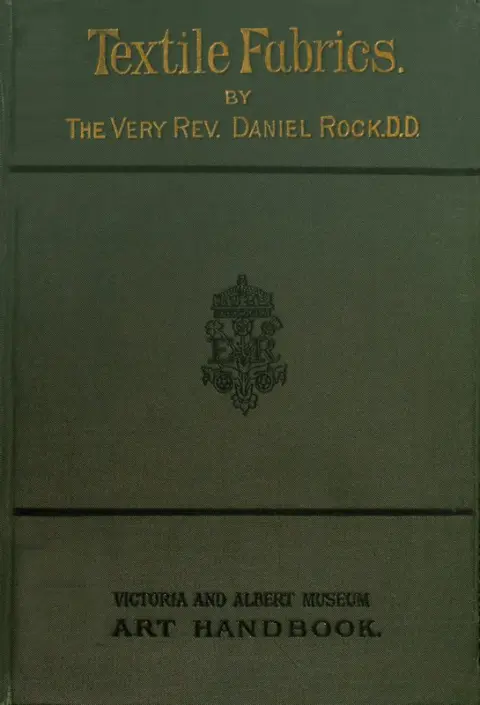
Textile Fabrics
Daniel Rock

THE CLASSIC COLLECTION · 1876
"Textile Fabrics" by Daniel Rock is a descriptive catalogue written in the late 19th century. The work focuses on a collection of church vestments, dresses, silk stuffs, needlework, and tapestries housed in the South Kensington Museum. The book offers insights into the history, techniques, and cultural significance of various textiles, examining materials such as wool, silk, and gold, as well as their geographical sources and styles. The opening of the catalogue introduces the reader to the extensive collection and its intended purpose. It emphasizes the historical relevance of textiles, showcasing the evolution of weaving and the role of women in the textile arts throughout various cultures and eras. Rock highlights the importance of these fabrics not only as functional items but also as works of art, worthy of study for their craftsmanship and aesthetic qualities. By delineating the materials and methods used in creating textiles, he sets the stage for a deeper exploration of the various sections that will follow in the catalog.
Introduction adapted from the source catalogue; source summaries may be automatically generated.
Free to read · English · 173,992 words · No account needed
MAKE TIME FOR A GOOD BOOK
On by default. Untick to stop anonymous reading totals. Each page counts after 10 seconds in view. How this works.
Anonymous counting is on unless you have switched it off.
Piece of Silk-Velvet Damask; green, with pattern of large and small pomegranates in gold. Lucca, latter half of the 15th century. 3 feet 10 inches by 11½ inches.
Among the remarkable specimens of velvet in this collection, not the least conspicuous is the present one, being velvet upon velvet, that is, having, in a portion of it, a pattern in a higher pile than the pile of the ground. By looking narrowly at the larger pomegranate in golden thread within its heart-shaped oval, with featherings bounded by trefoiled cusps, the eye will catch an undulating pattern rising slightly above the rest of the pile; such examples, as distinguished from what is called cut or raised velvet, are very rare. The tone, too, of the fine green, as well as the goodness of the gold, in the ornamentation, enhance the value of this piece, which was once the back part of a chasuble.
Piece of Silk Damask; white, with the rose and pomegranate pattern woven in gold thread. Spanish, latter half of the 15th century.
This piece, from the looms of Spain, for the beauty of design and the thick richness of its silk, is somewhat remarkable.
Box covered with crimson raised velvet, having, round the lid, a many-coloured cotton fringe. It holds two liturgical pallæ, both of fine linen and figured--one mounted on pasteboard and measuring 7¾ inches by 7¼ inches, with an altar and two figures; the other, with the Crucifixion and St. Mary and St. John, measuring 9½ inches by 9¾ inches. Inside the lid of this box is an illuminated border of flowers, and the central design is effaced. Velvet, Italian, 16th century, all the paintings very late 15th century, and German. Box, 10 inches by 9½ inches.
As a case for holding “corporals” and “palls,” this box is a curiosity, in its way, of rare occurrence. It must be carefully distinguished from a square sort of case for the “corporal,” and called the “burse.” The corporal is a large square piece of fine linen; and at one time the chalice at mass not only stood upon it but was covered too by its inward border; but for a long period, the usage has been and is to put upon the chalice, instead of any part of the corporal, a much smaller separate square piece of fine linen, often stiffened, the better to serve its purpose, with card-board, like this example; such is a pall, and the one before us is figured, we may say illuminated, with what used to be called, in England, St. Gregory’s Pity; “Church of our Fathers,” i. 53. Upon an altar, around which are the instruments of the Passion, and on one side St. Peter, known by the key in his hand, and on the other the cock on the column, crowing, stands our Lord all bleeding, with the blood trickling into a chalice between His feet. At the foot of the altar kneels, veiled for mass, St. Gregory the Great, behind whom we see, holding a book in both hands, St. Jerome, robed as a cardinal; the whole is framed in a floriated border. The other, and unstiffened “pall,” is illuminated with the Crucifixion after the usual conventional manner, in all respects, that prevailed at the time it was done, that is, somewhere about the year 1490. As specimens on linen these two palls are rather rare. The border of flowers, on vellum, attached to the inside of the lid, is a free, well-coloured, and pleasing example of the Flemish school late in the 15th century. The raised velvet is of a rich crimson tone, and from Lucca or Genoa.
Your reading position is saved on this browser. Take it to another device with a library code. Reading pages adapt to text, rather than matching a printed edition.
Daniel Rock
BEHIND THE BOOK
This eBook is for the use of anyone anywhere in the United States and most other parts of the world at no cost and with almost no restrictions whatsoever. You may copy it, give it away or re-use it under the terms of the Project Gutenberg License included with this eBook or online at www.gutenberg.org. If you are not located in the United States, you will have to check the laws of the country where you are located before using this eBook. Read the source licence.
The original source file, including credits and licence, is retained by this library. Request an original-format copy at no charge. Please include the book title and Project Gutenberg identifier #66172.
KEEP YOUR CURIOSITY GOING
Cécile Tormay

Moritz Busch
John L. Ransom
Frances Wright
Cécile Tormay

Mabel Potter Daggett