THE CLASSIC COLLECTION✦The gate marked “Private”CLASSIC FREE BOOKS
The gate marked “Private”
Ethel M. (Ethel May) Dell
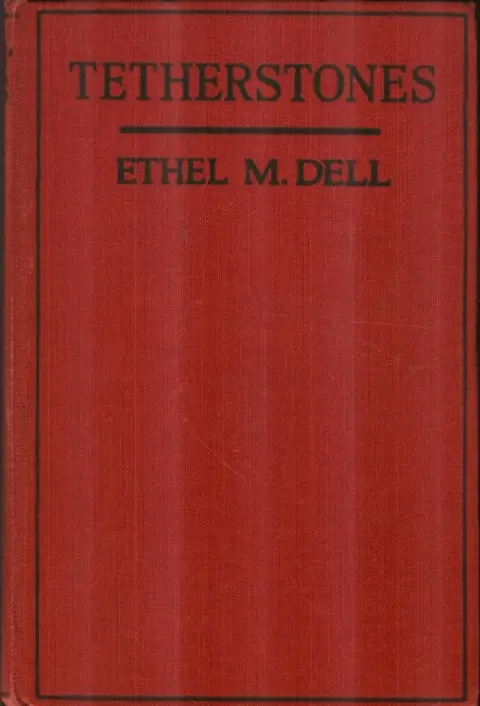
THE CLASSIC COLLECTION · 1923
"Tetherstones" by Ethel M. Dell is a novel written in the early 20th century. This work delves into themes of love, sacrifice, and personal struggle, centering around the character of Frances Thorold, who finds herself caught between her responsibilities as a secretary for a domineering Bishop and her yearning for a more fulfilling life. The story hints at a romantic entanglement with Montague Rotherby, a man who awakens emotions in her that she has long repressed. At the start of the novel, Frances is introduced as the Bishop's overworked secretary, feeling insignificant amidst the grandeur of her surroundings. We witness her exhausting routine and the toll it takes on her spirit, particularly in her interactions with the Bishop, who epitomizes the authoritarian figure in her life. The opening scenes establish the tension between her duty and her desires, culminating in a chance conversation with Rotherby that hints at a connection between them. This delicate balance of longing and duty unfolds as Frances grapples with both her ambition and the constraints imposed upon her, setting the stage for deeper conflict and emotional exploration in her journey.
Introduction adapted from the source catalogue; source summaries may be automatically generated.
Free to read · English · 105,205 words · No account needed
MAKE TIME FOR A GOOD BOOK
On by default. Untick to stop anonymous reading totals. Each page counts after 10 seconds in view. How this works.
Anonymous counting is on unless you have switched it off.
“That he was strongly attracted by you?” suggested the Bishop.
“I did not think that I was sufficiently attractive for that to be possible,” she answered with simplicity.
The flicker of a smile crossed his hard features. “You do not know human nature very well,” he observed. “But to continue! You went to Brookside. And then?”
“He came to see me there,” Frances said.
“And made love to you?”
“Yes.”
“Against your will?” asked the Bishop.
She met his look with great directness. “No, it was not—at first—against my will. But I misunderstood him. And he misunderstood me. Afterwards—very soon afterwards—I found out my mistake. That is all I have to say upon that subject. It is over and done with now, and I do not wish to think of it again.”
“I fear it has led to various complications,” said the Bishop, “which make it impossible to dismiss the matter in that fashion. However, we will pass on. May I ask you to give me the bald details of what followed?”
She hesitated. That he was already in possession of most of the circumstances attending her sojourn at Tetherstones was a fact which she did not question, but she had a strong repugnance to discussing them with him.
He read it, and in a moment, with a courtesy that surprised her, he tried to set her at her ease.
“You need not scruple,” he said, “to speak freely to me upon this matter. Nothing that you may tell me will go beyond this room.”
“Thank you,” she said, but still she hesitated. She could not tell him of that terrible night with Montague upon the moors. At last, with an effort, “I had an unpleasant adventure,” she said. “I was lost in a fog. A little blind girl from a farm near by called Tetherstones found me, and took me home with her. I was ill after that, and they nursed me.”
“They?” queried the Bishop.
“The Dermots,” she said.
“Ah!” said the Bishop.
He sat for a space lost in thought, his eyes still fixed upon her.
“Tell me about them!” he said at length. “Of what does the family now
consist?”
She told him, and he listened with close attention.
“What is the father like?” he asked then.
“He is an invalid,” she said. “The son works the farm, and the girls all help. The mother spends most of her time looking after the old man.”
“Is he very old?” asked the Bishop.
“Very, I should say,” she answered.
“And the child—she is blind, you say?”
“Not now,” said Frances gently. “She is dead.”
Your reading position is saved on this browser. Take it to another device with a library code. Reading pages adapt to text, rather than matching a printed edition.
Ethel M. (Ethel May) Dell
Ethel M. (Ethel May) Dell
BEHIND THE BOOK
This eBook is for the use of anyone anywhere in the United States and most other parts of the world at no cost and with almost no restrictions whatsoever. You may copy it, give it away or re-use it under the terms of the Project Gutenberg License included with this eBook or online at www.gutenberg.org. If you are not located in the United States, you will have to check the laws of the country where you are located before using this eBook. Read the source licence.
The original source file, including credits and licence, is retained by this library. Request an original-format copy at no charge. Please include the book title and Project Gutenberg identifier #59181.
KEEP YOUR CURIOSITY GOING
Coulson Kernahan

Maurice Baring
Frances Wright
Cécile Tormay

Frederic Jesup Stimson

W. H. P. (William Henry Pope) Jarvis