The East I know
Paul Claudel
THE CLASSIC COLLECTION · 1919
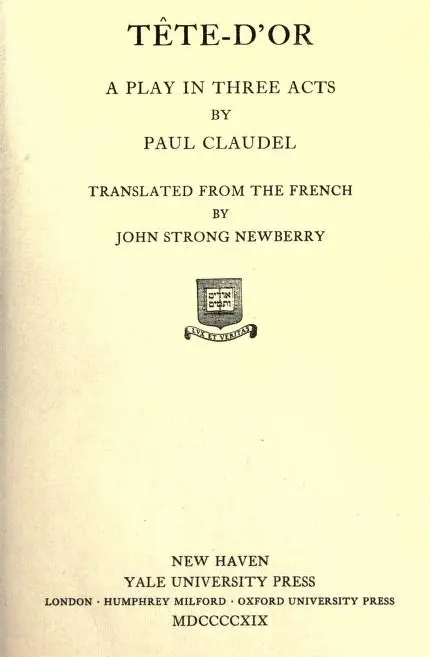
"Tête-d'Or: A play in three acts" by Paul Claudel is a theatrical work written in the early 20th century. The play introduces the characters Simon Agnel, who later takes on the title Tête-d'or, and Cébès, as they navigate themes of love, loss, and existential questioning. It contemplates the interplay between life and death, as Simon grapples with the profound meaning of existence after the death of a loved one. The opening of "Tête-d'Or" sets the stage with Simon Agnel carrying the body of a woman he loved, while Cébès expresses his own existential doubts and confusion about life and identity. As they converse, Simon reveals his tumultuous past and the burden of grief he carries, symbolized by the act of digging a grave. Cébès, grappling with his own mortality and the weight of despair, asks poignant questions about existence and the essence of human experience. Their dialogue explores weighty themes of love, loss, and the search for meaning in a world marked by sorrow and uncertainty.
Introduction adapted from the source catalogue; source summaries may be automatically generated.
Free to read · English · 39,671 words · No account needed
MAKE TIME FOR A GOOD BOOK
On by default. Untick to stop anonymous reading totals. Each page counts after 10 seconds in view. How this works.
Anonymous counting is on unless you have switched it off.
--I shall not live for you, but you must live for me.
And that is why I stand alone before you like a virgin.
(Pause.
(the TRIBUNE OF THE PEOPLE, the MAN OUT OF OFFICE and the others
withdraw a little leaving in front the group of the KING and his
officials.
THE SCHOOLMASTER: But what does all this mean?
THE HIGH PREFECT: Sire, will you make no answer? Why do you stand there motionless and mute, like a man who does not hear or one who has nothing at stake?
THE KING: Say what you have to say. The King will be the last to speak.
THE HIGH PREFECT: Maker of Demands, you are exorbitant in what you ask.
For he who demands must give an equivalent return, And you offer us nothing but stand before us with dishevelled hair,
And say that you wish to be Master and he who speaks unchallenged, and that you would seat yourself
Like a sovereign on the consecrated throne,
And not to administer
With prudent thrift for the common good of all,
But like a man at his desk to whom his tenants bring their money
That he may spend it in another place.
TÊTE-D'OR: I have saved you all! Like a man who takes another in his
arms.
THE HIGH PREFECT: All society, Tête-d'or,
Exists for the common advantage.
And each one has his place that he may serve the rest.
And the Sovereign, if one is needed, is he who serves everyone,
With his officials, according to their functions.
TÊTE-D'OR: And what is the good that they seek in living together?
THE SCHOOLMASTER: And you, what good have you to promise us, seducer?
But they seek for peace and to live in peace by the fruits of their
daily toil.
TÊTE-D'OR: You have not answered well, Schoolmaster. You think you are very wise and in truth you are only an ignoramus.
Man is like the insatiable fire which at the last will consume the
world,
And at present sleeps beneath the ashes and is used for cooking food.
But behold I appear before you like roaring flame
Mightily rearing itself under the mouth of the wind!
THE SCHOOLMASTER: There is no other good than that which I have named.
And that is why society exists. Men join together that each may serve
his neighbor.
TÊTE-D'OR: Serve?
And what is the function for which they fashioned me? What implement am
I?
I am not the spade nor the bag nor the scales. But I am the fire and
the sword!
I have no place among you but now I shall make myself one,
Your reading position is saved on this browser. Take it to another device with a library code. Reading pages adapt to text, rather than matching a printed edition.
Paul Claudel
BEHIND THE BOOK
This eBook is for the use of anyone anywhere in the United States and most other parts of the world at no cost and with almost no restrictions whatsoever. You may copy it, give it away or re-use it under the terms of the Project Gutenberg License included with this eBook or online at www.gutenberg.org. If you are not located in the United States, you will have to check the laws of the country where you are located before using this eBook. Read the source licence.
The original source file, including credits and licence, is retained by this library. Request an original-format copy at no charge. Please include the book title and Project Gutenberg identifier #52088.
KEEP YOUR CURIOSITY GOING
Maurice Baring
W. B. (William Butler) Yeats
Edward Martyn

John Brougham & Charlotte Brontë
Marguerite Merington
Leonid Andreyev