
Love Letters of a Violinist, and Other Poems
Eric Mackay
THE CLASSIC COLLECTION · 1836
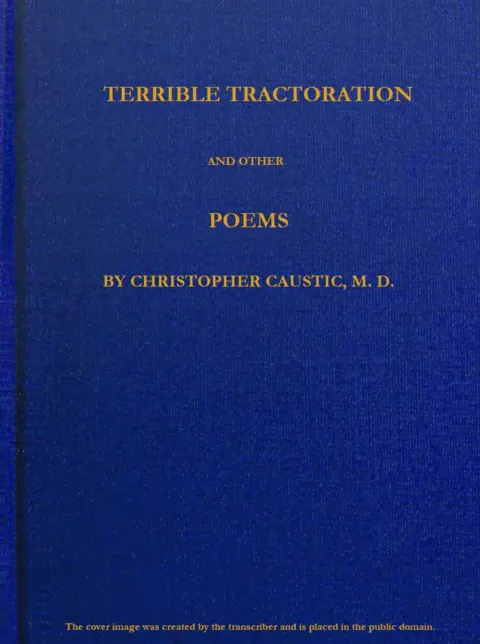
"Terrible Tractoration, and Other Poems" by Thomas Green Fessenden is a satirical collection of poetry that was likely written in the early 19th century. The book centers around a character named Dr. Christopher Caustic, an eccentric and ambitious physician who seeks recognition for his grand scientific inventions and theories. Through humorous and ironic verse, the poetry critiques various contemporary medical practices, particularly the controversial use of metallic tractors, which were promoted as a cure for diseases but were viewed with skepticism by many. The beginning of the work introduces us to Dr. Caustic, who laments his fallen fortunes as he navigates the trials of being a poet and a scientist in a world that seems to value superficial cures over genuine medical knowledge. He reflects on his past successes and the financial struggles that have led him to turn to poetry to make a living. This opening sets the stage for Caustic's various rants and proclamations regarding the absurdities of contemporary medicine and society, while simultaneously establishing his character as both a visionary and a figure of mockery within the realm of medical science. The tone is playful yet critical, inviting readers to explore a world of folly and irony through humorous verse.
Introduction adapted from the source catalogue; source summaries may be automatically generated.
Free to read · English · 51,557 words · No account needed
MAKE TIME FOR A GOOD BOOK
On by default. Untick to stop anonymous reading totals. Each page counts after 10 seconds in view. How this works.
Anonymous counting is on unless you have switched it off.
When first in high life you commence,
To virtue, reason, common sense,
You’ll please to bid adieu, sir;
And, lest some brother rake be higher,
Drink, till your blood be all on fire,
And face of crimson hue, sir.
Thus you’ll be dubb’d a dashing blade,
And, by the genteel world be said,
To be a man of spirit;
For stylish folks despise the chaps,
Who think that they may rise, perhaps,
By industry and merit.
With lubric arts, and wily tongue,
Debauch some maiden, fair and young,
For that will be genteel;
Be not too scrupulous; win the fair;
Then leave the frail one to despair:
A rake should never feel.
When wine has made your courage stout,
In midnight revel sally out,
Insulting all you meet;
Play pretty pranks about the town,
Break windows, knock the watchmen down,
Your frolic to complete!
Besides exhibiting your parts,
You’re sure to win the ladies’ hearts
By dint of dissipation;
Since “every woman is a rake,”
A fool may know what steps to take
To gain her approbation.
By practising these famous rules,
You’ll gain from wicked men and fools
A world of admiration:
And, as we know from good authority,
Such folks compose a clear majority,
There needs no hesitation.
Blest be the memory of the Sage,
Who taught the typographic page
To teem with symbols, heav’n-design’d,
The mute interpreters of mind.
The world at length had learn’d to prize
The art of speaking to the eyes,
Which had, by modes which CADMUS taught,
Giv’n immortality to thought;--
When FAUSTUS, by celestial skill,
Found means to multiply at will,
Those silent heralds of the kind,
Which give ubiquity to mind,--
Explored that Art, which brings to view,
All that we know--our father’s knew,--
And which developes every hour
That knowledge, which results in power,--
That Art, which gives to man’s control
Celestial treasures of the soul,
Transcending, many thousand fold,
Golconda’s gems, and Ophir’s gold.
What but the Printer’s Art sublime,
Can register the deeds of time,
Recording all that’s said and done
Most worthy note beneath the sun?
The poet, patriot, saint and sage
Have habitations on his page,
Are never absent when you call,
Alike accessible to all.
He introduces man to man,
Of every nation, tribe or clan,
The humble to the high--MOST HIGH,
In palaces above the sky.
Then bless the memory of the sage,
Who taught the typographic page
To teem with symbols, heav’n-design’d,
The silent heralds of the mind.
Your reading position is saved on this browser. Take it to another device with a library code. Reading pages adapt to text, rather than matching a printed edition.
BEHIND THE BOOK
This eBook is for the use of anyone anywhere in the United States and most other parts of the world at no cost and with almost no restrictions whatsoever. You may copy it, give it away or re-use it under the terms of the Project Gutenberg License included with this eBook or online at www.gutenberg.org. If you are not located in the United States, you will have to check the laws of the country where you are located before using this eBook. Read the source licence.
The original source file, including credits and licence, is retained by this library. Request an original-format copy at no charge. Please include the book title and Project Gutenberg identifier #65068.
KEEP YOUR CURIOSITY GOING
Eric Mackay
Edmund Gosse
Sophia Margaretta Hensley
Gilbert Parker
George MacDonald

Elizabeth Bibesco