
Love Letters of a Violinist, and Other Poems
Eric Mackay
THE CLASSIC COLLECTION · 1836
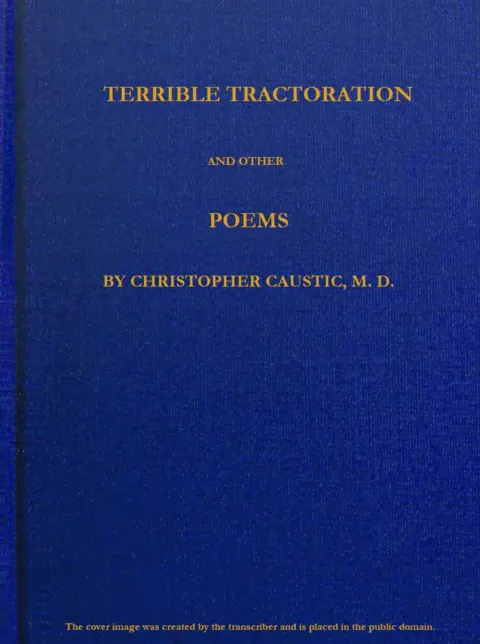
"Terrible Tractoration, and Other Poems" by Thomas Green Fessenden is a satirical collection of poetry that was likely written in the early 19th century. The book centers around a character named Dr. Christopher Caustic, an eccentric and ambitious physician who seeks recognition for his grand scientific inventions and theories. Through humorous and ironic verse, the poetry critiques various contemporary medical practices, particularly the controversial use of metallic tractors, which were promoted as a cure for diseases but were viewed with skepticism by many. The beginning of the work introduces us to Dr. Caustic, who laments his fallen fortunes as he navigates the trials of being a poet and a scientist in a world that seems to value superficial cures over genuine medical knowledge. He reflects on his past successes and the financial struggles that have led him to turn to poetry to make a living. This opening sets the stage for Caustic's various rants and proclamations regarding the absurdities of contemporary medicine and society, while simultaneously establishing his character as both a visionary and a figure of mockery within the realm of medical science. The tone is playful yet critical, inviting readers to explore a world of folly and irony through humorous verse.
Introduction adapted from the source catalogue; source summaries may be automatically generated.
Free to read · English · 51,557 words · No account needed
MAKE TIME FOR A GOOD BOOK
On by default. Untick to stop anonymous reading totals. Each page counts after 10 seconds in view. How this works.
Anonymous counting is on unless you have switched it off.
Where Britannia’s sons unite
To provoke the distant fight,
There shall countless heroes fall,
There shall countless heroes fall,
When the din of battle join’d,
Hurtles in the hollow wind.
Fiends of horror flit around,
Dying heroes strow the ground,
Countless ghosts shall wailing go
To the sullen shades below.
Laud we then the God of Heav’n,
At whose behest fair peace is giv’n,
The God who led our fathers o’er,
To Columbia’s happy shore.
May not anarch’s hydra form,
Thunder his voice, his breath the storm,
Desolate our happy land,
Desolate our happy land--
Mid fell discord’s wild uproar,
May no fiend of anarch roar,
Call the rugged, meddling throng
Of every clime, of every tongue,
To light fair freedom’s funeral pyre,
And bid her mid the blaze expire.
May the gracious God of Heav’n,
At whose behest fair peace is giv’n,
The God who led our fathers o’er,
Still protect Columbia’s shore.
Survey the world, through every zone,
From Lima to Japan,
In lineaments of light ’tis shown
That CULTURE makes the man.
By manual culture one attains
What industry may claim,
Another’s mental toil and pains
Attenuate his frame.
Some plough and plant the teeming soil
Some cultivate the arts;
And some devote a life of toil
To tilling heads and hearts.
Some train the adolescent mind,
While buds of promise blow,
And see each nascent twig inclined
The way the tree should grow.
The first man, and the first of men,
Were tillers of the soil;
And that was mercy’s mandate then,
Which destined man to moil.
Indulgence preludes fell attacks
Of merciless disease,
And sloth extends on fiery racks
Her listless devotees.
Hail, HORTICULTURE! Heaven-ordained,
Of every art the source,
Which man has polished, life sustained,
Since time commenced his course.
Where waves thy wonder-working wand
What splendid scenes disclose!
The blasted heath, the arid strand,
Out-bloom the gorgeous rose!
Even in the SERAPH-SEX is thy
Munificence described;
And Milton says in lady’s eye
Is Heaven identified.
A seedling, sprung from Adam’s side,
A most celestial shoot!
Became of Paradise the pride,
And bore a world of fruit.
The lily, rose, carnation, blent
By Flora’s magic power,
And tulip, feebly represent
So elegant a flower:
Then surely, bachelors, ye ought
In season to transfer
Some sprig of this sweet “TOUCH-ME-NOT,”
To grace your own parterre;
Your reading position is saved on this browser. Take it to another device with a library code. Reading pages adapt to text, rather than matching a printed edition.
BEHIND THE BOOK
This eBook is for the use of anyone anywhere in the United States and most other parts of the world at no cost and with almost no restrictions whatsoever. You may copy it, give it away or re-use it under the terms of the Project Gutenberg License included with this eBook or online at www.gutenberg.org. If you are not located in the United States, you will have to check the laws of the country where you are located before using this eBook. Read the source licence.
The original source file, including credits and licence, is retained by this library. Request an original-format copy at no charge. Please include the book title and Project Gutenberg identifier #65068.
KEEP YOUR CURIOSITY GOING
Eric Mackay
Edmund Gosse
Sophia Margaretta Hensley
Gilbert Parker
George MacDonald

Elizabeth Bibesco