
Love Letters of a Violinist, and Other Poems
Eric Mackay
THE CLASSIC COLLECTION · 1836
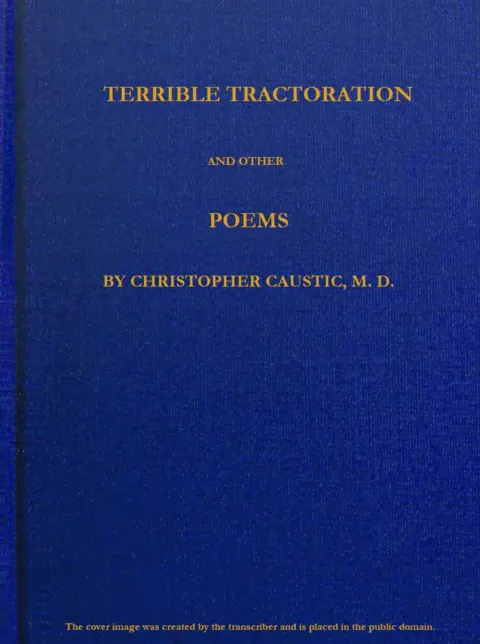
"Terrible Tractoration, and Other Poems" by Thomas Green Fessenden is a satirical collection of poetry that was likely written in the early 19th century. The book centers around a character named Dr. Christopher Caustic, an eccentric and ambitious physician who seeks recognition for his grand scientific inventions and theories. Through humorous and ironic verse, the poetry critiques various contemporary medical practices, particularly the controversial use of metallic tractors, which were promoted as a cure for diseases but were viewed with skepticism by many. The beginning of the work introduces us to Dr. Caustic, who laments his fallen fortunes as he navigates the trials of being a poet and a scientist in a world that seems to value superficial cures over genuine medical knowledge. He reflects on his past successes and the financial struggles that have led him to turn to poetry to make a living. This opening sets the stage for Caustic's various rants and proclamations regarding the absurdities of contemporary medicine and society, while simultaneously establishing his character as both a visionary and a figure of mockery within the realm of medical science. The tone is playful yet critical, inviting readers to explore a world of folly and irony through humorous verse.
Introduction adapted from the source catalogue; source summaries may be automatically generated.
Free to read · English · 51,557 words · No account needed
MAKE TIME FOR A GOOD BOOK
On by default. Untick to stop anonymous reading totals. Each page counts after 10 seconds in view. How this works.
Anonymous counting is on unless you have switched it off.
Great Doctor Caustic is a sage
Whose merit gilds this iron age,
And who deserves, as you’ll discover
When you have conn’d this canto over,
For grand discoveries and inventions,
A dozen peerages and pensions;
But, having met with rubs and breakers,
From Perkins’ metal mischief makers;
With but three halfpence in his pocket,
In verses blazing like sky rocket,
He first sets forth in this petition
His high deserts but low condition.
From garret high, with cobwebs hung,
The poorest wight that ever sung,
Most gentle Sirs, I come before ye,
To tell a lamentable story.
What makes my sorry case the sadder,
I once stood high on Fortune’s ladder;[1]
From whence contrive the fickle jilt did,
That your petitioner should be tilted.
And soon th’ unconscionable flirt,
Will tread me fairly in the dirt,
Unless, perchance, these pithy lays
Procure me pence as well as praise.
Already doom’d to hard quill-driving,
’Gainst spectred poverty still striving,
When e’er I doze, from vigils pale,
Dame Fancy locks me fast in jail.
Necessity, though I am no wit,
Compels me now to turn a poet;
Not born, but made, by transmutation,
And chymick process, call’d--starvation!
Though poet’s trade, of all that I know,
Requires the least of ready rhino,
I find a deficit of cash is
An obstacle to cutting dashes.
For gods and godesses, who traffic
In cantos, odes, and lays seraphic,
Who erst Arcadian whistle blew sharp,
Or now attune Apollo’s jews-harp,
Have sworn they will not loan me, gratis,
Their jingling sing-song apparatus,
Nor teach me how, nor where to chime in
My tintinabulum of rhyming.[2]
What then occurs? A lucky hit--
I’ve found a substitute for wit;
On Homer’s pinions mounting high,
I’ll drink Pierian puddle dry.[3]
Beddoes (bless the good doctor) has
Sent me a bag full of his gas,[4]
Which snuffed the nose up, makes wit brighter,
And eke a dunce an airy writer.
With this a brother bard, inflated,
Was so stupendously elated,
He tower’d, like Garnerin’s balloon,
Nor stopp’d, like half wits, at the moon:
But scarce had breath’d three times before he
Was hous’d in heaven’s high upper story,[5]
Where mortals none but poets enter,
Above where Mah’met’s ass dar’d venture.
Strange things he saw, and those who know him
Have said that, in his Epic Poem,[6]
To be complete within a year hence,
They’ll make a terrible appearance.
And now, to set my verses going,
Like “Joan of Arc,” sublimely flowing,
I’ll follow Southey’s bold exemple,
And snuff a sconce full, for a sample.
Your reading position is saved on this browser. Take it to another device with a library code. Reading pages adapt to text, rather than matching a printed edition.
BEHIND THE BOOK
This eBook is for the use of anyone anywhere in the United States and most other parts of the world at no cost and with almost no restrictions whatsoever. You may copy it, give it away or re-use it under the terms of the Project Gutenberg License included with this eBook or online at www.gutenberg.org. If you are not located in the United States, you will have to check the laws of the country where you are located before using this eBook. Read the source licence.
The original source file, including credits and licence, is retained by this library. Request an original-format copy at no charge. Please include the book title and Project Gutenberg identifier #65068.
KEEP YOUR CURIOSITY GOING
Eric Mackay
Edmund Gosse
Sophia Margaretta Hensley
Gilbert Parker
George MacDonald

Elizabeth Bibesco