
Love Letters of a Violinist, and Other Poems
Eric Mackay
THE CLASSIC COLLECTION · 1836
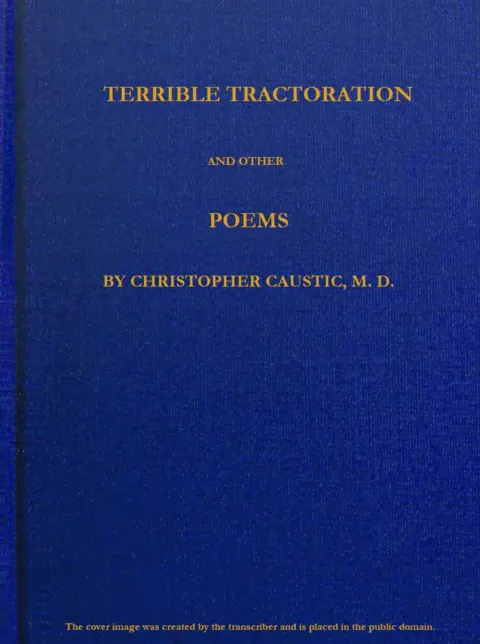
"Terrible Tractoration, and Other Poems" by Thomas Green Fessenden is a satirical collection of poetry that was likely written in the early 19th century. The book centers around a character named Dr. Christopher Caustic, an eccentric and ambitious physician who seeks recognition for his grand scientific inventions and theories. Through humorous and ironic verse, the poetry critiques various contemporary medical practices, particularly the controversial use of metallic tractors, which were promoted as a cure for diseases but were viewed with skepticism by many. The beginning of the work introduces us to Dr. Caustic, who laments his fallen fortunes as he navigates the trials of being a poet and a scientist in a world that seems to value superficial cures over genuine medical knowledge. He reflects on his past successes and the financial struggles that have led him to turn to poetry to make a living. This opening sets the stage for Caustic's various rants and proclamations regarding the absurdities of contemporary medicine and society, while simultaneously establishing his character as both a visionary and a figure of mockery within the realm of medical science. The tone is playful yet critical, inviting readers to explore a world of folly and irony through humorous verse.
Introduction adapted from the source catalogue; source summaries may be automatically generated.
Free to read · English · 51,557 words · No account needed
MAKE TIME FOR A GOOD BOOK
On by default. Untick to stop anonymous reading totals. Each page counts after 10 seconds in view. How this works.
Anonymous counting is on unless you have switched it off.
[125] The above ode was written, set to music, and sung on a public occasion in Rutland, Vermont, July, 1798. At that time the armament, which afterwards sailed to Egypt, under Buonaparte, lay at Toulon: its destination was not known in America, but many supposed that it was intended to waft the blessings of French liberty to the United States.
[126] This ode was written to the music of an anthem, previously composed for other words, by Oliver Holden, Esq. Charlestown, Mass., a gentleman eminent for his musical talents, and sung during divine service, at the anniversary of Vermont General Election.
[127] There is an inflated species of simplicity, consisting of exaggerations of thought expressed by colloquial barbarisms, mixed with occasional pomposity of diction, which it is the object of the above to ridicule. The measure is after the model of “THALABA;” but rhyme is added, as Butler says, merely by way of rudder to the verses.
[128] Killington Peak. The summit of the Green Mountains, in Vermont,
is so called.
[129] Written for the occasion, and sung in New York, July the fourth,
1805.
[130] Mud-pout and sucker are two kinds of fishes of little value, common enough in muddy streams. The otter pursues these with peculiar avidity.
[131] Wickapy is the popular name for a shrub, which is remarkably
flexible.
[132] Virgil says “acquirit,” which not rhyming we use a substitute;
“For rhyme the rudder is of verses.”
[133] Sung at the Anniversary of the Mass. Hort. Society, Sept. 10,
1830.
[134] Hon. Elias Phinney.
[135] The lady, to whom these lines were addressed, had been offended at the insolence of the character who sat as the original for our picture.
[A] We preferred whales both for the docility and the rhyme’s sake.
[B] “Divine Nonsensia.”
[C] And therefore the writer of the article “Earth,” in the Encyclopedia Britannica, is wrong in attempting to overturn this fine fabric of philosophy, by making it appear that metals, minerals, fossils, &c. are continually forming by accretion, &c. on the earth’s surface. Indeed, that writer has laid a heavy hand on all the theories of our modern earthmongers.
[D] I am afraid, after all, this would turn out but a bubble.
[E]Now, if it should happen that the comparative levity of air consists in the repellant powers of its particles, and those bodies which have the greatest cohesion are most prone to gravitate, there “needs some conjuror to tell us,” what should hinder bodies of greater specific gravity from riddling down between those particles of air. No man but Dr Franklin could have caught the fugitive air under the shell of the first earth, and pressed it till it became heavier than gold by a hurly-burly of elements “mixed in confusion.”
Your reading position is saved on this browser. Take it to another device with a library code. Reading pages adapt to text, rather than matching a printed edition.
BEHIND THE BOOK
This eBook is for the use of anyone anywhere in the United States and most other parts of the world at no cost and with almost no restrictions whatsoever. You may copy it, give it away or re-use it under the terms of the Project Gutenberg License included with this eBook or online at www.gutenberg.org. If you are not located in the United States, you will have to check the laws of the country where you are located before using this eBook. Read the source licence.
The original source file, including credits and licence, is retained by this library. Request an original-format copy at no charge. Please include the book title and Project Gutenberg identifier #65068.
KEEP YOUR CURIOSITY GOING
Eric Mackay
Edmund Gosse
Sophia Margaretta Hensley
Gilbert Parker
George MacDonald

Elizabeth Bibesco