
The Truth About an Author
Arnold Bennett
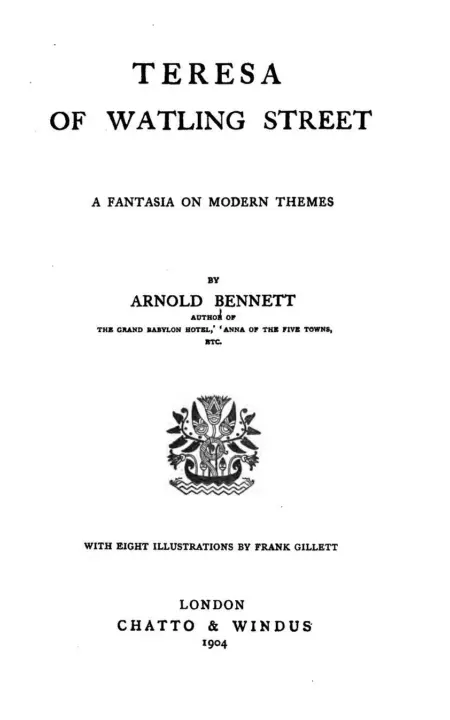
THE CLASSIC COLLECTION · 1904
"Teresa of Watling Street: A Fantasia on Modern Themes" by Arnold Bennett is a novel written in the early 20th century. The story revolves around Richard Redgrave, a young man who has transitioned from a clerk to a specialist in private inquiries. Set against the backdrop of early 1900s London, the narrative explores themes of wealth, mystery, and the subtleties of human behavior, particularly as Richard gets embroiled in the curious case surrounding a bank manager named Raphael Craig. The opening of the novel introduces Richard as he navigates a bustling area of the City of London, stepping into a world of banking that is as romantic as it is complex. With a blend of imagination and ambition, Richard attends a meeting with the directors of the British and Scottish Bank, where he is tasked with investigating Craig, who recently inherited a large fortune yet remains dedicated to his banking career. As the story unfolds, Richard’s inquiry leads him to Dunstable and a circus, where he encounters Teresa Craig, Raphael's daughter, and uncovers layers of mystery and danger intertwined with her family's secrets. The narrative sets the stage for a thrilling adventure filled with intrigue and the exploration of modern life’s eccentricities.
Introduction adapted from the source catalogue; source summaries may be automatically generated.
Free to read · English · 54,548 words · No account needed
MAKE TIME FOR A GOOD BOOK
On by default. Untick to stop anonymous reading totals. Each page counts after 10 seconds in view. How this works.
Anonymous counting is on unless you have switched it off.
‘I wanted, as I was saying, a couple of rooms myself, and I had a fancy to take the two rooms once occupied by the deceased Featherstone. It was a morbid fancy, perhaps. The landlady seemed to think so. Anyhow, I took them. I entered into possession this afternoon, and locked the door.’
‘Did you expect to see his ghost? Featherstone killed himself at the bank, not in his rooms.’
‘I am aware of it, sir,’ said Oakley. ‘I did not expect to see his ghost; I merely wanted to look round.’
‘Look round for what?’
‘For anything interesting that I might be able to see.’
‘But surely the police had searched?’
‘Yes, but they had found nothing. And I knew how anxious you were to find out anything that might be discovered about Feather-stone’s suicide.’
‘Was that your reason for taking the rooms?’ Simon Lock sneered.
‘Why not?’ said Oakley. ‘Why should it not have been my reason? I have always been loyal to you, sir.’
‘Well, well, did you find anything interesting, any trace of evidence that might clear up the mystery?’
‘There was apparently nothing in the rooms except the ordinary furniture of an ordinary lodging. In the bedroom a bed, a dressing-table, a washstand, a small table, a small wardrobe, two chairs, a small carpet, a few framed prints, and some nails behind the door. Nothing that could be called evidence. In the sitting-room--rather more elaborately furnished--were a dining-table, six chairs, an easy-chair, a firescreen, a large carpet, two footstools, a small sideboard, an old “Canterbury,” a mirror, some oleographs framed in German gold, and a few vases on the mantelpiece. Here is one of the vases.’
Mr. Oakley jumped from the table and took from Simon Lock’s own mantelpiece a small vase, whose intruding presence Simon Lock had not noticed there. Mr. Oakley handed it carefully to Mr. Lock.
‘Do you notice anything peculiar about it?’ he asked.
Simon Lock examined the vase attentively. It was in the shape of a cylinder, about seven inches high and three inches in diameter, and evidently a Staffordshire imitation of classic pottery. The ground-colour of the exterior was a brilliant red, and on this red were depicted several classic figures in white, with black outlines. Round the top edge the vase had been gilded. The interior surface of the vase was highly glazed.
‘No,’ said Simon Lock, ‘I see nothing peculiar about it.’
‘Neither did I at first, sir,’ said Mr. Oakley; ‘but see here.’
He wetted the end of his finger, and drew from the interior of the vase a roll of stiffish white writing-paper.
Your reading position is saved on this browser. Take it to another device with a library code. Reading pages adapt to text, rather than matching a printed edition.
Arnold Bennett

Arnold Bennett
Arnold Bennett
Arnold Bennett
BEHIND THE BOOK
This eBook is for the use of anyone anywhere in the United States and most other parts of the world at no cost and with almost no restrictions whatsoever. You may copy it, give it away or re-use it under the terms of the Project Gutenberg License included with this eBook or online at www.gutenberg.org. If you are not located in the United States, you will have to check the laws of the country where you are located before using this eBook. Read the source licence.
The original source file, including credits and licence, is retained by this library. Request an original-format copy at no charge. Please include the book title and Project Gutenberg identifier #55114.
KEEP YOUR CURIOSITY GOING
Coulson Kernahan

Maurice Baring
Frances Wright
Cécile Tormay

Frederic Jesup Stimson

W. H. P. (William Henry Pope) Jarvis