
The Truth About an Author
Arnold Bennett
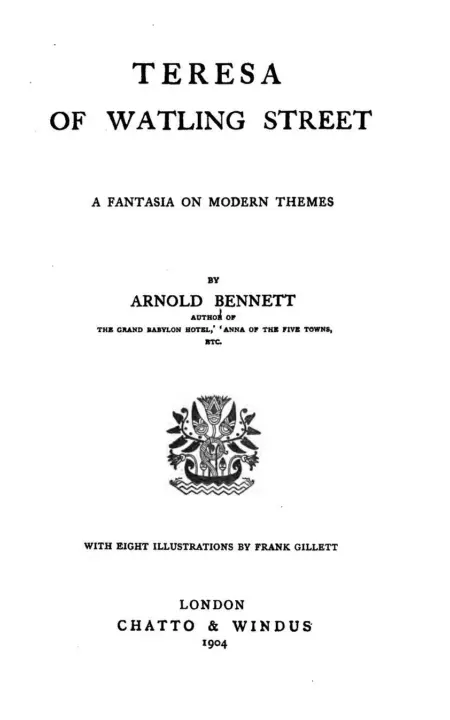
THE CLASSIC COLLECTION · 1904
"Teresa of Watling Street: A Fantasia on Modern Themes" by Arnold Bennett is a novel written in the early 20th century. The story revolves around Richard Redgrave, a young man who has transitioned from a clerk to a specialist in private inquiries. Set against the backdrop of early 1900s London, the narrative explores themes of wealth, mystery, and the subtleties of human behavior, particularly as Richard gets embroiled in the curious case surrounding a bank manager named Raphael Craig. The opening of the novel introduces Richard as he navigates a bustling area of the City of London, stepping into a world of banking that is as romantic as it is complex. With a blend of imagination and ambition, Richard attends a meeting with the directors of the British and Scottish Bank, where he is tasked with investigating Craig, who recently inherited a large fortune yet remains dedicated to his banking career. As the story unfolds, Richard’s inquiry leads him to Dunstable and a circus, where he encounters Teresa Craig, Raphael's daughter, and uncovers layers of mystery and danger intertwined with her family's secrets. The narrative sets the stage for a thrilling adventure filled with intrigue and the exploration of modern life’s eccentricities.
Introduction adapted from the source catalogue; source summaries may be automatically generated.
Free to read · English · 54,548 words · No account needed
MAKE TIME FOR A GOOD BOOK
On by default. Untick to stop anonymous reading totals. Each page counts after 10 seconds in view. How this works.
Anonymous counting is on unless you have switched it off.
Perhaps it was fate that induced Mr. Puddephatt, when they had discussed the weather, horses, motor-cars, steam-ploughs, wine, parish councils, London, and daily papers, to turn the conversation on to the subject of the Craigs. Mr. Puddephatt had had many and various dealings with the Craigs, and he recounted to Richard the whole of them, one after another, in detail. It seemed, from his narrative, that he had again and again, from sheer good-nature, saved the Craigs from the rapacity and unscrupulousness of the village community.
‘Nice young lady, that Miss Teresa,’ observed Mr. Puddephatt.
‘Yes,’ said Richard.
By this time they had passed through St. Albans and were well on the way
to Edgware.
‘They do say,’ said Mr. Puddephatt, leaning back luxuriously against the cushions--‘they do say as she isn’t his daughter--not rightly.’
‘They say what?’ asked Richard quietly, all alert, but not choosing to
seem so.
Mr. Puddephatt reaffirmed his statement.
‘Who says that?’ asked Richard.
‘Oh!’ said Mr. Puddephatt, ‘I dare say it isn’t true. But it’s gotten about the village. Ye never know how them tales begin. I dare say it isn’t true. Bless ye, there’s lots o’ tales.’
‘Oh, indeed!’ Richard remarked sagaciously.
‘Ay!’ said Mr. Puddephatt, filling his pipe, ‘lots o’ tales. That night as she ran away from the farm, and Mrs. Bridget had to fetch her back from the White Horse---- Everybody said as how the old man ill-treated her, daughter or no daughter.’
‘When was that?
‘A few weeks back,’ said Mr. Puddephatt laconically.
This was all he would say.
‘It’s a queer world, Mr. Puddephatt,’ said Richard aloud. To himself he said: ‘Then perhaps she isn’t involved with her father--if he is her father.’
At length they reached the suburbs of London and had to moderate their speed. As they wound in and out through the traffic of Kilburn, Richard’s eye chanced to catch the sign of the British and Scottish Bank. He drew up opposite the mahogany doors of the bank and, leaving Mr. Puddephatt in charge of the car, entered. It was turned ten o’clock. He felt fairly certain that Raphael Craig had not left Queen’s Farm, but he wanted to convince himself that the bank manager was not always so impeccably prompt at business as some people said.
‘I wish to see Mr. Craig,’ he said, just as he had said two hours before
to Mrs. Bridget.
‘Mr. Craig,’ said the clerk, ‘is at present taking his annual holiday. He will return to business in a fortnight’s time.’
Your reading position is saved on this browser. Take it to another device with a library code. Reading pages adapt to text, rather than matching a printed edition.
Arnold Bennett

Arnold Bennett
Arnold Bennett
Arnold Bennett
BEHIND THE BOOK
This eBook is for the use of anyone anywhere in the United States and most other parts of the world at no cost and with almost no restrictions whatsoever. You may copy it, give it away or re-use it under the terms of the Project Gutenberg License included with this eBook or online at www.gutenberg.org. If you are not located in the United States, you will have to check the laws of the country where you are located before using this eBook. Read the source licence.
The original source file, including credits and licence, is retained by this library. Request an original-format copy at no charge. Please include the book title and Project Gutenberg identifier #55114.
KEEP YOUR CURIOSITY GOING
Coulson Kernahan

Maurice Baring
Frances Wright
Cécile Tormay

Frederic Jesup Stimson

W. H. P. (William Henry Pope) Jarvis