
The Truth About an Author
Arnold Bennett
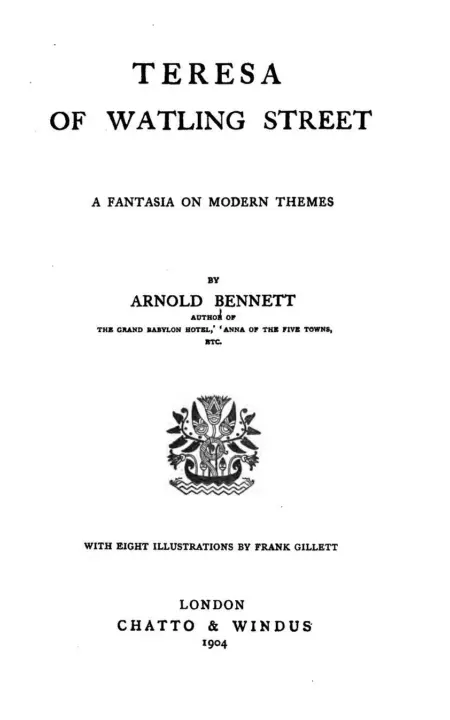
THE CLASSIC COLLECTION · 1904
"Teresa of Watling Street: A Fantasia on Modern Themes" by Arnold Bennett is a novel written in the early 20th century. The story revolves around Richard Redgrave, a young man who has transitioned from a clerk to a specialist in private inquiries. Set against the backdrop of early 1900s London, the narrative explores themes of wealth, mystery, and the subtleties of human behavior, particularly as Richard gets embroiled in the curious case surrounding a bank manager named Raphael Craig. The opening of the novel introduces Richard as he navigates a bustling area of the City of London, stepping into a world of banking that is as romantic as it is complex. With a blend of imagination and ambition, Richard attends a meeting with the directors of the British and Scottish Bank, where he is tasked with investigating Craig, who recently inherited a large fortune yet remains dedicated to his banking career. As the story unfolds, Richard’s inquiry leads him to Dunstable and a circus, where he encounters Teresa Craig, Raphael's daughter, and uncovers layers of mystery and danger intertwined with her family's secrets. The narrative sets the stage for a thrilling adventure filled with intrigue and the exploration of modern life’s eccentricities.
Introduction adapted from the source catalogue; source summaries may be automatically generated.
Free to read · English · 54,548 words · No account needed
MAKE TIME FOR A GOOD BOOK
On by default. Untick to stop anonymous reading totals. Each page counts after 10 seconds in view. How this works.
Anonymous counting is on unless you have switched it off.
‘Arrangement!’ exclaimed Raphael. ‘A good joke! Certainly we will come to some arrangement. But first I must tell Redgrave, who has the right to know, the history of the girl he is about to marry. I will tell him in your presence, and when I make any error of fact you can correct me. Many years ago, Richard, I was engaged to a beautiful girl, a native of Limerick. She was an orphan, and had lived with friends until she became a school-teacher, when she lived by herself. She had some aristocratic Spanish blood in her veins through her mother’s father, who had married her grand-mother in Buenos Ayres. I met her in Limerick when I was a clerk in the bank there. I fell in love with her. I asked her to be my wife, and she consented. We were to be married as soon as my salary had sufficiently increased. I then had an offer of a situation in the British and Scottish, just starting on its successful career, and I removed to London. We arranged that I should save every possible penny, and that we should get married in about two years’ time. It was from motives of economy that I allowed a whole year to pass without revisiting Limerick. I continually received letters from my fiancee, and though their tone was never excessively warm, it was always tender, and it satisfied me. As for me, I was passionately in love. I had never seen such an adorable creature as my betrothed--her name was Juana--and I have never since seen her equal. For me she was, and always will be, the world’s jewel.... Well, a change came over the scene. I noticed something in her letters--something which I could not define. Then, after an interval of silence, came a letter saying she could not marry me. I got leave of absence--not without a great deal of difficulty--and hastened over to Limerick. Juana had left Limerick. I found her at length in a remote mountain village, and I drew from her her story. It was a shocking one. A man--a stranger from London--who must have been a highly plausible person in those days, whatever he is now--had dazzled her by his professions of admiration and love. He was a rich man even then, and he made her a brilliant offer of marriage. The poor girl was carried off her feet. Unduly urged, and her mind poisoned by his lies concerning myself, her faith in me shaken by the stoppage for some weeks of my letters, she consented to marry this man. She married him. They lived together for a brief period. And all this time she had not courage to write and confess to me the truth. Then the man left her, and coolly informed her that the marriage was a bogus marriage from beginning to end--that he was, in fact, already married. He said he wished to have nothing more to do with her, and gave her a bank-note for a thousand pounds to solace her wounded feelings, which bank-note she flung into the fire. You may ask why this man was not prosecuted for bigamy. I will tell you. The matter was kept quiet in order to spare the feelings of my poor deluded Juana. Think what the trial would have meant to her. I myself arranged with the priest and one or two other officials that the whole thing should be buried in oblivion. I had reserved my own punishment for the villain who thus escaped the law. To proceed, Juana had two children--twins. They were named Juana and Teresa. Shortly after their birth their mother died. But before she died--on her death-bed--I married her. I had begged to do so before, but she had declined. I swore to her that I would regard Juana and Teresa as my own children, but of my intended vengeance against her murderer I said nothing. Hers was a gentle heart, and she might have put me on my oath to abandon that vengeance. From the day of her death I lived for nothing save the punishment of a villain. It was my one thought. I subordinated everything to it. It made my temper uncertain; it involved me in endless difficulties; it estranged me from my dear one’s elder daughter, and often I felt that I was harsh to Teresa, my favourite and the last-born. But I could not do otherwise. I was a monomaniac. I dreamt only of the moment when I should see my enemy at my feet, begging for mercy. That moment has come. He is here. Watch him. He could only be wounded in one place--his pocket. His pocket is the heel of this noble Achilles, and it is his pocket that my sword has pierced.’
Your reading position is saved on this browser. Take it to another device with a library code. Reading pages adapt to text, rather than matching a printed edition.
Arnold Bennett

Arnold Bennett
Arnold Bennett
Arnold Bennett
BEHIND THE BOOK
This eBook is for the use of anyone anywhere in the United States and most other parts of the world at no cost and with almost no restrictions whatsoever. You may copy it, give it away or re-use it under the terms of the Project Gutenberg License included with this eBook or online at www.gutenberg.org. If you are not located in the United States, you will have to check the laws of the country where you are located before using this eBook. Read the source licence.
The original source file, including credits and licence, is retained by this library. Request an original-format copy at no charge. Please include the book title and Project Gutenberg identifier #55114.
KEEP YOUR CURIOSITY GOING
Coulson Kernahan

Maurice Baring
Frances Wright
Cécile Tormay

Frederic Jesup Stimson

W. H. P. (William Henry Pope) Jarvis