THE CLASSIC COLLECTION✦HumbugCLASSIC FREE BOOKS
Humbug
E. M. Delafield
THE CLASSIC COLLECTION · 1920
"Tension" by E. M. Delafield is a novel written in the early 20th century." The story introduces a variety of characters, including Aunt Iris, who has written a provocative book titled "Why, Ben! A Story of the Sexes," and her unwitting young niece, Ruthie, who announces this news to Lady Rossiter and Sir Julian Rossiter during breakfast. The narrative alludes to family dynamics, societal expectations, and the way personal interests clash within a seemingly genteel community. "The opening of "Tension" sets a lively and chaotic scene at the Rossiter household, as young Ruthie eagerly shares the news of her aunt's book, bringing about varying reactions of shock and disbelief from the adults." As the children, Ruthie and her brother Ambrose, display their excitement about Aunt Iris's literary endeavor, their behaviors invite both humor and exasperation from Sir Julian and Lady Rossiter. The mention of Aunt Iris's book not only serves as a catalyst for the conversation but also hints at underlying themes of gender dynamics and the expectations placed upon women of the era, particularly through the scandalous title and subject matter of the book itself. This lively introduction promises a narrative that will explore tension—not just in relationships but in societal norms and personal aspirations as well.
Introduction adapted from the source catalogue; source summaries may be automatically generated.
Free to read · English · 66,481 words · No account needed
MAKE TIME FOR A GOOD BOOK
On by default. Untick to stop anonymous reading totals. Each page counts after 10 seconds in view. How this works.
Anonymous counting is on unless you have switched it off.
"Well, Sir Julian," said Mark Easter, turning to him, "shall we put it
to the directors?"
Sir Julian made no immediate reply, and Fuller, nothing if not intent upon his business, laid both arms upon the paper-bestrewn table, leant well forward, and began in an earnest and expostulating tone:
"I see you're hesitating, sir. I wish you could have had a personal interview with the young lady, for I really was most favourably impressed--most favourably. As I say, a superior young woman is always an influence, if there's no nonsense about her, and Miss Marchrose certainly has none, so far as I could judge. Of course, sir, the decision rests with you, but I must say I should like to give her a trial. I believe we might do worse."
"What sort of age is she?"
"She told me she was twenty-eight," said Fuller, with a grin that revealed dazzling teeth in his swarthy face, and thereby considerably increased his already marked resemblance to a Southern State negro.
"I should have preferred an older woman."
"I doubt if she'll ever see thirty again, sir," said Fuller simply.
"Well, Fuller, I know you've the interests of the College very much at heart, and I'm quite willing to give her a trial on your recommendation," said Julian. "We'll put it before the directors at the meeting."
"Thank you, Sir Julian. I thought you'd probably trust my judgment," Fuller remarked, with satisfaction. "And I don't think you will regret it. She struck me as being a thorough woman of business, most capable, and as hard as nails."
At this final qualification Sir Julian looked rather glum, irresistibly reminded of the heroine of that episode which had wrought so much havoc in the household of his wife's relatives.
"However," he remarked to Mark Easter, as they went towards the committee-room at the appointed hour, "I really do trust Fuller's judgment, so far as the good of the College goes, though I haven't his own implicit belief in his absolute infallibility."
"He thinks the whole show rests on him," said Mark Easter, and added with belated justice, "And for the matter of that, I really don't know where we should get another man like him. He's a nailer for work."
"I hope his protégée will be a success. If he talks to the directors about her being practically a lady, as distinguished, I suppose, from a 'young lady in business,' he'll fetch that old snob Bellew."
"He probably won't mention it," said Mark Easter shrewdly. "He looks upon it as a disadvantage in the abstract, but he told me yesterday that he thought he could explain it if any objection were raised."
Your reading position is saved on this browser. Take it to another device with a library code. Reading pages adapt to text, rather than matching a printed edition.
E. M. Delafield
E. M. Delafield
E. M. Delafield
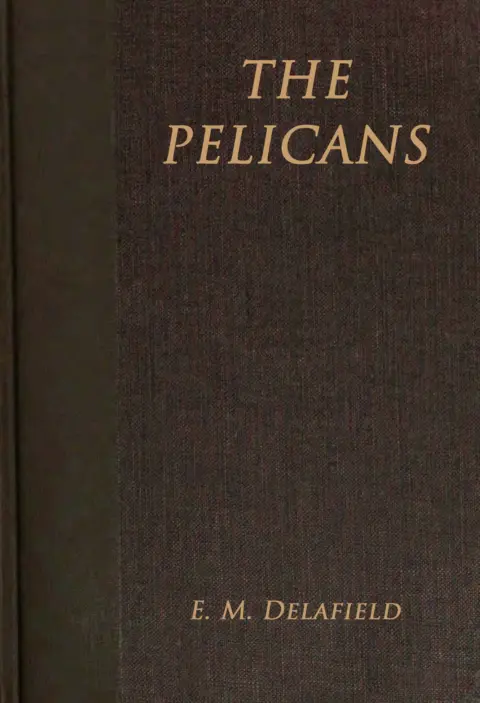
E. M. Delafield
BEHIND THE BOOK
This eBook is for the use of anyone anywhere in the United States and most other parts of the world at no cost and with almost no restrictions whatsoever. You may copy it, give it away or re-use it under the terms of the Project Gutenberg License included with this eBook or online at www.gutenberg.org. If you are not located in the United States, you will have to check the laws of the country where you are located before using this eBook. Read the source licence.
The original source file, including credits and licence, is retained by this library. Request an original-format copy at no charge. Please include the book title and Project Gutenberg identifier #74638.
KEEP YOUR CURIOSITY GOING
Coulson Kernahan

Maurice Baring
Frances Wright
Cécile Tormay

Frederic Jesup Stimson

W. H. P. (William Henry Pope) Jarvis