
Last letters from the living dead man
David Patterson (Spirit) Hatch
THE CLASSIC COLLECTION · 1897
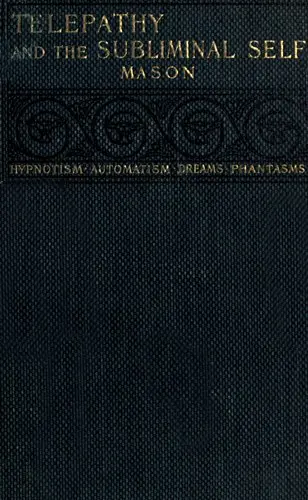
"Telepathy and the Subliminal Self" by R. Osgood Mason is a scientific publication written in the late 19th century. The book delves into recent investigations related to hypnotism, telepathy, automatism, dreams, phantasms, and other psychical phenomena. It aims to explore and clarify the burgeoning field of psychical research amidst rising public interest and skepticism surrounding these subjects. The opening of the book presents a preface that sets the stage for the exploration of psychical research, highlighting the contrasting views between skeptical scientific circles and the curious public eager to understand phenomena like telepathy and hypnotism. Mason emphasizes the importance of approaching these subjects with an open mind, advocating for systematic inquiry into the human psyche and its unexplained powers. He introduces the reader to key concepts such as thought-transference and the history of psychical research while preparing them for in-depth discussions on various psychical experiences that challenge conventional scientific understanding.
Introduction adapted from the source catalogue; source summaries may be automatically generated.
Free to read · English · 70,791 words · No account needed
MAKE TIME FOR A GOOD BOOK
On by default. Untick to stop anonymous reading totals. Each page counts after 10 seconds in view. How this works.
Anonymous counting is on unless you have switched it off.
Jan. 17th, 1887, Ansel Bourne, an evangelist, left his home in Rhode Island, and, after transacting some business in Providence, one item of which was to draw some money to pay for a farm for which he had bargained, he went to Boston, then to New York, then to Philadelphia, and, finally, to Norristown, Penn., fifteen or twenty miles from Philadelphia, where he opened a small store for the sale of stationery, confectionery, and five-cent articles. In this business he was known as A. J. Brown. He lived in a room partitioned off from the back of the store, eating, sleeping, and doing his own cooking there. He rented the store from a Mr. Earl, who also, with his family, lived in the building. Mr. Brown went back and forth to Philadelphia for goods to keep up his stock, and seems to have conducted his business as if accustomed to it.
Sunday, March 13th, he went to church, and at night went to bed as usual. On Monday, March 14th, about 5 o'clock in the morning, he awoke and found himself in what appeared to him an altogether new and strange place; he thought he must have broken into the place, and was much troubled, fearing arrest. Finally, after waiting two hours in great uneasiness of mind, he got up and found the door locked on the inside. He went out into the hall, and, hearing some one moving about, he rapped at the door. Mr. Earl, his landlord, opened it, and said: "Good-morning, Mr. Brown."
"Where am I?" said Mr. Brown.
"You are all right," replied Mr. Earl.
"I'm all wrong, and my name is not Brown. Where am I?"
"You are in Norristown."
"Where is Norristown?"
"In Pennsylvania, about seventeen miles west of Philadelphia."
"What day of the month is it?" inquired Mr. Brown.
"The 14th," replied Mr. Earl.
"Does time run backward here? When I left home it was the 17th."
"Seventeenth of what?" said Mr. Earl.
"Seventeenth of January."
"Now it is the 14th of March," said Mr. Earl.
Mr. Earl thought Mr. Brown was out of his mind, and sent for a physician. To the doctor he said his name was Ansel Bourne; that he remembered seeing the Adams Express wagons on Dorrance Street in Providence on Jan. 17th, and remembered nothing since, until he awoke here this morning, March 14th.
"These people," said he, "tell me that I have been here six weeks, and have been living with them all this time; I have no recollection of ever having seen one of them, until this morning."
His nephew, Mr. H., was telegraphed to in Providence.
"Do you know Ansel Bourne?"
Your reading position is saved on this browser. Take it to another device with a library code. Reading pages adapt to text, rather than matching a printed edition.
BEHIND THE BOOK
This eBook is for the use of anyone anywhere in the United States and most other parts of the world at no cost and with almost no restrictions whatsoever. You may copy it, give it away or re-use it under the terms of the Project Gutenberg License included with this eBook or online at www.gutenberg.org. If you are not located in the United States, you will have to check the laws of the country where you are located before using this eBook. Read the source licence.
The original source file, including credits and licence, is retained by this library. Request an original-format copy at no charge. Please include the book title and Project Gutenberg identifier #37203.
KEEP YOUR CURIOSITY GOING
David Patterson (Spirit) Hatch
Coulson Kernahan

Ralph Waldo Emerson
Frances Wright

Edwin Abbott Abbott

Joseph Droz