Facts you should know about the classics
Joseph McCabe
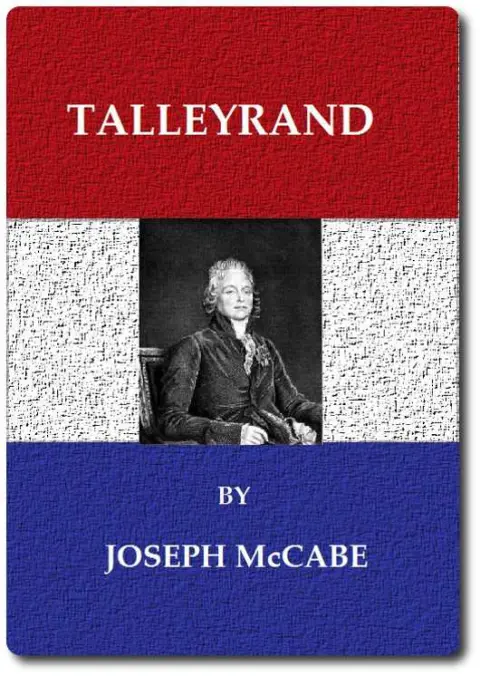
THE CLASSIC COLLECTION · 1906
"Talleyrand: A Biographical Study" by Joseph McCabe is a historical account written in the early 20th century. The book delves into the intriguing life of Charles Maurice de Talleyrand-Périgord, the enigmatic French diplomat who navigated the tumultuous political landscape of late 18th and early 19th century France. McCabe aims to unravel the complexity of Talleyrand's character and career, which spanned significant events such as the French Revolution and the rise of Napoleon, while revealing the personal and political nuances that defined his legacy. The opening of the study introduces Talleyrand's formative years, revealing how a childhood accident led to his eventual role in the Church instead of a military career. The narrative explores Talleyrand's elite upbringing in an aristocratic family, his struggles with family separation, and the indifferent educational system of the time. As he grows into his teenage years, we see the early development of his character, defined by a sharp intellect and a natural inclination towards diplomacy, as he became increasingly disenchanted with the Church and his predetermined ecclesiastical career. This sets the stage for an examination of how these childhood experiences and observations shaped Talleyrand into one of the most fascinating political figures of his time.
Introduction adapted from the source catalogue; source summaries may be automatically generated.
Free to read · English · 97,603 words · No account needed
MAKE TIME FOR A GOOD BOOK
On by default. Untick to stop anonymous reading totals. Each page counts after 10 seconds in view. How this works.
Anonymous counting is on unless you have switched it off.
Moreover, the Directors left their Ministers no initiative. Talleyrand says he had little to do except sign documents drawn up by them and give passports. On one occasion Rewbell compelled him to re-write the instructions he was sending to envoys. The romantic biographers describe another occasion when, they say, Barras threw an ink-pot at him. Representatives abroad complained that France had no policy. The Directors were too slavishly influenced by their emissaries, and each of them had his own plan. There was, too, the eternal scarcity of money. At the Department the salaries of most of the officials were in arrears. At his official residence he would have us believe that the servants were dining off Sèvres dishes because they could not afford to buy earthenware.
The difficulty increased rapidly. There was still great distress in the country, and plots against the Directory were continual; one writer says there was an average of one per day. Six weeks after Talleyrand’s nomination a crisis occurred, and his conduct during it has been severely censured. The relaxation of the more violent measures had encouraged the royalists and other malcontents to act more vigorously. Evidence reached the Directors (partly from Napoleon) of a powerful and far-reaching conspiracy against them. At the head of it was the royalist General Pichegru, who was believed to have a following of 180 deputies. The Clichy Club at Paris had become a notorious rallying-place for malcontents, and Director Carnot was patronising it in a very compromising way. On the other hand, the Constitutional Club—with Talleyrand and Constant and Mme. de Staël—could naturally be relied on to oppose a counter-revolution, little as it respected the Directorate. Napoleon, too, made it clear that his assistance could be had.
It is, however, in complete opposition to the evidence, that Lytton accuses Talleyrand of taking the initiative; and still worse is Michaud’s reckless statement that Talleyrand “arranged everything.” A sober inquiry into the coup d’état of Fructidor only discovers that Talleyrand supported it in advance, but was not implicated in the violent manner of its execution, which, indeed, he used his influence to moderate. On the information supplied to the Directors no legal action could be taken. Reveillère, whose life was threatened, then conceived the idea of acting by force, though without unnecessary severity. He approached Rewbell, who consented, and the two easily induced Barras to join. It is absurd to suppose that these officials, who hampered Talleyrand in his own department and kept him in habitual ignorance of other affairs, should do more than secure his support as a Constitutionalist. Napoleon was requested to send troops, and to these he added as general the excitable and meddlesome Augereau, who soon had his men quartered within striking distance. The Clichy Clubbites meantime grew more audacious, and on September 3rd they warmly cheered a proposal in the Chamber to destroy the executive. That night the streets of Paris rang with the unfamiliar tread of an army, a token to all that an unconstitutional act was afoot. The next morning the two Councils found themselves surrounded by 10,000 troops. Pichegru and 42 of his followers in the Five Hundred, Barbé-Mabois and eleven of the Ancients, and 148 other alleged conspirators, especially journalists, were arrested. The Directors had warned Carnot and Barthélemy, whom they had no wish to injure personally. Carnot, who had long toyed with the Opposition, and had resisted every friendly overture, now fled. Barthélemy was arrested. Merlin de Douai, a lawyer, and Francois de Neufchateau, a literary man, took the places of Carnot and Barthélemy. The new Directorate obtained extensive powers from the newly-constituted Councils, revived the old stringent decrees against emigrants and priests, and initiated a long series of deportations. They sent 65 of the worst conspirators to Guiana—the guillotine would have been more merciful—and the rest to the Isle of Oléron. In all some 10,000 Nonconformist priests and returned royalists were prescribed, but only a proportion of these were actually banished. There was another general flight to the frontier.
Your reading position is saved on this browser. Take it to another device with a library code. Reading pages adapt to text, rather than matching a printed edition.
Joseph McCabe
Joseph McCabe
Joseph McCabe
Joseph McCabe
BEHIND THE BOOK
This eBook is for the use of anyone anywhere in the United States and most other parts of the world at no cost and with almost no restrictions whatsoever. You may copy it, give it away or re-use it under the terms of the Project Gutenberg License included with this eBook or online at www.gutenberg.org. If you are not located in the United States, you will have to check the laws of the country where you are located before using this eBook. Read the source licence.
The original source file, including credits and licence, is retained by this library. Request an original-format copy at no charge. Please include the book title and Project Gutenberg identifier #46660.
KEEP YOUR CURIOSITY GOING
Cécile Tormay

Moritz Busch
John L. Ransom
Frances Wright
Cécile Tormay

Mabel Potter Daggett