Facts you should know about the classics
Joseph McCabe
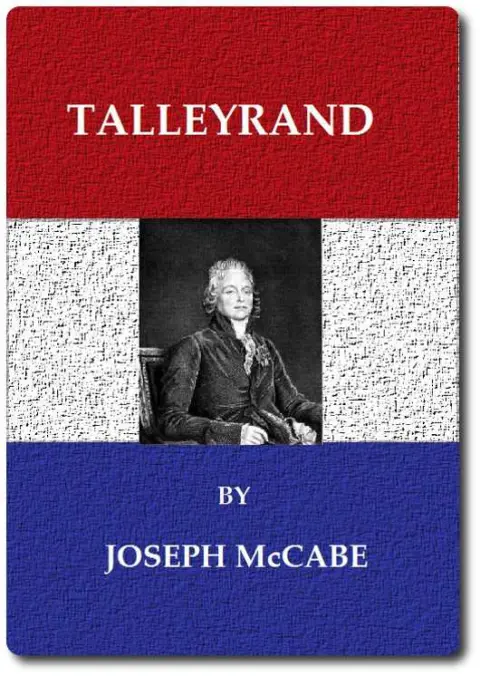
THE CLASSIC COLLECTION · 1906
"Talleyrand: A Biographical Study" by Joseph McCabe is a historical account written in the early 20th century. The book delves into the intriguing life of Charles Maurice de Talleyrand-Périgord, the enigmatic French diplomat who navigated the tumultuous political landscape of late 18th and early 19th century France. McCabe aims to unravel the complexity of Talleyrand's character and career, which spanned significant events such as the French Revolution and the rise of Napoleon, while revealing the personal and political nuances that defined his legacy. The opening of the study introduces Talleyrand's formative years, revealing how a childhood accident led to his eventual role in the Church instead of a military career. The narrative explores Talleyrand's elite upbringing in an aristocratic family, his struggles with family separation, and the indifferent educational system of the time. As he grows into his teenage years, we see the early development of his character, defined by a sharp intellect and a natural inclination towards diplomacy, as he became increasingly disenchanted with the Church and his predetermined ecclesiastical career. This sets the stage for an examination of how these childhood experiences and observations shaped Talleyrand into one of the most fascinating political figures of his time.
Introduction adapted from the source catalogue; source summaries may be automatically generated.
Free to read · English · 97,603 words · No account needed
MAKE TIME FOR A GOOD BOOK
On by default. Untick to stop anonymous reading totals. Each page counts after 10 seconds in view. How this works.
Anonymous counting is on unless you have switched it off.
Two years later he had to summon the clergy to an Extraordinary Assembly at the Grands-Augustins. The King’s letter which he had to submit to his colleagues must have appealed to his diplomatic sense. Louis XVI declared that, though there had been unforeseen losses in connection with the help given to America, he had no actual need to appeal to the country. But the fact was that every class seemed so eager to contribute towards covering these losses, and he could not think of excluding his devoted clergy from a share. He therefore graciously permitted them to assemble in extraordinary session in 1782. Talleyrand was charged to explain to the Assembly why the King had altered his mind, and not kept the solemn promise that he would ask no more money until 1785. The fifteen millions were granted as usual, and the clergy added a million to be applied to the relief of the poor families who had suffered by the war. Talleyrand went further, and pressed one of the prelates to urge the granting permission to re-marry to the Breton women whose husbands had disappeared without any definite proof of death. He says that the prelate saw no advantage to himself in making a motion, and so the matter was not brought before the Assembly. Bad books occupied more attention than ever. A complete edition of Voltaire was being printed at Kehl, and was expected at Paris with the most open rejoicing. The deputies drew the King’s attention to its “monstrous obscenities,” and petitioned him to prevent its circulation. Talleyrand had not to sign this petition, but he saw Loménie de Brienne and many another Voltairean pastor do so.
In this Assembly Talleyrand himself made two proposals of an interesting character. The first was that the clergy should buy up the royal lottery, by making the King a “gratuitous gift” every year to cover the profits missed. His colleagues were not sufficiently moved by his eloquent denunciation of public gambling to make the sacrifice. Some of them, who knew the Abbé de Périgord’s own habits, may have even smiled. But Talleyrand’s aim was good, if not virtuous. He saw that the clergy were rapidly losing ground, and he felt that a sacrifice like this, in such a cause, would do much to redeem their degradation. The memoir to present to the King (and, of course, publish afterwards) “might have been superb,” he observes with a chuckle; he would have been very glad to write it. The other proposal he made was to raise the salaries of the lower clergy. On these fell the real work of maintaining religion in the country, yet the curé had only 700 livres (less than thirty pounds) a year and his vicaire the miserable sum of 350 livres. The episcopate was, like the army commissions, a preserve of the nobles, and a great gulf yawned between the two Orders. I calculate that the 140 bishops of France then drew about 8,000,000 francs a year from ecclesiastical sources alone; and as all were nobles, many of them had in addition huge private incomes and some State emoluments. Dillon had 160,000 a year from the Queen’s private purse for his amiability. They drove about Paris in gilded coaches, contributed to the opera, had opulent hotels and country palaces and hunting seats, and so on. The starving peasantry were beginning to rebel. At the Assembly of Notables the Archbishop of Aix spoke of tithe as “that voluntary offering from the piety of the faithful”; “as to which,” broke in the Duke de la Rochefoucauld, “there are now 40,000 cases on in the Courts.” The lower clergy, too, were forming associations for the betterment of their condition. The prelates heard this with pained surprise, but resisted Talleyrand’s motion. His earliest political efforts, as he said afterwards, failed because his proposals were too bold for his colleagues. But there can be no question as to the wisdom of his counsels. No one could at that time have had even the dimmest prevision of the events of 1789-1790—and so we may at once reject Pozzo di Borgo’s suggestion (afterwards) that Talleyrand from the first took the side of the weak and poor on subtle calculation—but Talleyrand’s view of the situation of the Church was singularly wise and shrewd, and his suggestions were, as we now very clearly see, wholly to its advantage. Nor can we with justice ignore the clear strain of humanity that is seen in the young abbé’s proposals in favour of the Breton widows (whom he had seen in their native home) and the lower clergy. In the latter instance he was even endangering his interest with the prelates.
Your reading position is saved on this browser. Take it to another device with a library code. Reading pages adapt to text, rather than matching a printed edition.
Joseph McCabe
Joseph McCabe
Joseph McCabe
Joseph McCabe
BEHIND THE BOOK
This eBook is for the use of anyone anywhere in the United States and most other parts of the world at no cost and with almost no restrictions whatsoever. You may copy it, give it away or re-use it under the terms of the Project Gutenberg License included with this eBook or online at www.gutenberg.org. If you are not located in the United States, you will have to check the laws of the country where you are located before using this eBook. Read the source licence.
The original source file, including credits and licence, is retained by this library. Request an original-format copy at no charge. Please include the book title and Project Gutenberg identifier #46660.
KEEP YOUR CURIOSITY GOING
Cécile Tormay

Moritz Busch
John L. Ransom
Frances Wright
Cécile Tormay

Mabel Potter Daggett