
Facts you should know about the classics
Joseph McCabe
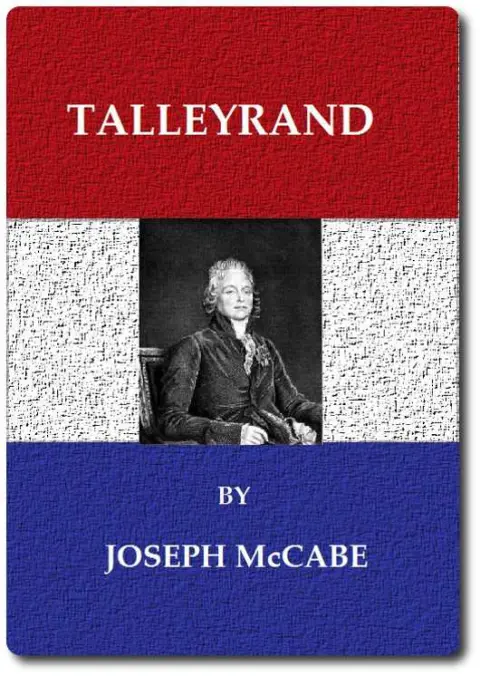
THE CLASSIC COLLECTION · 1906
"Talleyrand: A Biographical Study" by Joseph McCabe is a historical account written in the early 20th century. The book delves into the intriguing life of Charles Maurice de Talleyrand-Périgord, the enigmatic French diplomat who navigated the tumultuous political landscape of late 18th and early 19th century France. McCabe aims to unravel the complexity of Talleyrand's character and career, which spanned significant events such as the French Revolution and the rise of Napoleon, while revealing the personal and political nuances that defined his legacy. The opening of the study introduces Talleyrand's formative years, revealing how a childhood accident led to his eventual role in the Church instead of a military career. The narrative explores Talleyrand's elite upbringing in an aristocratic family, his struggles with family separation, and the indifferent educational system of the time. As he grows into his teenage years, we see the early development of his character, defined by a sharp intellect and a natural inclination towards diplomacy, as he became increasingly disenchanted with the Church and his predetermined ecclesiastical career. This sets the stage for an examination of how these childhood experiences and observations shaped Talleyrand into one of the most fascinating political figures of his time.
Introduction adapted from the source catalogue; source summaries may be automatically generated.
Free to read · English · 97,603 words · No account needed
MAKE TIME FOR A GOOD BOOK
On by default. Untick to stop anonymous reading totals. Each page counts after 10 seconds in view. How this works.
Anonymous counting is on unless you have switched it off.
” Napoleon at the, 180.
Turgot, 48, 50.
Tuscany, Talleyrand seeks to go to, 130.
Tysykiewitz, Countess, 247, 266, 363.
Ulm, Battle of, 232.
Universal Suffrage under Napoleon, 178.
Valençay, 256, 278, 342, 364.
” The Spanish Princes at, 256, 278.
Varennes, Flight to, 104.
Vars, The Baron de, 36.
Venality of Talleyrand, 157-63.
Vercelli, The Bishop of, 201.
Versailles, Court life at, 226.
Veto, The right of, 79.
Vice-grand Electorship, The, 250.
Vienna, Congress of, 303.
Vienne, The Archbishop of, 67, 69.
Vitrolles, Baron, 283.
Voltaire’s last visit to Paris, 35.
Walewski, The Countess, 245.
Warsaw, Talleyrand at, 245.
Waterloo, 322.
Wealth of the French Clergy, 21, 42, 83.
Weimar, Napoleon at, 264.
Wellington, 297, 314, 324, 327, 331, 360.
Whitworth, Lord, 225.
Wieland, 264.
Yarmouth, Lord, 237, 239.
[1] The date is variously given as February 2nd or 13th, and even March. The first seems to be correct. Dupanloup speaks of the Prince celebrating his eighty-fourth birthday on that date. But the myth-making faculty has been so busy with the life of Talleyrand that his very birthplace and parentage have been disputed. It will prepare the reader for the wild legends we shall encounter to learn at once that serious French writers have attributed Talleyrand’s lameness to a congenital defect or to an encounter with a savage sow, and that serious American writers (Bookman, September 26, 1901) have asked us to consider gravely a story of his having been born at Mount Desert, Maine, the illegitimate son of an American fisher-girl and a French naval officer.
[2] Mr. Holland Rose (Life of Napoleon) is entirely wrong in speaking of his “resentment against his parents.”
[3] I have already ignored scores of stories about Talleyrand’s youth. The biographer has to plunge beneath a mass of them to reach his true subject. A discharged secretary of his, who could imitate his signature, flooded Paris and London with fabricated letters and anecdotes, and he had many rivals in the business. Writers like Bastide, Pichot, Villemarest, Michaud, Stewartson, Touchard-Lafosse, and even Sainte-Beuve, readily admit these, and some of the best biographies contain a few that are inconsistent with known facts. Such are the stories of his chalking Voltairean verses on his uncle’s garden wall, and of (in the following year) scaling the walls of Saint Sulpice by night, seducing a whole family, and being imprisoned in the Bastille. The dates or other features betray these apocryphal legends.
[4] Lady Blennerhassett and most biographers wrongly describe him as a priest. He was not ordained until four years later. The archives of the Sorbonne, in registering his application in April and June, 1775, speak of him as a sub-deacon.
Your reading position is saved on this browser. Take it to another device with a library code. Reading pages adapt to text, rather than matching a printed edition.
Joseph McCabe
Joseph McCabe
Joseph McCabe
Joseph McCabe
BEHIND THE BOOK
This eBook is for the use of anyone anywhere in the United States and most other parts of the world at no cost and with almost no restrictions whatsoever. You may copy it, give it away or re-use it under the terms of the Project Gutenberg License included with this eBook or online at www.gutenberg.org. If you are not located in the United States, you will have to check the laws of the country where you are located before using this eBook. Read the source licence.
The original source file, including credits and licence, is retained by this library. Request an original-format copy at no charge. Please include the book title and Project Gutenberg identifier #46660.
KEEP YOUR CURIOSITY GOING
Cécile Tormay

Moritz Busch
John L. Ransom
Frances Wright
Cécile Tormay

Mabel Potter Daggett