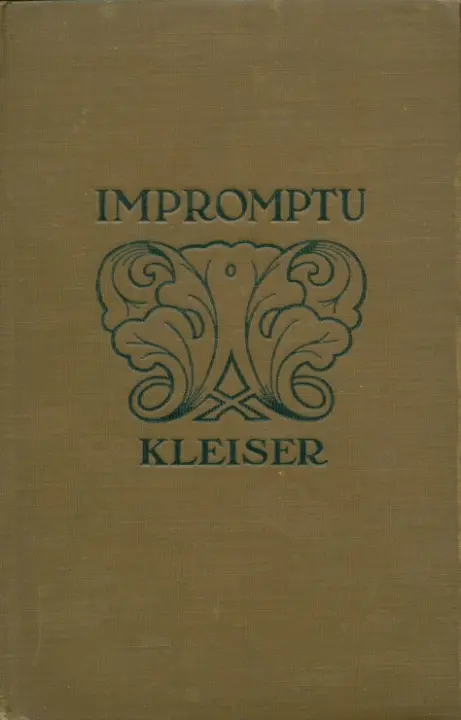
“Impromptu”; or, How to Think on Your Feet
Grenville Kleiser
THE CLASSIC COLLECTION · 1916
"Talks on Talking" by Grenville Kleiser is a guide on effective communication, written in the early 20th century. The book provides practical advice for improving conversational skills and public speaking techniques, drawing from the author’s experience as an instructor in public speaking. The central theme revolves around the art of conversation, exploring the dynamics of communication and offering insights into how to engage with others meaningfully and persuasively. At the start of the text, Kleiser emphasizes the importance of naturalness and sincerity in conversation, cautioning against rigid rules of speech that can stifle genuine expression. He discusses the significance of adaptability in conversation, suggesting that personality and the manner of delivery are as crucial as the content of what is being said. Kleiser identifies various types of talkers, illustrating common conversational pitfalls and encouraging readers to develop qualities that enhance their speaking abilities and foster engaging, effective communication.
Introduction adapted from the source catalogue; source summaries may be automatically generated.
Free to read · English · 26,745 words · No account needed
MAKE TIME FOR A GOOD BOOK
On by default. Untick to stop anonymous reading totals. Each page counts after 10 seconds in view. How this works.
Anonymous counting is on unless you have switched it off.
How forcible are right words!
To every thing there is a season, a time to keep silence, and a time to
speak.
Set a watch, O Lord, before my mouth; keep the door of my lips.
Let no corrupt communication proceed out of your mouth, but that which is good to the use of edifying.
Be swift to hear, slow to speak, slow to wrath.
Let your speech be always with grace, seasoned with salt, that ye may know how ye ought to answer every man.
Be ye holy in all manner of conversation.
Let all bitterness, and wrath, and anger, and clamor, and evil speaking,
be put away from you.
Know how to speak a word in season to him that is weary.
Let the words of my mouth, and the meditation of my heart, be acceptable in Thy sight, O Lord, my strength, and my redeemer.
To make a good talker, genius and learning, even wit and eloquence, are insufficient; to these, in all or in part, must be added in some degree the talents of active life. The character has as much to do with colloquial power as has the intellect; the temperament, feelings, and animal spirits, even more, perhaps, than the mental gifts. "Napoleon said things which tell in history like his battles. Luther's Table-Talk glows with the fire that burnt the Pope's bull." Caesar, Cicero, Themistocles, Lord Bacon, Selden, Talleyrand, and, in our own country, Aaron Burr, Jefferson, Webster, and Choate, were all, more or less, men of action. Sir Walter Scott tells us that, at a great dinner party, he thought the lawyers beat the Bishops as talkers, and the Bishops the wits. Nearly all great orators have been fine talkers. Lord Chatham, who could electrify the House of Lords by pronouncing the word "Sugar," but who in private was but commonplace, was an exception; but the conversation of Pitt and Fox was brilliant and fascinating,--that of Burke, rambling, but splendid, rich and instructive, beyond description. The latter was the only man in the famous "Literary Club" who could cope with Johnson. The Doctor confessed that in Burke he had a foeman worthy of his steel. On one occasion, when debilitated by sickness, he said: "That fellow calls forth all my powers. Were I to see Burke now, it would kill me." At another time he said: "Burke, sir, is such a man that, if you met him for the first time in the street, where you were stopped by a drove of oxen, and you and he stepped aside to take shelter but for five minutes, he'd talk to you in such a manner, that when you parted you'd say--'This is an extraordinary man.'" "Can he wind into a subject like a serpent, as Burke does?" asked Goldsmith of a certain talker. Fox said that he had derived more political information from Burke's conversation alone than from books, science, and all his worldly experience put together. Moore finely says of the same conversation, that it must have been like the procession of a Roman triumph, exhibiting power and riches at every step, occasionally mingling the low Fescennine jest with the lofty music of the march, but glittering all over with the spoils of a ransacked world.
Your reading position is saved on this browser. Take it to another device with a library code. Reading pages adapt to text, rather than matching a printed edition.
Grenville Kleiser
Grenville Kleiser
Grenville Kleiser
Grenville Kleiser
BEHIND THE BOOK
This eBook is for the use of anyone anywhere in the United States and most other parts of the world at no cost and with almost no restrictions whatsoever. You may copy it, give it away or re-use it under the terms of the Project Gutenberg License included with this eBook or online at www.gutenberg.org. If you are not located in the United States, you will have to check the laws of the country where you are located before using this eBook. Read the source licence.
The original source file, including credits and licence, is retained by this library. Request an original-format copy at no charge. Please include the book title and Project Gutenberg identifier #17476.
KEEP YOUR CURIOSITY GOING

Charles G. (Charles Griffith) Ross
Hannah Webster Foster

Emily Lawless
Edwin Hamlin Carr

Charles De Lano Hine
Andrew Ure