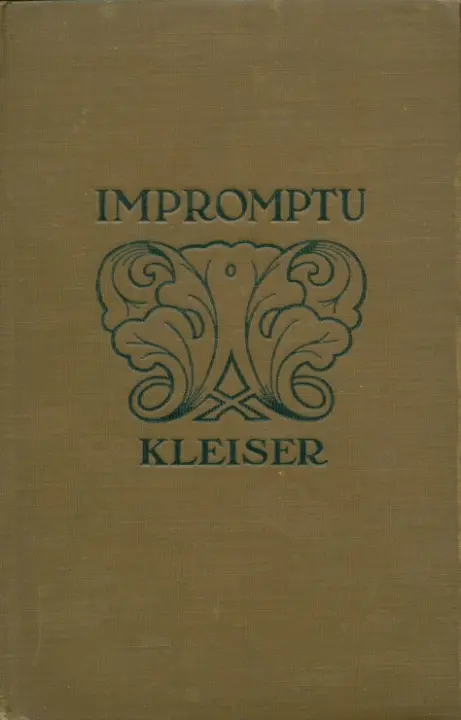
“Impromptu”; or, How to Think on Your Feet
Grenville Kleiser
THE CLASSIC COLLECTION · 1916
"Talks on Talking" by Grenville Kleiser is a guide on effective communication, written in the early 20th century. The book provides practical advice for improving conversational skills and public speaking techniques, drawing from the author’s experience as an instructor in public speaking. The central theme revolves around the art of conversation, exploring the dynamics of communication and offering insights into how to engage with others meaningfully and persuasively. At the start of the text, Kleiser emphasizes the importance of naturalness and sincerity in conversation, cautioning against rigid rules of speech that can stifle genuine expression. He discusses the significance of adaptability in conversation, suggesting that personality and the manner of delivery are as crucial as the content of what is being said. Kleiser identifies various types of talkers, illustrating common conversational pitfalls and encouraging readers to develop qualities that enhance their speaking abilities and foster engaging, effective communication.
Introduction adapted from the source catalogue; source summaries may be automatically generated.
Free to read · English · 26,745 words · No account needed
MAKE TIME FOR A GOOD BOOK
On by default. Untick to stop anonymous reading totals. Each page counts after 10 seconds in view. How this works.
Anonymous counting is on unless you have switched it off.
The conclusion is a vital part of a speech. It is a place of peril to many a public speaker. Countless speeches have been ruined by a bad conclusion.
The most important thing here is that having decided beforehand upon the particular ideas or message with which you intend to conclude your speech, not to let any influence lead you away from this preconceived purpose.
Some speakers are about to conclude effectively but are unwilling to omit anything which they have planned to give in their speech, and so continue in an endeavor to recall every item. At last such a speech has a loose and straggling ending.
The words of the conclusion need not be memorized, but the ideas should be definitely outlined in the mind and fixed in the memory, not as words, but as ideas.
The knowledge that you can turn at will to these definite ideas, and so bring your speech to a close, will confer upon you a degree of self-confidence which will be of immense service to you.
You should ever bear in mind this golden rule for the conclusion of your speech: When you have finished what you have of importance to say, do not be tempted to wander off into by-paths, or to tell an additional story, or to say "and one word more," but having finished your speech, stop on the instant and sit down.
Cultivate as the most desirable thoughts those which are definite, clear, deep, logical, profound, strong, precise, impressive, original, significant, explicit, luminous, positive, suggestive, comprehensive, and practical. Resolutely avoid all thoughts which are uncertain, recondite, obscure, immature, unimportant, shallow, weak, visionary, absurd, vague, extravagant, indefinite, or impractical.
In your choice and use of words give preference to those which are definite, simple, real, significant, forcible, expressive, adequate, musical, varied, and copious. Avoid those which are foreign, slangy, obsolete, unusual, extravagant, technical, long, colloquial, or commonplace.
The most desirable qualities in the use of English are the simple, plain, exact, lucid, concise, trenchant, vigorous, impressive, lively, figurative, polished, graceful, fluent, rhythmical, copious, elevated, flexible, smooth, dignified, terse, epigrammatic, felicitous, euphonious, elegant, and lofty. Undesirable qualities are the diffuse, verbose, redundant, inflated, prolix, ambiguous, feeble, monotonous, loose, slip-shod, dry, flowery, pedantic, pompous, rhetorical, grandiloquent, artificial, formal, ornate, halting, ponderous, ungrammatical, vague, and obscure.
Your reading position is saved on this browser. Take it to another device with a library code. Reading pages adapt to text, rather than matching a printed edition.
Grenville Kleiser
Grenville Kleiser
Grenville Kleiser
Grenville Kleiser
BEHIND THE BOOK
This eBook is for the use of anyone anywhere in the United States and most other parts of the world at no cost and with almost no restrictions whatsoever. You may copy it, give it away or re-use it under the terms of the Project Gutenberg License included with this eBook or online at www.gutenberg.org. If you are not located in the United States, you will have to check the laws of the country where you are located before using this eBook. Read the source licence.
The original source file, including credits and licence, is retained by this library. Request an original-format copy at no charge. Please include the book title and Project Gutenberg identifier #17476.
KEEP YOUR CURIOSITY GOING

Charles G. (Charles Griffith) Ross
Hannah Webster Foster

Emily Lawless
Edwin Hamlin Carr

Charles De Lano Hine
Andrew Ure