
Letters to a Friend, Written to Mrs. Ezra S. Carr, 1866-1879
John Muir
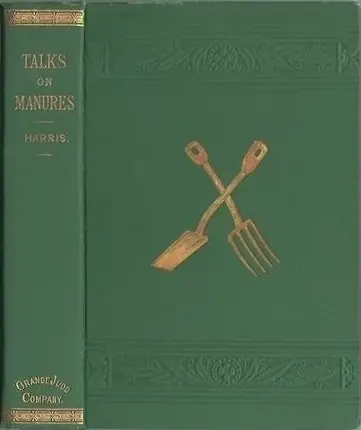
THE CLASSIC COLLECTION · 1878
"Talks on Manures" by Joseph Harris is a practical agricultural guide written in the late 19th century. This work adopts a conversational format, featuring discussions between the author, a deacon, a doctor, and other local farmers concerning the role and importance of manures and fertilizers in farming. It aims to provide insights into effective farming practices that can enhance soil fertility and improve crop yields. The opening of the book sets the stage for a series of dialogue-driven discussions on various aspects of farming and manures. The author introduces concepts like the necessity of personal investment in farming, various definitions of manure, and the importance of drawing out soil nutrients for crop growth. Through illustrative conversations, Harris challenges common beliefs about farming practices, highlighting how even experienced farmers grapple with ideas of soil productivity and the necessity of fertilizers. Each interaction builds a foundation for a deeper exploration into agricultural science and practical methods for enhancing crop production.
Introduction adapted from the source catalogue; source summaries may be automatically generated.
Free to read · English · 149,155 words · No account needed
MAKE TIME FOR A GOOD BOOK
On by default. Untick to stop anonymous reading totals. Each page counts after 10 seconds in view. How this works.
Anonymous counting is on unless you have switched it off.
“With nitrogen at 20 cents per lb., and soluble phosphoric acid at 12½ c. per lb., this half ton of superphosphate, made from 620 lbs. of good bone-dust, would be worth $22.50, or $45 per ton.”
“Or, to look at it in another light,” continued the Doctor, “a ton of bone-dust, made into such a superphosphate as we are talking about, would be worth $72.58.”
“How much,” asked the Deacon, “would a ton of the bone-dust be considered worth before it was converted into superphosphate?”
“A ton of bone-dust,” replied the Doctor, “contains 76 lbs. of nitrogen, worth, at 18 cents per lb., $13.68, and 464 lbs. phosphoric acid, worth 7 cents per lb., $32.48. In other words, a ton of bone-dust, at the usual estimate, is worth $46.16.”
“And,” said the Deacon, “after it is converted into superphosphate, the same ton of bones is worth $72.58. It thus appears that you pay $26.42 per ton for simply making the phosphoric acid in a ton of bones soluble. Isn’t it paying a little too much for the whistle?”
“Possibly such is the case,” said I, “and in point of fact, I think bone-dust, especially from steamed or boiled bones, can be used with more economy in its natural state than in the form of superphosphate.”
Superphosphate can be made more economically from mineral phosphates than from bones--the nitrogen, if desired, being supplied from fish-scrap or from some other cheap source of nitrogen.
But for my own use I would prefer to buy a good article of superphosphate of lime, containing no nitrogen, provided it can be obtained cheap enough. I would buy the ammoniacal, or nitrogenous manure separately, and do my own mixing--unless the mixture could be bought at a less cost than the same weight of soluble phosphoric acid, and available nitrogen could be obtained separately.
A pure superphosphate--and by pure I mean a superphosphate containing no nitrogen--can be drilled in with the seed without injury, but I should be a little afraid of drilling in some of the ammoniacal or nitrogenous superphosphates with small seeds.
And then, again, the “nitrogen” in a superphosphate mixture may be in the form of nitric acid, or sulphate of ammonia, in one case, or, in another case, in the form of hair, woollen rags, hide, or leather. It is far more valuable as nitric acid or ammonia, because it will act quicker, and if I wanted hair, woollen rags, horn-shavings, etc., I would prefer to have them separate from the superphosphate.
Your reading position is saved on this browser. Take it to another device with a library code. Reading pages adapt to text, rather than matching a printed edition.
BEHIND THE BOOK
This eBook is for the use of anyone anywhere in the United States and most other parts of the world at no cost and with almost no restrictions whatsoever. You may copy it, give it away or re-use it under the terms of the Project Gutenberg License included with this eBook or online at www.gutenberg.org. If you are not located in the United States, you will have to check the laws of the country where you are located before using this eBook. Read the source licence.
The original source file, including credits and licence, is retained by this library. Request an original-format copy at no charge. Please include the book title and Project Gutenberg identifier #19448.
KEEP YOUR CURIOSITY GOING
John Muir

Asa Gray
Asa Gray

Florence Nightingale
Elizabeth Robins Pennell
Denison Olmsted