
Letters to a Friend, Written to Mrs. Ezra S. Carr, 1866-1879
John Muir
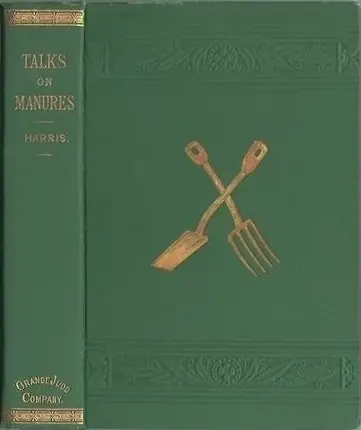
THE CLASSIC COLLECTION · 1878
"Talks on Manures" by Joseph Harris is a practical agricultural guide written in the late 19th century. This work adopts a conversational format, featuring discussions between the author, a deacon, a doctor, and other local farmers concerning the role and importance of manures and fertilizers in farming. It aims to provide insights into effective farming practices that can enhance soil fertility and improve crop yields. The opening of the book sets the stage for a series of dialogue-driven discussions on various aspects of farming and manures. The author introduces concepts like the necessity of personal investment in farming, various definitions of manure, and the importance of drawing out soil nutrients for crop growth. Through illustrative conversations, Harris challenges common beliefs about farming practices, highlighting how even experienced farmers grapple with ideas of soil productivity and the necessity of fertilizers. Each interaction builds a foundation for a deeper exploration into agricultural science and practical methods for enhancing crop production.
Introduction adapted from the source catalogue; source summaries may be automatically generated.
Free to read · English · 149,155 words · No account needed
MAKE TIME FOR A GOOD BOOK
On by default. Untick to stop anonymous reading totals. Each page counts after 10 seconds in view. How this works.
Anonymous counting is on unless you have switched it off.
“No, Deacon,” said I, “I feed the bran, malt-combs and corn-meal to the cows, pigs, and sheep, and let them do the mixing. They work it up fine, moisten it, break up the particles, take out the carbonaceous matter, which we do not need for manure, and the cows and sheep and horses mix it up thoroughly with the hay, straw, and corn-stalks, leaving the whole in just the right condition to put into a pile to ferment or to apply directly to the land.”
“Oh! I see,” said the Deacon, “I did not think you used bran for
manure.”
“Yes, I do, Deacon,” said I, “but I use it for food first, and this is precisely what I would urge you and all others to do. I feel sure that our dairymen can well afford to buy more mill-feed, corn-meal, oil-cake, etc., and mix it with their cow-dung--or rather, let the cows do the mixing.”
I wrote to the Hon. Harris Lewis, the well-known dairyman of Herkimer Co., N.Y., asking him some questions in regard to making and managing manure on dairy farms. The questions will be understood from the answers. He writes as follows:
“My Friend Harris.--This being the first leisure time I have had since the receipt of your last letter, I devote it to answering your questions:
“1st. I have no manure cellar.
“I bed my cows with dry basswood sawdust, saving all the liquid manure, keeping the cows clean, and the stable odors down to a tolerable degree. This bedding breaks up the tenacity of the cow-manure, rendering it as easy to pulverize and manage as clear horse-manure. I would say it is just lovely to bed cows with dry basswood sawdust. This manure, if left in a large pile, will ferment and burn like horse-manure in about 10 days. Hence I draw it out as made where I desire to use it, leaving it in small heaps, convenient to spread.
“My pigs and calves are bedded with straw, and this is piled and rotted
before using.
“I use most of my manure on grass land, and mangels, some on corn and potatoes; but it pays me best, when in proper condition, to apply all I do not need for mangels, on meadow and pasture.
“Forty loads, or about 18 to 20 cords is a homœopathic dose for an acre, and this quantity, or more, applied once in three years to grass land, agrees with it first rate.
“The land where I grow mangels gets about this dose every year.
“I would say that my up-land meadows have been mown twice each year for
a great many years.
Your reading position is saved on this browser. Take it to another device with a library code. Reading pages adapt to text, rather than matching a printed edition.
BEHIND THE BOOK
This eBook is for the use of anyone anywhere in the United States and most other parts of the world at no cost and with almost no restrictions whatsoever. You may copy it, give it away or re-use it under the terms of the Project Gutenberg License included with this eBook or online at www.gutenberg.org. If you are not located in the United States, you will have to check the laws of the country where you are located before using this eBook. Read the source licence.
The original source file, including credits and licence, is retained by this library. Request an original-format copy at no charge. Please include the book title and Project Gutenberg identifier #19448.
KEEP YOUR CURIOSITY GOING
John Muir

Asa Gray
Asa Gray

Florence Nightingale
Elizabeth Robins Pennell
Denison Olmsted