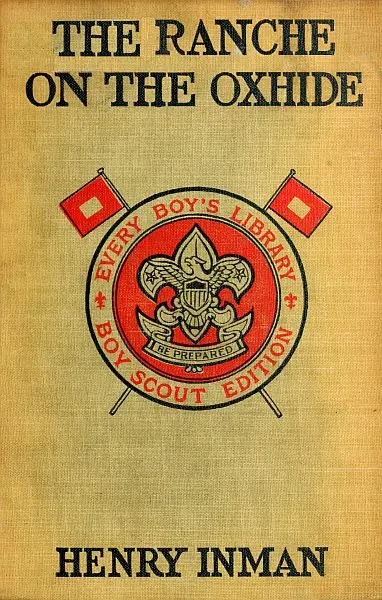
The Ranche on the Oxhide: A Story of Boys’ and Girls’ Life on the Frontier
Henry Inman
THE CLASSIC COLLECTION · 1898
"Tales of the Trail: Short Stories of Western Life" by Colonel Henry Inman is a collection of short stories written in the late 19th century." This anthology draws on real events witnessed by the author during his time on the American frontier, capturing the spirit and challenges of life in the Old West. The stories feature a variety of characters, including soldiers, pioneers, and Native Americans, all set against the backdrop of the uncharted territories west of the Missouri, reflecting on themes of adventure, survival, and the complex interactions between diverse cultures. "The opening of the collection provides an engaging preface and introduces the first story, "General Forsythe at the Arrickaree," which centers around the tense moments before a significant military conflict with Native American tribes in 1868." Colonel Inman sets the stage at Fort Harker, where General Forsythe prepares for an upcoming Indian war, contemplating the recent massacres and the growing tensions. The narrative vividly depicts the general's resolve and the soon-to-be besieged scouts' plight as they encounter overwhelming odds against a large band of Native warriors. As the story unfolds, it promises thrilling action and deepens the reader's understanding of the struggles, bravery, and tragic losses that define the Western experience.
Introduction adapted from the source catalogue; source summaries may be automatically generated.
Free to read · English · 56,391 words · No account needed
MAKE TIME FOR A GOOD BOOK
On by default. Untick to stop anonymous reading totals. Each page counts after 10 seconds in view. How this works.
Anonymous counting is on unless you have switched it off.
New horrors now made their appearance in the shape of gangrened wounds, and suffering for food. The putrid flesh of the dead horses and mules was all that remained to support life, and however revolting, it had to be swallowed. The nauseating effluvia of the rapidly decaying carcasses, too, made the place almost intolerable, and so insufferable did it become that the General told those who were disheartened to go; but all to a man, to their honor be it recorded, refused, electing to remain with their companions-in-arms--to be rescued, or die with them.
Two more days of torture, and then, on the ridge between them and the golden sunlight gleamed the bright bayonets of Col. Carpenter and his column of "the boys in blue."
Their Havelock had reached this American Lucknow, and cheer after cheer--feeble though they were--went up from the little island, and our story closes with the rescue of these brave men.
GENERAL FORSYTHE (himself wounded in both legs) gives a very graphic description of the charge of the Indians, and the appearance of their hero and chief, Roman Nose. He says:
"As Roman Nose dashed gallantly forward and swept into the open at the head of his superb command, he was the very beau-ideal of an Indian chief. Mounted on a large, clean-limbed chestnut horse, he sat well forward on his bareback charger, his knees passing under a horsehair lariat that twice loosely encircled the animal's body, his horse's bridle grasped in his left hand, which was also closely wound in its flowing mane, and at the same time clutched his rifle at the guard, the butt of which lay partially across the animal's neck, while its barrel, crossing diagonally in front of his body, rested slightly against the hollow of his left arm, leaving his right free to direct the course of his men. He was a man over six feet three inches in height, beautifully formed, and save for a crimson silk sash knotted around his waist and his moccasins on his feet, perfectly naked. His face was hideously painted in alternate lines of red and black, and his head crowned with a magnificent war-bonnet, from which, just above his temples and curving slightly forward, stood up two short black buffalo horns, while its ample length of eagles' feathers and herons' plumes trailed wildly on the wind behind him; and as he came swiftly on at the head of his charging warriors, in all his barbaric strength and grandeur, he proudly rode that day the most perfect type of a savage warrior it has been my lot to see. Turning his face for an instant toward the women and children of the united tribes, who literally by thousands were watching the fight from the crest of the low bluffs back from the river's bank, he raised his right arm and waved his right hand with a royal gesture, in answer to their wild cries of rage and encouragement as he and his command swept down upon us; and again, facing squarely towards where we lay, he drew his body to its full height and shook his clenched fist defiantly at us; then, throwing back his head and glancing skyward, he suddenly struck the palm of his hand across his mouth and gave tongue to a war-cry that I have never yet heard equaled in power and intensity. Scarcely had its echos reached the river's bank when it was caught up by each and every one of the charging warriors with an energy that baffles description, and answered back with blood-curdling yells of exultation and prospective vengeance by the women and children on the river's bluff and by the Indians who lay in ambush around us. On they came at a swinging gallop, rending the air with their wild war-whoops, each individual warrior in all his bravery of war paint and long braided scalp-lock tipped with eagles' feathers, and all stark naked but for their cartridge belts and moccasins, keeping their line almost perfectly, with a front of about sixty men all riding horseback, with only a loose lariat about their horses' bodies, and about a yard apart, and with a depth of six or seven ranks, forming together a compact body of massive fighting strength, and of almost resistless weight. 'Boldly they rode and well,' with their horses' bridles in their left hands, while with their right they grasped their rifles at the guard and held them squarely in front of themselves, resting lightly upon their horses' necks.
Your reading position is saved on this browser. Take it to another device with a library code. Reading pages adapt to text, rather than matching a printed edition.
Henry Inman
Henry Inman
Henry Inman & Buffalo Bill
BEHIND THE BOOK
This eBook is for the use of anyone anywhere in the United States and most other parts of the world at no cost and with almost no restrictions whatsoever. You may copy it, give it away or re-use it under the terms of the Project Gutenberg License included with this eBook or online at www.gutenberg.org. If you are not located in the United States, you will have to check the laws of the country where you are located before using this eBook. Read the source licence.
The original source file, including credits and licence, is retained by this library. Request an original-format copy at no charge. Please include the book title and Project Gutenberg identifier #58568.
KEEP YOUR CURIOSITY GOING
Cécile Tormay

Moritz Busch
Coulson Kernahan
John L. Ransom

Maurice Baring
Frances Wright