THE CLASSIC COLLECTION✦The Catholic Church and conversionCLASSIC FREE BOOKS
The Catholic Church and conversion
G. K. (Gilbert Keith) Chesterton
THE CLASSIC COLLECTION · 1925
"Tales of the Long Bow" by G. K. Chesterton is a collection of intriguing stories likely written in the early 20th century. The narratives revolve around eccentric characters and improbable events, showcasing the whimsical and sometimes absurd nature of human existence. The opening tale introduces Colonel Crane, a seemingly typical and respectable military man, who surprises his conservative neighbors by walking to church with a cabbage on his head, setting the stage for a humorous exploration of social conventions and individuality. At the start of the tale, the narrative establishes the context in a mundane suburban setting, with Colonel Crane appearing as a mundane figure among ordinary neighbors. However, a mysterious note leads him to behave quite unconventionally, culminating in his decision to wear a cabbage as a hat while on his way to church. This peculiar act attracts the attention and bewilderment of those around him, particularly focusing on a young woman named Audrey Smith, who admires Crane's audacity. The interaction between the Colonel and Audrey hints at deeper themes of societal pressures, identity, and the tension between convention and individual expression. The opening portion sets a humorous yet thought-provoking tone, inviting readers to ponder the nature of normalcy and the courage it takes to defy it.
Introduction adapted from the source catalogue; source summaries may be automatically generated.
Free to read · English · 62,571 words · No account needed
MAKE TIME FOR A GOOD BOOK
On by default. Untick to stop anonymous reading totals. Each page counts after 10 seconds in view. How this works.
Anonymous counting is on unless you have switched it off.
He had been almost dancing with excitement on the top of the ridge; now he suddenly went bounding down the slope beyond, calling to the girl to follow, as carelessly as if they had been two children playing at hide and seek. Strangely enough, perhaps, she did follow; more strangely still when we consider the extravagant scenes through which she allowed herself to be led. They were scenes more insanely incongruous with all her sensitive and even secretive dignity than if she had been changing hats with a costermonger on a Bank Holiday. For there the world would only be loud with vulgarity, and here it was also loud with lies. She could never have described that Saturnalia of a political election; but she did dimly feel the double impression of a harlequinade at the end of a pantomime and of Hood’s phrase about the end of the world. It was as if a Bank Holiday could also be a Day of Judgment. But as the farce could no longer offend her, so the tragedy could no longer terrify. She went through it all with a wan smile, which perhaps nobody in the world would have known her well enough to interpret. It was not in the normal sense excitement; yet it was something much more positive than patience. In a sense perhaps, more than ever before in her lonely life, she was walled up in her ivory tower; but it was all alight within, as if it were lit with candles or lined with gold.
Hood’s impetuous movements brought them to the bank of the river and the outer offices of the factory, all of which were covered with the coloured posters of the candidature, and one of which was obviously fitted up as a busy and bustling committee-room. Hood actually met Mr. Low coming out of it, buttoned up in a fur coat and bursting with speechless efficiency. But Mr. Low’s beady black eyes glistened with an astonishment bordering on suspicion when Hood in the most hearty fashion offered his sympathy and co-operation. That strange subconscious fear, that underlay all the wealthy manager’s success and security in this country, always came to the surface at the sight of Owen Hood’s long ironical face. Just at that moment, however, one of the local agents rushed at him in a distracted fashion, with telegrams in his hand. They were short of canvassers; they were short of cars; they were short of speakers; the crowd at Little Puddleton had been waiting half an hour; Dr. Hunter could not get round to them till ten past nine, and so on. The agent in his agony would probably have hailed a Margate nigger and entrusted him with the cause of the great National Party, without any really philosophical inquiry into the nigger’s theory of citizenship. For all such over-practical push and bustle in our time is always utterly unpractical at the last minute and in the long run. On that night Robert Owen Hood would have been encouraged to go anywhere and say anything; and he did. It might be interesting to imagine what the lady thought about it; but it is possible that she did not think about it. She had a radiantly abstracted sense of passing through a number of ugly rooms and sheds with flaring gas and stacks of leaflets behind which little irritable men ran about like rabbits. The walls were covered with large allegorical pictures printed in line or in a few bright colours, representing Dr. Hunter as clad in armour, as slaying dragons, as rescuing ladies rather like classical goddesses, and so on. Lest it should be too literally understood that Dr. Hunter was in the habit of killing dragons in his daily round, as a form of field-sport, the dragon was inscribed with its name in large letters. Apparently its name was “National Extravagance.” Lest there should be any doubt about the alternative which Dr. Hunter had discovered as a corrective to extravagance, the sword which he was thrusting through the dragon’s body was inscribed with the word “Economy.” Elizabeth Seymour, through whose happy but bewildered mind these pictures passed, could not but reflect vaguely that she herself had lately but to practise a good deal of economy and resist a good many temptations to extravagance; but it would never have occurred to her unaided imagination to conceive the action as that of plunging a sword into a scaly monster of immense size. In the central committee-room they actually came face to face for a moment with the candidate, who came in very hot and breathless with a silk hat on the back of his head; where he had possibly forgotten it, for he certainly did not remove it. She was a little ashamed of being sensitive about such trifles; but she came to the conclusion that she would not like to have a husband standing for Parliament.
Your reading position is saved on this browser. Take it to another device with a library code. Reading pages adapt to text, rather than matching a printed edition.
G. K. (Gilbert Keith) Chesterton
G. K. (Gilbert Keith) Chesterton
G. K. (Gilbert Keith) Chesterton
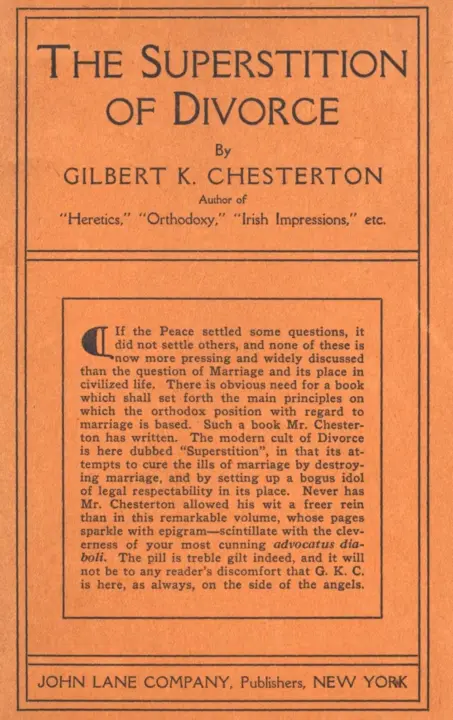
G. K. (Gilbert Keith) Chesterton
BEHIND THE BOOK
This eBook is for the use of anyone anywhere in the United States and most other parts of the world at no cost and with almost no restrictions whatsoever. You may copy it, give it away or re-use it under the terms of the Project Gutenberg License included with this eBook or online at www.gutenberg.org. If you are not located in the United States, you will have to check the laws of the country where you are located before using this eBook. Read the source licence.
The original source file, including credits and licence, is retained by this library. Request an original-format copy at no charge. Please include the book title and Project Gutenberg identifier #69185.
KEEP YOUR CURIOSITY GOING
Coulson Kernahan

Maurice Baring
Frances Wright
Cécile Tormay

Frederic Jesup Stimson

W. H. P. (William Henry Pope) Jarvis