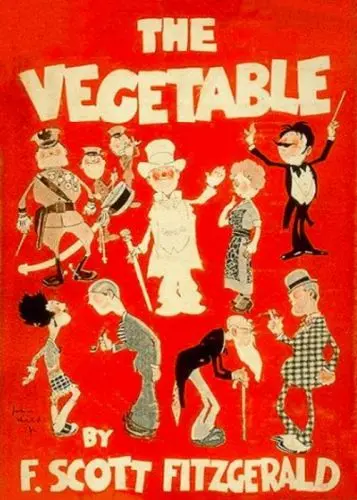
The Vegetable; or, From President to Postman
F. Scott (Francis Scott) Fitzgerald
THE CLASSIC COLLECTION · 1922
"Tales of the Jazz Age" by F. Scott Fitzgerald is a collection of 11 short stories published in 1922. Divided into three parts—"My Last Flappers," "Fantasies," and "Unclassified Masterpieces"—the collection includes "The Curious Case of Benjamin Button" and explores themes ranging from the indolent rich to a broader spectrum of social classes. Fitzgerald provided his own commentary on each story, demonstrating what critics called his "authorial self-consciousness." The collection showcases his transitional "second manner" as a writer.
Introduction adapted from the source catalogue; source summaries may be automatically generated.
Free to read · English · 88,580 words · No account needed
MAKE TIME FOR A GOOD BOOK
On by default. Untick to stop anonymous reading totals. Each page counts after 10 seconds in view. How this works.
Anonymous counting is on unless you have switched it off.
“It’s--it’s mortifying,” said Dean suddenly.
“Wha’s mortifying?”
“The idea their objecting us having champagne breakfast.”
“Mortifying?” Peter considered. “Yes, tha’s word--mortifying.”
Again they collapsed into laughter, howled, swayed, rocked back and forth in their chairs, repeating the word “mortifying” over and over to each other--each repetition seeming to make it only more brilliantly absurd.
After a few more gorgeous minutes they decided on another quart. Their anxious waiter consulted his immediate superior, and this discreet person gave implicit instructions that no more champagne should be served. Their check was brought.
Five minutes later, arm in arm, they left the Commodore and made their way through a curious, staring crowd along Forty-second Street, and up Vanderbilt Avenue to the Biltmore. There, with sudden cunning, they rose to the occasion and traversed the lobby, walking fast and standing unnaturally erect.
Once in the dining-room they repeated their performance. They were torn between intermittent convulsive laughter and sudden spasmodic discussions of politics, college, and the sunny state of their dispositions. Their watches told them that it was now nine o’clock, and a dim idea was born in them that they were on a memorable party, something that they would remember always. They lingered over the second bottle. Either of them had only to mention the word “mortifying” to send them both into riotous gasps. The dining-room was whirring and shifting now; a curious lightness permeated and rarefied the heavy air.
They paid their check and walked out into the lobby.
It was at this moment that the exterior doors revolved for the thousandth time that morning, and admitted into the lobby a very pale young beauty with dark circles under her eyes, attired in a much-rumpled evening dress. She was accompanied by a plain stout man, obviously not an appropriate escort.
At the top of the stairs this couple encountered Mr. In and Mr. Out.
“Edith,” began Mr. In, stepping toward her hilariously and making a sweeping bow, “darling, good morning.”
The stout man glanced questioningly at Edith, as if merely asking her permission to throw this man summarily out of the way.
“’Scuse familiarity,” added Peter, as an afterthought. “Edith,
good-morning.”
He seized Dean’s elbow and impelled him into the foreground.
“Meet Mr. In, Edith, my bes’ frien’. Inseparable. Mr. In and Mr. Out.”
Mr. Out advanced and bowed; in fact, he advanced so far and bowed so low that he tipped slightly forward and only kept his balance by placing a hand lightly on Edith’s shoulder.
“I’m Mr. Out, Edith,” he mumbled pleasantly. “S’misterin Misterout.”
“’Smisterinanout,” said Peter proudly.
Your reading position is saved on this browser. Take it to another device with a library code. Reading pages adapt to text, rather than matching a printed edition.
F. Scott (Francis Scott) Fitzgerald
BEHIND THE BOOK
This eBook is for the use of anyone anywhere in the United States and most other parts of the world at no cost and with almost no restrictions whatsoever. You may copy it, give it away or re-use it under the terms of the Project Gutenberg License included with this eBook or online at www.gutenberg.org. If you are not located in the United States, you will have to check the laws of the country where you are located before using this eBook. Read the source licence.
The original source file, including credits and licence, is retained by this library. Request an original-format copy at no charge. Please include the book title and Project Gutenberg identifier #6695.
KEEP YOUR CURIOSITY GOING
Coulson Kernahan

Maurice Baring
Frances Wright
Cécile Tormay

Frederic Jesup Stimson

W. H. P. (William Henry Pope) Jarvis