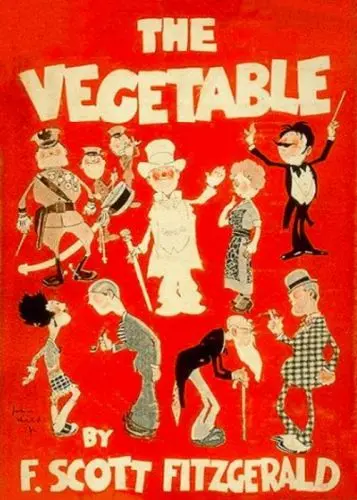
The Vegetable; or, From President to Postman
F. Scott (Francis Scott) Fitzgerald
THE CLASSIC COLLECTION · 1922
"Tales of the Jazz Age" by F. Scott Fitzgerald is a collection of 11 short stories published in 1922. Divided into three parts—"My Last Flappers," "Fantasies," and "Unclassified Masterpieces"—the collection includes "The Curious Case of Benjamin Button" and explores themes ranging from the indolent rich to a broader spectrum of social classes. Fitzgerald provided his own commentary on each story, demonstrating what critics called his "authorial self-consciousness." The collection showcases his transitional "second manner" as a writer.
Introduction adapted from the source catalogue; source summaries may be automatically generated.
Free to read · English · 88,580 words · No account needed
MAKE TIME FOR A GOOD BOOK
On by default. Untick to stop anonymous reading totals. Each page counts after 10 seconds in view. How this works.
Anonymous counting is on unless you have switched it off.
The man at the other end of the room had been looking at them curiously, but at Henry’s beckoning gesture he approached. He was loosely fat with little twinkling eyes, and, having removed his collar and tie, he gave the impression of a Middle-Western farmer on a Sunday afternoon.
“This is my sister,” said Henry. “She dropped in to see me.”
“How do you do?” said the fat man, smiling. “My name’s Bartholomew, Miss Bradin. I know your brother has forgotten it long ago.”
Edith laughed politely.
“Well,” he continued, “not exactly gorgeous quarters we have here, are
they?”
Edith looked around the room.
“They seem very nice,” she replied. “Where do you keep the bombs?”
“The bombs?” repeated Bartholomew, laughing. “That’s pretty good--the bombs. Did you hear her, Henry? She wants to know where we keep the bombs. Say, that’s pretty good.”
Edith swung herself onto a vacant desk and sat dangling her feet over the edge. Her brother took a seat beside her.
“Well,” he asked, absent-mindedly, “how do you like New York this
trip?”
“Not bad. I’ll be over at the Biltmore with the Hoyts until Sunday. Can’t you come to luncheon to-morrow?”
He thought a moment.
“I’m especially busy,” he objected, “and I hate women in groups.”
“All right,” she agreed, unruffled. “Let’s you and me have luncheon
together.”
“Very well.”
“I’ll call for you at twelve.”
Bartholomew was obviously anxious to return to his desk, but apparently considered that it would be rude to leave without some parting pleasantry.
“Well”--he began awkwardly.
They both turned to him.
“Well, we--we had an exciting time earlier in the evening.”
The two men exchanged glances.
“You should have come earlier,” continued Bartholomew, somewhat encouraged. “We had a regular vaudeville.”
“Did you really?”
“A serenade,” said Henry. “A lot of soldiers gathered down there in the street and began to yell at the sign.”
“Why?” she demanded.
“Just a crowd,” said Henry, abstractedly. “All crowds have to howl. They didn’t have anybody with much initiative in the lead, or they’d probably have forced their way in here and smashed things up.”
“Yes,” said Bartholomew, turning again to Edith, “you should have been
here.”
He seemed to consider this a sufficient cue for withdrawal, for he turned abruptly and went back to his desk.
“Are the soldiers all set against the Socialists?” demanded Edith of her brother. “I mean do they attack you violently and all that?”
Henry replaced his eye-shade and yawned.
Your reading position is saved on this browser. Take it to another device with a library code. Reading pages adapt to text, rather than matching a printed edition.
F. Scott (Francis Scott) Fitzgerald
BEHIND THE BOOK
This eBook is for the use of anyone anywhere in the United States and most other parts of the world at no cost and with almost no restrictions whatsoever. You may copy it, give it away or re-use it under the terms of the Project Gutenberg License included with this eBook or online at www.gutenberg.org. If you are not located in the United States, you will have to check the laws of the country where you are located before using this eBook. Read the source licence.
The original source file, including credits and licence, is retained by this library. Request an original-format copy at no charge. Please include the book title and Project Gutenberg identifier #6695.
KEEP YOUR CURIOSITY GOING
Coulson Kernahan

Maurice Baring
Frances Wright
Cécile Tormay

Frederic Jesup Stimson

W. H. P. (William Henry Pope) Jarvis