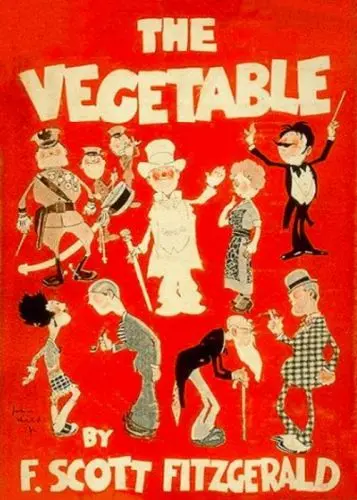
The Vegetable; or, From President to Postman
F. Scott (Francis Scott) Fitzgerald
THE CLASSIC COLLECTION · 1922
"Tales of the Jazz Age" by F. Scott Fitzgerald is a collection of 11 short stories published in 1922. Divided into three parts—"My Last Flappers," "Fantasies," and "Unclassified Masterpieces"—the collection includes "The Curious Case of Benjamin Button" and explores themes ranging from the indolent rich to a broader spectrum of social classes. Fitzgerald provided his own commentary on each story, demonstrating what critics called his "authorial self-consciousness." The collection showcases his transitional "second manner" as a writer.
Introduction adapted from the source catalogue; source summaries may be automatically generated.
Free to read · English · 88,580 words · No account needed
MAKE TIME FOR A GOOD BOOK
On by default. Untick to stop anonymous reading totals. Each page counts after 10 seconds in view. How this works.
Anonymous counting is on unless you have switched it off.
Peter listened while the words filtered into his consciousness.
“Now this,” he thought, “is most remarkable.”
He was excited. He was jubilant. He felt that he had stumbled upon a mystery. Affecting an elaborate carelessness he arose and waited around the table--then, turning quickly, pulled open the green door, precipitating Private Rose into the room.
Peter bowed.
“How do you do?” he said.
Private Rose set one foot slightly in front of the other, poised for fight, flight, or compromise.
“How do you do?” repeated Peter politely.
“I’m o’right.”
“Can I offer you a drink?”
Private Rose looked at him searchingly, suspecting possible sarcasm.
“O’right,” he said finally.
Peter indicated a chair.
“Sit down.”
“I got a friend,” said Rose, “I got a friend in there.” He pointed to
the green door.
“By all means let’s have him in.”
Peter crossed over, opened the door and welcomed in Private Key, very suspicious and uncertain and guilty. Chairs were found and the three took their seats around the punch bowl. Peter gave them each a highball and offered them a cigarette from his case. They accepted both with some diffidence.
“Now,” continued Peter easily, “may I ask why you gentlemen prefer to lounge away your leisure hours in a room which is chiefly furnished, as far as I can see, with scrubbing brushes. And when the human race has progressed to the stage where seventeen thousand chairs are manufactured on every day except Sunday--” he paused. Rose and Key regarded him vacantly. “Will you tell me,” went on Peter, “why you choose to rest yourselves on articles, intended for the transportation of water from one place to another?”
At this point Rose contributed a grunt to the conversation.
“And lastly,” finished Peter, “will you tell me why, when you are in a building beautifully hung with enormous candelabra, you prefer to spend these evening hours under one anemic electric light?”
Rose looked at Key; Key looked at Rose. They laughed; they laughed uproariously; they found it was impossible to look at each other without laughing. But they were not laughing with this man--they were laughing at him. To them a man who talked after this fashion was either raving drunk or raving crazy.
“You are Yale men, I presume,” said Peter, finishing his highball and
preparing another.
They laughed again.
“Na-ah.”
“So? I thought perhaps you might be members of that lowly section of the university known as the Sheffield Scientific School.”
“Na-ah.”
“Hm. Well, that’s too bad. No doubt you are Harvard men, anxious to preserve your incognito in this--this paradise of violet blue, as the newspapers say.”
Your reading position is saved on this browser. Take it to another device with a library code. Reading pages adapt to text, rather than matching a printed edition.
F. Scott (Francis Scott) Fitzgerald
BEHIND THE BOOK
This eBook is for the use of anyone anywhere in the United States and most other parts of the world at no cost and with almost no restrictions whatsoever. You may copy it, give it away or re-use it under the terms of the Project Gutenberg License included with this eBook or online at www.gutenberg.org. If you are not located in the United States, you will have to check the laws of the country where you are located before using this eBook. Read the source licence.
The original source file, including credits and licence, is retained by this library. Request an original-format copy at no charge. Please include the book title and Project Gutenberg identifier #6695.
KEEP YOUR CURIOSITY GOING
Coulson Kernahan

Maurice Baring
Frances Wright
Cécile Tormay

Frederic Jesup Stimson

W. H. P. (William Henry Pope) Jarvis