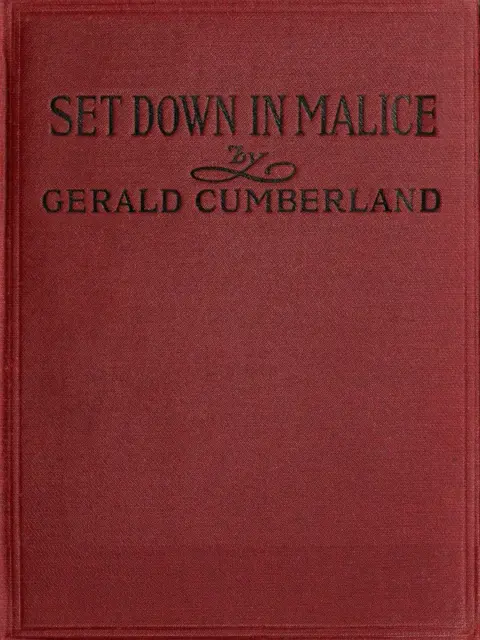
Set Down in Malice: A Book of Reminiscences
Gerald Cumberland

THE CLASSIC COLLECTION · 1919
"Tales of a Cruel Country" by Gerald Cumberland is a collection of narratives written in the early 20th century. The stories explore the lives, loves, and struggles of characters set against the backdrop of Macedonia, delving into themes of passion, loss, and the cruelties of human relationships. The collection features a range of compelling characters, including Stephanie Miniati, who navigates conflicting affections, and Orosdi, who is consumed by both love and jealousy. The opening of the collection introduces us to Stephanie Miniati, a beautiful young woman torn between the memory of her deceased lover and her relationship with the handsome Orosdi. As she faces the anniversary of her first lover's death, her internal conflict becomes apparent: while she desires Orosdi's love, societal expectations and her own memories weigh heavily on her. Orosdi, on the other hand, grapples with his own feelings of frustration and possessiveness towards Stephanie. He is determined to confront her, culminating in a passionate and turbulent encounter in a cemetery where he disrupts her communion with her past. This powerful dynamic between love, memory, and the expectations of a small village sets the stage for the stories to unfold.
Introduction adapted from the source catalogue; source summaries may be automatically generated.
Free to read · English · 65,947 words · No account needed
MAKE TIME FOR A GOOD BOOK
On by default. Untick to stop anonymous reading totals. Each page counts after 10 seconds in view. How this works.
Anonymous counting is on unless you have switched it off.
Quite the most exciting occupation in the world is to read new pianoforte music for a good singer. Reynaldo Hahn is the most atmospheric of composers, the most delicate, the most decadent: not a great man, of course, but an interesting man. Like my companion’s voice, his music has no colour: it consists of whites, blacks, and innumerable shades of grey.
“You play almost as well as I sing,” she remarked, after we had gone through an entire volume of songs.
“You make me play well,” I said; “you are sympathetic. That’s a silly word--but you know what I mean.”
“But it’s really very heartless music,” said she; “it’s so sentimental, so insincere. It suits me. I can’t do the real things--not even the modern people--Hugo Wolfe, for example. The great men lacerate me so, and I don’t like being lacerated.”
“No,” said I mischievously, “you’d rather lacerate other people. Your friend from Oxford for example.”
“Ah! Lovelace, you mean. I thought you would be curious about him.”
“Well, I confess it: I am curious.”
She laughed teasingly.
“If you wait long enough, you will find out everything. But there goes the first dinner-gong, and you’re not dressed.”
I hurried away to change. Though I dressed as speedily as possible, the dinner had begun when I entered the dining-room. As I noticed that Lovelace was bending low over the table at which Miss Langdon sat, and that she was speaking to him with some vehemence, I approached them very slowly and deliberately; even so, their conversation was not finished when I had sat down at my place.
“ ...And what happened to Walter had nothing to do with me,” she protested, though she knew I was present; “and if it had--what then? Am I to love all the men who love me? Are men children that they require nurses?”
“No, Madame,” he said. “Will Madame take thick or clear soup?”
“I will take no soup at all. Write down your answer on a piece of paper and bring it with the entrée.”
He departed, white and trembling, and for a minute my sympathy was
entirely with him.
“What surprises me,” I said to her, “is that you asked me always to sit
at your table.”
Though a minute previously she had been speaking passionately, almost angrily, to Lovelace, she now turned to me a face at once gentle and beseeching.
“Do you mind?” she asked.
“Well--no. To be perfectly frank, you do make me feel a little uncomfortable. Lovelace is a gentleman. Even if he weren’t, I shouldn’t like to interrupt your private conversations with him.”
Your reading position is saved on this browser. Take it to another device with a library code. Reading pages adapt to text, rather than matching a printed edition.
Gerald Cumberland
BEHIND THE BOOK
This eBook is for the use of anyone anywhere in the United States and most other parts of the world at no cost and with almost no restrictions whatsoever. You may copy it, give it away or re-use it under the terms of the Project Gutenberg License included with this eBook or online at www.gutenberg.org. If you are not located in the United States, you will have to check the laws of the country where you are located before using this eBook. Read the source licence.
The original source file, including credits and licence, is retained by this library. Request an original-format copy at no charge. Please include the book title and Project Gutenberg identifier #60272.
KEEP YOUR CURIOSITY GOING
Coulson Kernahan

Maurice Baring
Frances Wright
Cécile Tormay

Frederic Jesup Stimson

W. H. P. (William Henry Pope) Jarvis