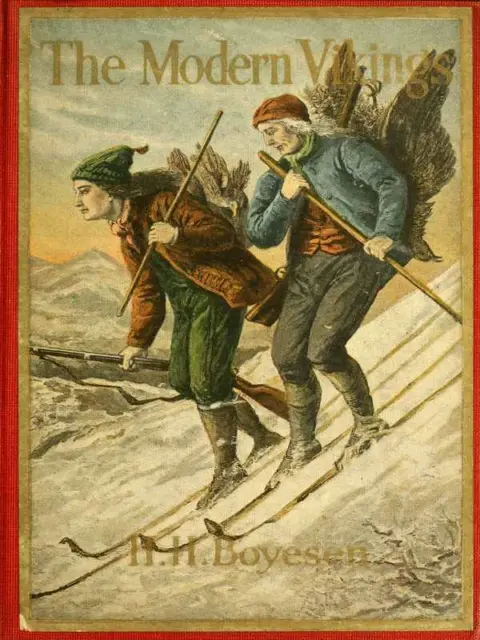
The Modern Vikings: Stories of Life and Sport in the Norseland
Hjalmar Hjorth Boyesen
THE CLASSIC COLLECTION · 1877
"Tales from Two Hemispheres" by Hjalmar Hjorth Boysen is a collection of stories written in the late 19th century. The opening tale introduces Halfdan Bjerk, a young Norseman who arrives in America, filled with idealistic dreams of freedom and success but soon finds himself facing the stark realities of immigrant life and societal indifference. At the start of the book, we meet Halfdan as he disembarks in New York, excited yet terrified of his new life. As he navigates the bustling streets, he grapples with feelings of isolation and dislocation, compounded by a series of misfortunes, including losing his belongings and being fined as a vagrant. Through his encounters—both with the charming innocence of a young girl named Clara and the dismissive attitudes of adults—Boysen paints a poignant portrait of an immigrant's struggle to find his place in a vibrant yet unforgiving society. The opening effectively sets the stage for Halfdan's journey, highlighting themes of belonging, identity, and the often harsh contrast between dreams and reality.
Introduction adapted from the source catalogue; source summaries may be automatically generated.
Free to read · English · 57,118 words · No account needed
MAKE TIME FOR A GOOD BOOK
On by default. Untick to stop anonymous reading totals. Each page counts after 10 seconds in view. How this works.
Anonymous counting is on unless you have switched it off.
“What is your name, my little girl?” he asked, in a tone of friendly
interest.
“Clara,” answered the child, hesitatingly; then, having by another look assured herself of his harmlessness, she added: “How very funny you speak!”
“Yes,” he said, stooping down to take he tiny begloved hand. “I do not speak as well as you do, yet; but I shall soon learn.”
Clara looked puzzled.
“How old are you?” she asked, raising her parasol, and throwing back her head with an air of superiority.
“I am twenty-four years old.”
She began to count half aloud on her fingers: “One, two, three, four,” but, before she reached twenty, she lost her patience.
“Twenty-four,” she exclaimed, “that is a great deal. I am only seven, and papa gave me a pony on my birthday. Have you got a pony?”
“No; I have nothing but what is in this valise, and you know I could not very well get a pony into it.”
Clara glanced curiously at the valise and laughed; then suddenly she grew serious again, put her hand into her pocket and seemed to be searching eagerly for something. Presently she hauled out a small porcelain doll’s head, then a red-painted block with letters on it, and at last a penny.
“Do you want them?” she said, reaching him her treasures in both hands. “You may have them all.”
Before he had time to answer, a shrill, penetrating voice cried out:
“Why, gracious! child, what are you doing?”
And the nurse, who had been deeply absorbed in “The New York Ledger,” came rushing up, snatched the child away, and retreated as hastily as she had come.
Halfdan rose and wandered for hours aimlessly along the intertwining roads and footpaths. He visited the menageries, admired the statues, took a very light dinner, consisting of coffee, sandwiches, and ice, at the Chinese Pavilion, and, toward evening, discovered an inviting leafy arbor, where he could withdraw into the privacy of his own thoughts, and ponder upon the still unsolved problem of his destiny. The little incident with the child had taken the edge off his unhappiness and turned him into a more conciliatory mood toward himself and the great pitiless world, which seemed to take so little notice of him. And he, who had come here with so warm a heart and so ardent a will to join in the great work of human advancement--to find himself thus harshly ignored and buffeted about, as if he were a hostile intruder! Before him lay the huge unknown city where human life pulsated with large, full heart-throbs, where a breathless, weird intensity, a cold, fierce passion seemed to be hurrying everything onward in a maddening whirl, where a gentle, warm-blooded enthusiast like himself had no place and could expect naught but a speedy destruction. A strange, unconquerable dread took possession of him, as if he had been caught in a swift, strong whirlpool, from which he vainly struggled to escape. He crouched down among the foliage and shuddered. He could not return to the city. No, no: he never would return. He would remain here hidden and unseen until morning, and then he would seek a vessel bound for his dear native land, where the great mountains loomed up in serene majesty toward the blue sky, where the pine-forests whispered their dreamily sympathetic legends, in the long summer twilights, where human existence flowed on in calm beauty with the modest aims, small virtues, and small vices which were the happiness of modest, idyllic souls. He even saw himself in spirit recounting to his astonished countrymen the wonderful things he had heard and seen during his foreign pilgrimage, and smiled to himself as he imagined their wonder when he should tell them about the beautiful little girl who had been the first and only one to offer him a friendly greeting in the strange land. During these reflections he fell asleep, and slept soundly for two or three hours. Once, he seemed to hear footsteps and whispers among the trees, and made an effort to rouse himself, but weariness again overmastered him and he slept on. At last, he felt himself seized violently by the shoulders, and a gruff voice shouted in his ear:
Your reading position is saved on this browser. Take it to another device with a library code. Reading pages adapt to text, rather than matching a printed edition.
Hjalmar Hjorth Boyesen
Hjalmar Hjorth Boyesen
Hjalmar Hjorth Boyesen
Hjalmar Hjorth Boyesen
BEHIND THE BOOK
This eBook is for the use of anyone anywhere in the United States and most other parts of the world at no cost and with almost no restrictions whatsoever. You may copy it, give it away or re-use it under the terms of the Project Gutenberg License included with this eBook or online at www.gutenberg.org. If you are not located in the United States, you will have to check the laws of the country where you are located before using this eBook. Read the source licence.
The original source file, including credits and licence, is retained by this library. Request an original-format copy at no charge. Please include the book title and Project Gutenberg identifier #299.
KEEP YOUR CURIOSITY GOING
Coulson Kernahan

Maurice Baring
Frances Wright
Cécile Tormay

Frederic Jesup Stimson

W. H. P. (William Henry Pope) Jarvis