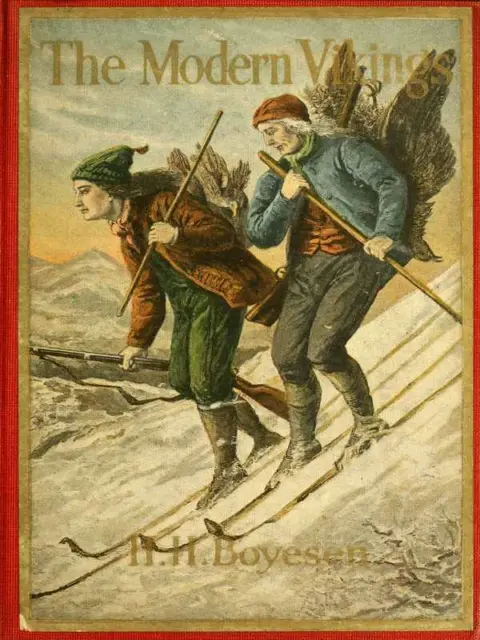
The Modern Vikings: Stories of Life and Sport in the Norseland
Hjalmar Hjorth Boyesen
THE CLASSIC COLLECTION · 1877
"Tales from Two Hemispheres" by Hjalmar Hjorth Boysen is a collection of stories written in the late 19th century. The opening tale introduces Halfdan Bjerk, a young Norseman who arrives in America, filled with idealistic dreams of freedom and success but soon finds himself facing the stark realities of immigrant life and societal indifference. At the start of the book, we meet Halfdan as he disembarks in New York, excited yet terrified of his new life. As he navigates the bustling streets, he grapples with feelings of isolation and dislocation, compounded by a series of misfortunes, including losing his belongings and being fined as a vagrant. Through his encounters—both with the charming innocence of a young girl named Clara and the dismissive attitudes of adults—Boysen paints a poignant portrait of an immigrant's struggle to find his place in a vibrant yet unforgiving society. The opening effectively sets the stage for Halfdan's journey, highlighting themes of belonging, identity, and the often harsh contrast between dreams and reality.
Introduction adapted from the source catalogue; source summaries may be automatically generated.
Free to read · English · 57,118 words · No account needed
MAKE TIME FOR A GOOD BOOK
On by default. Untick to stop anonymous reading totals. Each page counts after 10 seconds in view. How this works.
Anonymous counting is on unless you have switched it off.
It was late one summer night; the young maiden was sitting on the brink of the ravine, pondering on the old legend and peering down into the deep below. It was not the first time she had found her way hither, where but seldom a human foot had dared to tread. To her every alder and bramble-bush, that clothed the naked wall of the rock, were as familiar as were the knots and veins in the ceiling of the chamber where from her childhood she had slept; and as she sat there on the brink of the precipice, the late summer sun threw its red lustre upon her and upon the fogs that came drifting up from the deep. With her eyes she followed the drifting masses of fog, and wondered, as they rose higher and higher, when they would reach her; in her fancy she saw herself dancing over the wide expanse of heaven, clad in the sun-gilded evening fogs; and Saint Olaf, the great and holy king, came riding to meet her, mounted on a flaming steed made of the glory of a thousand sunsets; then Saint Olaf took her hand and lifted her up, and she sat with him on the flaming steed: but the fog lingered in the deep below, and as it rose it spread like a thin, half-invisible gauze over the forests and the fields, and at last vanished into the infinite space. But hark! a huge stone rolls down over the mountain-side, then another, and another; the noise grows, the birches down there in the gorge tremble and shake. Aasa leaned out over the brink of the ravine, and, as far as she could distinguish anything from her dizzying height, thought she saw something gray creeping slowly up the neck-breaking mountain path; she watched it for a while, but as it seemed to advance no farther she again took refuge in her reveries. An hour might have passed, or perhaps more, when suddenly she heard a noise only a few feet distant, and, again stooping out over the brink, saw the figure of a man struggling desperately to climb the last great ledge of the rock. With both his hands he clung to a little birch-tree which stretched its slender arms down over the black wall, but with every moment that passed seemed less likely to accomplish the feat. The girl for a while stood watching him with unfeigned curiosity, then, suddenly reminding herself that the situation to him must be a dangerous one, seized hold of a tree that grew near the brink, and leaned out over the rock to give him her assistance. He eagerly grasped her extended hand, and with a vigorous pull she flung him up on the grassy level, where he remained lying for a minute or two, apparently utterly unable to account for his sudden ascent, and gazing around him with a half-frightened, half-bewildered look. Aasa, to whom his appearance was no less strange than his demeanor, unluckily hit upon the idea that perhaps her rather violent treatment had momentarily stunned him, and when, as answer to her sympathizing question if he was hurt, the stranger abruptly rose to his feet and towered up before her to the formidable height of six feet four or five, she could no longer master her mirth, but burst out into a most vehement fit of laughter. He stood calm and silent, and looked at her with a timid but strangely bitter smile. He was so very different from any man she had ever seen before; therefore she laughed, not necessarily because he amused her, but because his whole person was a surprise to her; and there he stood, tall and gaunt and timid, and said not a word, only gazed and gazed. His dress was not the national costume of the valley, neither was it like anything that Aasa had ever known. On his head he wore a cap that hung all on one side, and was decorated with a long, heavy silk tassel. A threadbare coat, which seemed to be made expressly not to fit him, hung loosely on his sloping shoulders, and a pair of gray pantaloons, which were narrow where they ought to have been wide, and wide where it was their duty to be narrow, extended their service to a little more than the upper half of the limb, and, by a kind of compromise with the tops of the boots, managed to protect also the lower half. His features were delicate, and would have been called handsome had they belonged to a proportionately delicate body; in his eyes hovered a dreamy vagueness which seemed to come and vanish, and to flit from one feature to another, suggesting the idea of remoteness, and a feeling of hopeless strangeness to the world and all its concerns.
Your reading position is saved on this browser. Take it to another device with a library code. Reading pages adapt to text, rather than matching a printed edition.
Hjalmar Hjorth Boyesen
Hjalmar Hjorth Boyesen
Hjalmar Hjorth Boyesen
Hjalmar Hjorth Boyesen
BEHIND THE BOOK
This eBook is for the use of anyone anywhere in the United States and most other parts of the world at no cost and with almost no restrictions whatsoever. You may copy it, give it away or re-use it under the terms of the Project Gutenberg License included with this eBook or online at www.gutenberg.org. If you are not located in the United States, you will have to check the laws of the country where you are located before using this eBook. Read the source licence.
The original source file, including credits and licence, is retained by this library. Request an original-format copy at no charge. Please include the book title and Project Gutenberg identifier #299.
KEEP YOUR CURIOSITY GOING
Coulson Kernahan

Maurice Baring
Frances Wright
Cécile Tormay

Frederic Jesup Stimson

W. H. P. (William Henry Pope) Jarvis