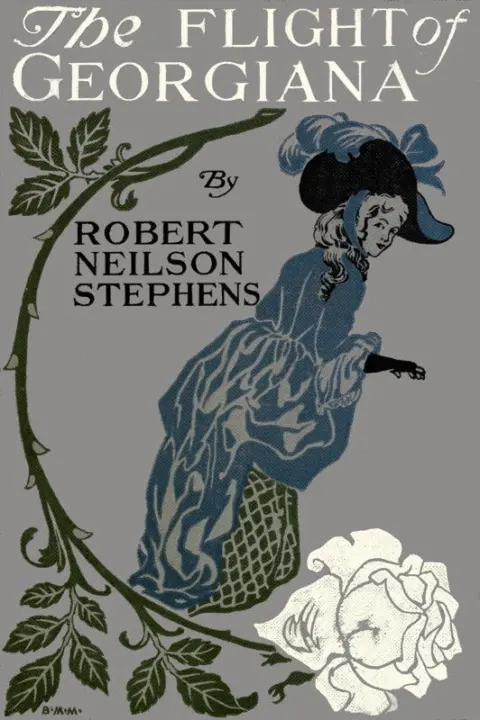
The Flight of Georgiana: A Story of Love and Peril in England in 1746
Robert Neilson Stephens
THE CLASSIC COLLECTION · 1908
"Tales from Bohemia" by Robert Neilson Stephens is a collection of short stories written in the late 19th century. The narratives explore the lives, struggles, and friendships of individuals within a close-knit community of aspiring writers and artists, primarily centered around Stephens himself and those he encountered in the literary world. This tapestry of stories captures the spirit of bohemian life, delving into themes of love, ambition, and the hardships of the creative process. The opening portion introduces readers to a pivotal friendship formed between the narrator and Robert Neilson Stephens, a young private secretary with literary aspirations. Their camaraderie develops against the backdrop of a newspaper office where they share their ambitions and thoughts on the literary scene of their time. As they engage in discussions about writers and artistic influences, the narrative hints at the tales to come, drawing on their experiences and the colorful personalities that populate their world. This engaging introduction sets the stage for a journey filled with humor, nostalgia, and the essence of artistic endeavor.
Introduction adapted from the source catalogue; source summaries may be automatically generated.
Free to read · English · 54,865 words · No account needed
MAKE TIME FOR A GOOD BOOK
On by default. Untick to stop anonymous reading totals. Each page counts after 10 seconds in view. How this works.
Anonymous counting is on unless you have switched it off.
I descended the stairs softly, traversed the hallway, and, looking through the open door, beheld the professor at the piano.
The curtains of a window were drawn aside, and the moonlight swept grandly in. It passed over a part of the piano, bathed the professor's head in soft radiance, fell upon the carpet, and touched the base of the opposite wall. Upon a sofa, half in light, half in shadow, reclined Schaaf, who had fallen asleep listening while the professor played.
The professor's face was uplifted and calm. Rapture and pain--so often mutual companions--were depicted upon it. I hesitated to break the spell which he had woven for himself. After watching for some seconds, however, I began quietly:
“Professor.”
The tune broke off with a jangling discord, and the player turned to face me, smiling pleasantly.
“Pardon me,” I went on, advancing into the room and standing in the moonshine that he might recognize me, “but I was attracted by the air you were playing. They tell me that it isn't Millocker's, but was composed by your new conductor at the ----”
The professor answered with a laugh:
“Ja! He got de honour of it. Honour is sheap. He buy dat. It doesn't
matter.”
“Ah, then it isn't his own. And he bought the tune? From whom?”
“Me.”
“You?”
“Ja. And I have many oder to gif sheap, too.”
“But where did you get it?”
“I make it.”
“When?”
“Long 'go. I forget. I have make so many. Dey go away from my mindt an' come again back long time after.”
“Professor, what would you give me to tell you where and when you
composed that tune?”
He looked at me with a slightly bewildered expression. It was with an effort that I continued, as I looked straight into his eyes:
“I will hazard a guess. Could it have been in Paris--one day twelve
years ago--”
“I neffer be in Paris,” he interrupted, with a start which shocked and convinced me, slight evidence though it may seem. So I spoke on:
“What, never? Not even just that night--that 17th of February? Try to recall it, Heinrich Spellerberg. You remember she came in late, and--who would think that those soft white fingers had been strong enough?”
“Hush, my friendt! I not touch her! She kill herself--she try to hang and she shoke her neck. No, no, to you I vill not lie! You speak all true! Mein Gott! Vat vill you do?”
The man was on his knees. I thought of the circumstances, the persons concerned, the high-strung, sensitive lover of music, the coarse, derisive, perhaps faithless woman, and I replied quickly:
Your reading position is saved on this browser. Take it to another device with a library code. Reading pages adapt to text, rather than matching a printed edition.
Robert Neilson Stephens
Robert Neilson Stephens
Robert Neilson Stephens
Robert Neilson Stephens
BEHIND THE BOOK
This eBook is for the use of anyone anywhere in the United States and most other parts of the world at no cost and with almost no restrictions whatsoever. You may copy it, give it away or re-use it under the terms of the Project Gutenberg License included with this eBook or online at www.gutenberg.org. If you are not located in the United States, you will have to check the laws of the country where you are located before using this eBook. Read the source licence.
The original source file, including credits and licence, is retained by this library. Request an original-format copy at no charge. Please include the book title and Project Gutenberg identifier #8869.
KEEP YOUR CURIOSITY GOING
Coulson Kernahan

Maurice Baring
Frances Wright
Cécile Tormay

Frederic Jesup Stimson

W. H. P. (William Henry Pope) Jarvis