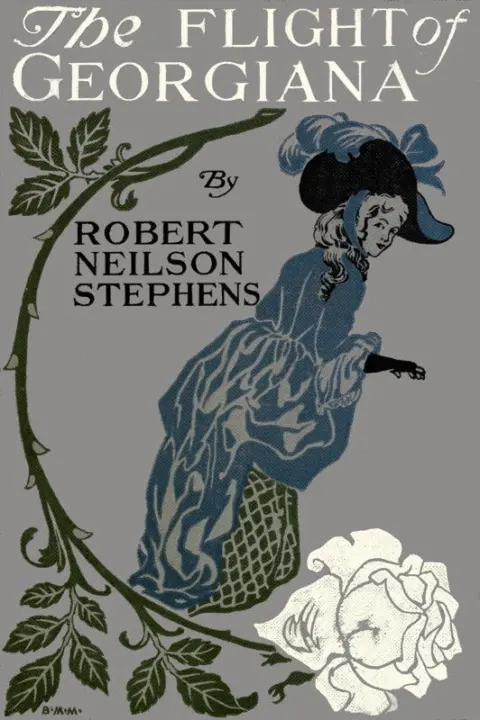
The Flight of Georgiana: A Story of Love and Peril in England in 1746
Robert Neilson Stephens
THE CLASSIC COLLECTION · 1908
"Tales from Bohemia" by Robert Neilson Stephens is a collection of short stories written in the late 19th century. The narratives explore the lives, struggles, and friendships of individuals within a close-knit community of aspiring writers and artists, primarily centered around Stephens himself and those he encountered in the literary world. This tapestry of stories captures the spirit of bohemian life, delving into themes of love, ambition, and the hardships of the creative process. The opening portion introduces readers to a pivotal friendship formed between the narrator and Robert Neilson Stephens, a young private secretary with literary aspirations. Their camaraderie develops against the backdrop of a newspaper office where they share their ambitions and thoughts on the literary scene of their time. As they engage in discussions about writers and artistic influences, the narrative hints at the tales to come, drawing on their experiences and the colorful personalities that populate their world. This engaging introduction sets the stage for a journey filled with humor, nostalgia, and the essence of artistic endeavor.
Introduction adapted from the source catalogue; source summaries may be automatically generated.
Free to read · English · 54,865 words · No account needed
MAKE TIME FOR A GOOD BOOK
On by default. Untick to stop anonymous reading totals. Each page counts after 10 seconds in view. How this works.
Anonymous counting is on unless you have switched it off.
One night Newgag drank two glasses of beer in rapid succession and looked at me with a touching countenance.
“Old boy,” he said, in his homely drawl, “I'm discouraged! I begin to think I'm not in it!”
“Why, what's wrong?”
“Well, I've dropped to the fact that, after all these years in the business, I can't make them laugh.”
I was just about to say, “So you've just awakened to that?” but pity and politeness deterred me. Every one else had known it, all these years. Newgag, to be sure, should naturally have been, as he was, the last to discover it.
Newgag thus went one step further than any comedian I have ever known. Having detected his inability to amuse audiences, he confessed it.
People who know actors and read this will already have said that it is a fiction, and that Newgag's admission is false to life. Not so; I am writing not about comedians in general, but about Newgag.
That he had come to so exceptional a concession marked the depth of his despair. I tried to cheer him.
“Nonsense, my boy! They give you bad parts. Go out of comic opera. Try
tragedy.”
I had spoken innocently and sincerely, but Newgag thought I was jesting. Instead of his usual attempt at lofty callousness, however, he smiled that dismal, marionette-like smile of his. That gave me an idea, of which I said nothing at the time.
Several months afterward, a manager, who is a friend of mine, was suddenly plunged in distress because of the serious illness of an actor who was to fill a part in a new American comedy that the manager was to produce on the next night.
“What on earth shall I do?” he asked.
“Play the part yourself, as Hoyt does in such an emergency--or get
Newgag.”
“Who's Newgag?”
“He's a friend of mine, out of a position. I met him to-day very much
frayed.”
“Bring him to me.”
Newgag was overwhelmed when I told him of the opportunity.
“I never acted in straight comedy,” he said. “I can't do it. I might as well try to play Juliet.”
“He wants you only to speak the lines, that's all. You're a quick study,
you know. Come on!”
I had almost to drag the man to the manager. He allowed himself, in a semistupefied condition, to be engaged. He took the part, sat up all night in his boarding-house and learned it, went to rehearsal almost letter-perfect in the morning, and nervously prepared to face the ordeal of the evening.
At six o'clock, he wished to go to the manager and give up the part.
Your reading position is saved on this browser. Take it to another device with a library code. Reading pages adapt to text, rather than matching a printed edition.
Robert Neilson Stephens
Robert Neilson Stephens
Robert Neilson Stephens
Robert Neilson Stephens
BEHIND THE BOOK
This eBook is for the use of anyone anywhere in the United States and most other parts of the world at no cost and with almost no restrictions whatsoever. You may copy it, give it away or re-use it under the terms of the Project Gutenberg License included with this eBook or online at www.gutenberg.org. If you are not located in the United States, you will have to check the laws of the country where you are located before using this eBook. Read the source licence.
The original source file, including credits and licence, is retained by this library. Request an original-format copy at no charge. Please include the book title and Project Gutenberg identifier #8869.
KEEP YOUR CURIOSITY GOING
Coulson Kernahan

Maurice Baring
Frances Wright
Cécile Tormay

Frederic Jesup Stimson

W. H. P. (William Henry Pope) Jarvis