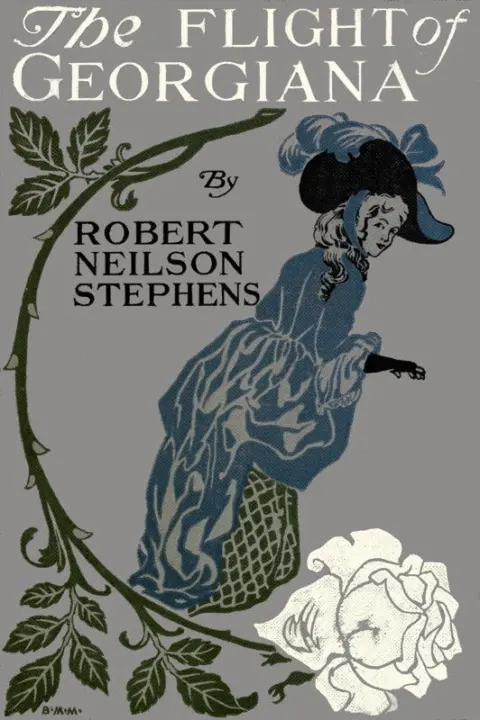
The Flight of Georgiana: A Story of Love and Peril in England in 1746
Robert Neilson Stephens
THE CLASSIC COLLECTION · 1908
"Tales from Bohemia" by Robert Neilson Stephens is a collection of short stories written in the late 19th century. The narratives explore the lives, struggles, and friendships of individuals within a close-knit community of aspiring writers and artists, primarily centered around Stephens himself and those he encountered in the literary world. This tapestry of stories captures the spirit of bohemian life, delving into themes of love, ambition, and the hardships of the creative process. The opening portion introduces readers to a pivotal friendship formed between the narrator and Robert Neilson Stephens, a young private secretary with literary aspirations. Their camaraderie develops against the backdrop of a newspaper office where they share their ambitions and thoughts on the literary scene of their time. As they engage in discussions about writers and artistic influences, the narrative hints at the tales to come, drawing on their experiences and the colorful personalities that populate their world. This engaging introduction sets the stage for a journey filled with humor, nostalgia, and the essence of artistic endeavor.
Introduction adapted from the source catalogue; source summaries may be automatically generated.
Free to read · English · 54,865 words · No account needed
MAKE TIME FOR A GOOD BOOK
On by default. Untick to stop anonymous reading totals. Each page counts after 10 seconds in view. How this works.
Anonymous counting is on unless you have switched it off.
“How d'ye do?” said the “Professor.” “Glad to see you here. You turn up
every year.”
“You're still given to rhyming,” commented Morrow.
“Yes, I have a rhyme for every time, in pleasure or sorrow. Is this Mrs.
Morrow?”
“No.”
“You ought to be sorry she isn't,” remarked the “Professor,” taking his
departure.
Morrow and Clara walked on in silence. At last he said somewhat
nervously:
“Everybody thinks we're married. Why shouldn't we be?”
She answered softly, with downcast eyes:
“I would be willing if I were sure of one thing.”
“What's that?”
“That you have never loved any other woman. Have you?”
“How can you ask? Believe me, you are the only girl I have ever loved.”
That evening, after dinner, Morrow and Clara, the newly affianced, about starting from the hotel to the boardwalk, were at the top of the hotel steps when a man appeared at the bottom.
Morrow uttered a cry of recognition.
“Why, Haddon, old boy, I'm glad to see you. Let me introduce you to my
wife that is to be.”
Haddon stood still and stared. Clara, too, remained motionless. After a moment, Haddon said very quietly:
“You're mistaken. Let me introduce you to my wife that is.”
Morrow looked at Clara. She turned her gray eyes fearlessly on Haddon.
“You, too, are mistaken,” she said. “I had a husband before you married me. He's my husband still. He's doing a song and dance act in a variety theatre in Chicago. I'm sorry about all this, Mr. Morrow. I really like you. Good-bye.”
She ran back into the hotel and arranged to make her departure on an
early train next morning.
Haddon turned toward the boardwalk, and Morrow, quite dazed, involuntarily followed him. After a period of silence, Morrow said:
“This is astonishing. A bigamist, and a would-be trigamist. She came here the night before you left. How did you find out she was here?”
“I read it in the Atlantic City letter of The Philadelphia Press that one of the Comic Opera singers daily seen on the boardwalk is Miss Clara Hunt, who is known to theatre-goers by her stage name, Lulu Ray. These newspaper correspondents know some of the obscurest people. If I had told you her real name, you would have known who she was in time to have avoided being taken in by her.”
“Her having another husband lets you out.”
“Yes. I'm glad and sorry, for damn it, I was fond of the girl. Excuse me awhile, old fellow. I want to go on the pier and think awhile.”
Your reading position is saved on this browser. Take it to another device with a library code. Reading pages adapt to text, rather than matching a printed edition.
Robert Neilson Stephens
Robert Neilson Stephens
Robert Neilson Stephens
Robert Neilson Stephens
BEHIND THE BOOK
This eBook is for the use of anyone anywhere in the United States and most other parts of the world at no cost and with almost no restrictions whatsoever. You may copy it, give it away or re-use it under the terms of the Project Gutenberg License included with this eBook or online at www.gutenberg.org. If you are not located in the United States, you will have to check the laws of the country where you are located before using this eBook. Read the source licence.
The original source file, including credits and licence, is retained by this library. Request an original-format copy at no charge. Please include the book title and Project Gutenberg identifier #8869.
KEEP YOUR CURIOSITY GOING
Coulson Kernahan

Maurice Baring
Frances Wright
Cécile Tormay

Frederic Jesup Stimson

W. H. P. (William Henry Pope) Jarvis