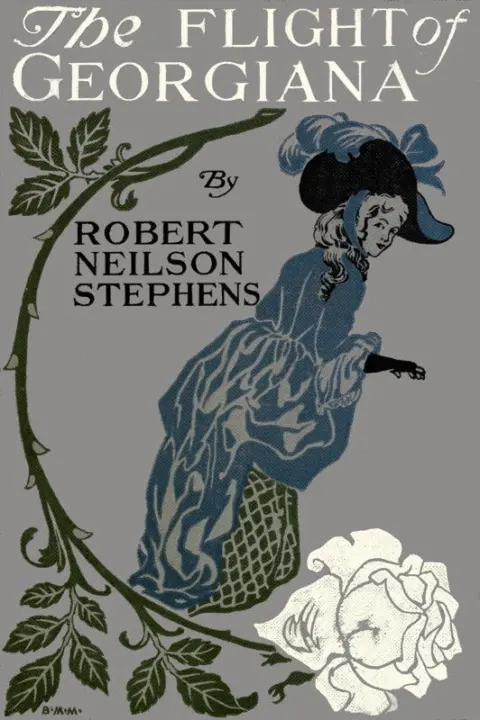
The Flight of Georgiana: A Story of Love and Peril in England in 1746
Robert Neilson Stephens
THE CLASSIC COLLECTION · 1908
"Tales from Bohemia" by Robert Neilson Stephens is a collection of short stories written in the late 19th century. The narratives explore the lives, struggles, and friendships of individuals within a close-knit community of aspiring writers and artists, primarily centered around Stephens himself and those he encountered in the literary world. This tapestry of stories captures the spirit of bohemian life, delving into themes of love, ambition, and the hardships of the creative process. The opening portion introduces readers to a pivotal friendship formed between the narrator and Robert Neilson Stephens, a young private secretary with literary aspirations. Their camaraderie develops against the backdrop of a newspaper office where they share their ambitions and thoughts on the literary scene of their time. As they engage in discussions about writers and artistic influences, the narrative hints at the tales to come, drawing on their experiences and the colorful personalities that populate their world. This engaging introduction sets the stage for a journey filled with humor, nostalgia, and the essence of artistic endeavor.
Introduction adapted from the source catalogue; source summaries may be automatically generated.
Free to read · English · 54,865 words · No account needed
MAKE TIME FOR A GOOD BOOK
On by default. Untick to stop anonymous reading totals. Each page counts after 10 seconds in view. How this works.
Anonymous counting is on unless you have switched it off.
“Hello, Pop!” said the division superintendent, upon whose hand time was hanging heavily. “What have you there?”
“Doan' know, Mistah Monroe. Doan' know, sah. Looks like jes' a chunk o'
mud.”
He held out the clod to Mr. Monroe.
The spectacle of the division superintendent talking to the old negro attracted a group of lazy fellows,--the driver of an express wagon, the man who hauls the mail to the post-office, a boy who sold fruit to passengers on the train, two porters, with tin signs upon their hats, who solicited patronage from the hotels.
“Why, Pop,” said the superintendent, winking to the expressman, “this lump looks as though it contained gold.”
“Yes,” put in the expressman, “that's how gold comes in a mine. I've often handled it. That's the stuff, sure.”
The fruit-selling boy and the mail-man grinned. Pop Thornberry opened wide his mouth and eyes and softly repeated the word:
“Goal!”
“I'd be careful of it,” advised Mr. Monroe, handing the clod back to the
negro.
Pop took it with a trembling hand and looked at it. Presently he asked:
“W'at'll you give me foh dat air goal, Mistah Monroe.”
“Oh, a piece like that would be no use to me. It has to be washed and it wouldn't be worth while putting just one piece through the whole process of cleaning. Now. If you have a lot of it, we might go into partnership in the gold business.”
Before the old man could answer to this pleasantry a whistle was heard up the track, and Pop was forgotten in the excitement attending the arrival of the train.
Dislodged from the baggage-truck, the old man looked around for Mr. Monroe, but the superintendent had disappeared. Pop did not seek to carry any satchels that day. His mind was full of other matters. He went behind the station and sat down beside the river.
“Goal!” That meant proper tombstones for the graves of his wife and children, a new pulpit for the African Methodist Church, equal to that of the African Baptist Church, future ease for his somewhat weary legs and arms and back.
The next afternoon the division superintendent found himself awaited at his office door by Pop Thornberry, who was very dusty and who carried a basket heavy with clods of clay and mica. He had been out to the arid field that morning.
“H-sh!” whispered Pop. “Doan' say a word, Mistah Monroe! Hyah's a lot o' dem air goal lumps, and I know weah dey's bushels moah,--plenty 'nuff to go into pahtnehship on.”
The superintendent, looked bewildered, then amused, then ashamed. Embarrassed for a reply, he finally said:
Your reading position is saved on this browser. Take it to another device with a library code. Reading pages adapt to text, rather than matching a printed edition.
Robert Neilson Stephens
Robert Neilson Stephens
Robert Neilson Stephens
Robert Neilson Stephens
BEHIND THE BOOK
This eBook is for the use of anyone anywhere in the United States and most other parts of the world at no cost and with almost no restrictions whatsoever. You may copy it, give it away or re-use it under the terms of the Project Gutenberg License included with this eBook or online at www.gutenberg.org. If you are not located in the United States, you will have to check the laws of the country where you are located before using this eBook. Read the source licence.
The original source file, including credits and licence, is retained by this library. Request an original-format copy at no charge. Please include the book title and Project Gutenberg identifier #8869.
KEEP YOUR CURIOSITY GOING
Coulson Kernahan

Maurice Baring
Frances Wright
Cécile Tormay

Frederic Jesup Stimson

W. H. P. (William Henry Pope) Jarvis