THE CLASSIC COLLECTION✦My diaries, being a personal narrative of events 1888-1914, Part 2 (1900-1914)CLASSIC FREE BOOKS
My diaries, being a personal narrative of events 1888-1914, Part 2 (1900-1914)
Wilfrid Scawen Blunt
THE CLASSIC COLLECTION · 1906
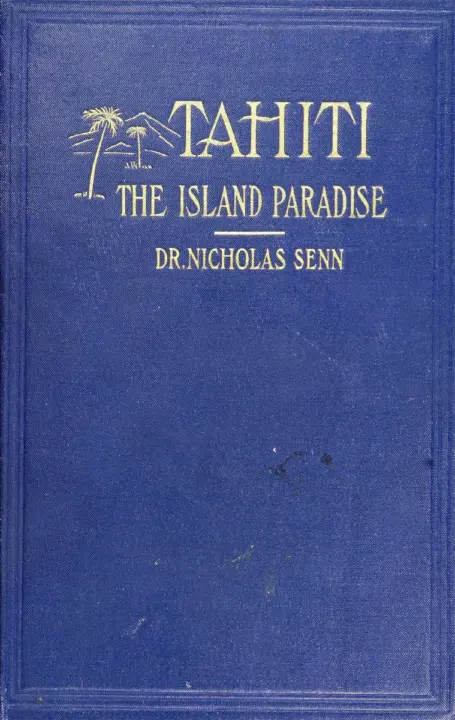
"Tahiti, the Island Paradise" by Nicholas Senn is a travelogue written in the early 20th century. This descriptive work showcases the natural beauty, culture, and history of Tahiti, a remote island in the South Pacific, emphasizing its idyllic landscape and the tranquil lifestyle of its inhabitants. Senn captures the charm and allure of Tahiti, depicting it as a paradise untouched by the burdens of modern life. At the start of the book, the author introduces readers to the breathtaking beauty of Tahiti, describing its lush vegetation, tranquil climate, and friendly natives, who live carefree lives provided for by nature. He reflects on the island's cultural richness and its historical significance while hinting that visitors can enjoy restorative vacations amidst stunning scenery. The opening sets the stage for a journey into the depths of Tahitian life, inviting readers to explore the island's wonders through the author's keen observations and vivid descriptions.
Introduction adapted from the source catalogue; source summaries may be automatically generated.
Free to read · English · 55,084 words · No account needed
MAKE TIME FOR A GOOD BOOK
On by default. Untick to stop anonymous reading totals. Each page counts after 10 seconds in view. How this works.
Anonymous counting is on unless you have switched it off.
It is interesting to know how these minute coral polyps manage their work of island-building, or, rather, island-preservation. Coral formation is a calcareous secretion or deposit of many kinds of zoöphytes of the class Anthozoa, which assumes infinite and often beautiful forms, according to the different laws which govern the manner of germination of the polyps of various species. The coral-producing zoöphytes are compound animals, which multiply in the very swiftest manner, by germination or budding, young polyp buds springing from the original polyp, sometimes indifferently from any part of its surface, sometimes only from its upper circumference or from its base, and not separating from it, but remaining in the same spot when the original parent or polyp is dead, and producing buds in their turn. The reproductive capacity of these polyps is marvelous and explains the greatness of their work in building up whole islands and the countless submerged reefs so much dreaded by the mariners of the South Seas. The calcareous deposition begins when the zoöphytes are still simple polyps, owing their existence to oviparous reproduction, adhering to a rock or other substance, to which the calcareous material becomes attached, and on which the coral is built up, the hard deposits of past generations forming the base to which those of the progeny are attracted. The coral formation takes place with astonishing rapidity; under favorable circumstances, masses of coral have been found to increase in height several feet in a few months, and a channel cut in a reef surrounding a coral island, to permit the passage of a schooner, has been blocked with coral in ten years. Coral formations have been found immediately attached to the land, whilst in many other cases the reef surrounds the island, the intervening space, of irregular, but nowhere of great width, forming a lagoon or channel of deep water, protected by the reef from wind and waves. According to Darwin, this kind of reef is formed from a reef of the former merely fringing kind, by the gradual subsidence of the rocky basis, carrying down the fringe of coral to a greater depth; whilst the greatest activity of life is displayed by polyps of the kind most productive of large masses of coral in the outer parts which are most exposed to the waves. In this manner he also accounts for the formation of true coral islands, or atolls, which consist merely of a narrow reef of coral surrounding a central lagoon, and very often of a reef, perhaps half a mile in breadth, clothed with luxuriant vegetation and the never-absent cocoa-palms, bordered by a narrow beach of snowy whiteness, and forming an arc, the convexity of which is toward the prevailing wind, whilst a straight line of reef not generally rising above the reach of the tide, forms the chord of the arc. The reef is generally intersected by a narrow channel into the enclosed lagoon, the waters of which are still and beautifully transparent, teeming with the greatest variety of fish. Its surface is enlivened by water-fowl, and the depth of water close to the precipitous sides of the reef is almost always very great. The channels are kept open by the flux and reflux of the tide, the current and waves of which are often so swift and high as to become a menace to schooners attempting entrance into the lagoon. On the beach, soil most conducive to the growth of cocoanut-palms is formed by accumulation of sand, shells, fragments of coral, seaweeds, decayed leaves, etc. The giant cocoanuts planted in this soil either by the hand of man or by the waves washing them ashore, germinate quickly, and in a few years the narrow circular strip of land enclosing the lagoon is fringed with colonnades of tall fruit-bearing palms. These islands rise nowhere more than a few feet above the level of the sea. Sometimes the upheaval of coral formation by volcanic action results in the making of a real island, in which event the lagoon disappears. Islands with such an origin sometimes rise to a height of five hundred feet and often exhibit precipitous cliffs and contain extensive caves. I had read a description of the Paumotu atoll islands by Stevenson, and consequently I was much interested in the little group of atolls we passed before coming into full view of Tahiti. As these islands, like all true atolls, are only a few feet above the level of the sea, they can not be seen from the sea at anything like a great distance. When they were pointed out to us by an officer of the steamer, we could see no land; they appeared like oases in the desert, green patches in the ocean, due to the cocoa-palms which guarded their shores. As we came nearer, we could make out the rim of land and the snow-white coral beach. The smallest of these atoll islands are not inhabited, but regular visits are made to them in a small schooner or native double canoe to harvest and bring to market the never-failing crops of cocoanuts.
Your reading position is saved on this browser. Take it to another device with a library code. Reading pages adapt to text, rather than matching a printed edition.
BEHIND THE BOOK
This eBook is for the use of anyone anywhere in the United States and most other parts of the world at no cost and with almost no restrictions whatsoever. You may copy it, give it away or re-use it under the terms of the Project Gutenberg License included with this eBook or online at www.gutenberg.org. If you are not located in the United States, you will have to check the laws of the country where you are located before using this eBook. Read the source licence.
The original source file, including credits and licence, is retained by this library. Request an original-format copy at no charge. Please include the book title and Project Gutenberg identifier #69945.
KEEP YOUR CURIOSITY GOING
Wilfrid Scawen Blunt
Wilfrid Scawen Blunt

E. W. (Edgar Watson) Howe
Francis Greenleaf Allinson & Anne C. E. (Anne Crosby Emery) Allinson
Cyrenus Cole

John Martineau