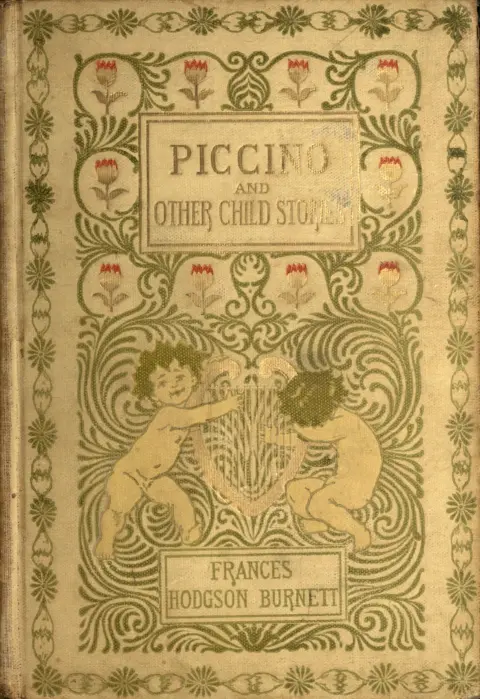
Piccino, and other child stories
Frances Hodgson Burnett
THE CLASSIC COLLECTION · 1913
"T. Tembarom" by Frances Hodgson Burnett is a novel written in the late 19th century. The story centers around a young boy named Temple Barom, affectionately nicknamed Tembarom, who faces adversity and poverty after the death of his parents. As he navigates life in Brooklyn, he demonstrates resilience, resourcefulness, and an innate optimism that gradually leads him towards ambition and opportunity in the bustling city. The opening of the novel introduces Tembarom's humble beginnings as a ten-year-old boy who is suddenly thrown into the harsh realities of life after losing his mother. Left to fend for himself, he tries a variety of odd jobs, including selling newspapers and running errands for the neighborhood. Through his spirited nature and ability to make friends, he finds small support systems among his peers and the adults in his life. As he grows older, Tembarom's journey continues as he works his way up from a newsboy to a position in a newspaper office, driven by his desire to succeed and his plainspoken charm, which draws the affection of those around him, including a young woman named Little Ann Hutchinson, who becomes an important part of his life and aspirations.
Introduction adapted from the source catalogue; source summaries may be automatically generated.
Free to read · English · 180,482 words · No account needed
MAKE TIME FOR A GOOD BOOK
On by default. Untick to stop anonymous reading totals. Each page counts after 10 seconds in view. How this works.
Anonymous counting is on unless you have switched it off.
The chief street of the village of Temple Barholm wandered almost within hailing distance of the great entrance to the park. The gates were supported by massive pillars, on which crouched huge stone griffins. Tembarom felt that they stared savagely over his head as he was driven toward them as for inspection, and in disdainful silence allowed to pass between them as they stood on guard, apparently with the haughtiest mental reservations.
The park through which the long avenue rolled concealed its beauty to the unaccustomed eye, showing only more bare trees and sodden stretches of brown grass. The house itself, as it loomed up out of the thickening rain-mist, appalled Tembarom by its size and gloomily gray massiveness. Before it was spread a broad terrace of stone, guarded by more griffins of even more disdainful aspect than those watching over the gates. The stone noses held themselves rigidly in the air as the reporter of the up-town society page passed with Mr. Palford up a flight of steps broad enough to make him feel as though he were going to church. Footmen with powdered heads received him at the carriage door, seemed to assist him to move, to put one foot before the other for him, to stand in rows as though they were a military guard ready to take him into custody.
Then he was inside, standing in an enormous hall filled with furnishings such as he had never seen or heard of before. Carved oak, suits of armor, stone urns, portraits, another flight of church steps mounting upward to surrounding galleries, stained-glass windows, tigers' and lions' heads, horns of tremendous size, strange and beautiful weapons, suggested to him that the dream he had been living in for weeks had never before been so much a dream. He had walked about as in a vision, but among familiar surroundings. Mrs. Bowse's boarders and his hall bedroom had helped him to retain some hold over actual existence. But here the reverently saluting villagers staring at him through windows as though he were General Grant, the huge, stone entrance, the drive of what seemed to be ten miles through the park, the gloomy mass of architecture looming up, the regiment of liveried men-servants, with respectfully lowered but excitedly curious eyes, the dark and solemn richness inclosing and claiming him--all this created an atmosphere wholly unreal. As he had not known books, its parallel had not been suggested to him by literature. He had literally not heard that such things existed. Selling newspapers and giving every moment to the struggle for life or living, one did not come within the range of splendors. He had indeed awakened in that other world of which he had spoken. And though he had heard that there was another world, he had had neither time nor opportunity to make mental pictures of it. His life so far had expressed itself in another language of figures. The fact that he had in his veins the blood of the Norman lords and Saxon kings may or may not have had something to do with the fact that he was not abashed, but bewildered. The same factor may or may not have aided him to preserve a certain stoic, outward composure. Who knows what remote influences express themselves in common acts of modern common life? As Cassivellaunus observed his surroundings as he followed in captive chains his conqueror's triumphal car through the streets of Rome, so the keen-eyed product of New York pavement life “took in” all about him. Existence had forced upon him the habit of sharp observance. The fundamental working law of things had expressed itself in the simple colloquialism, “Keep your eye skinned, and don't give yourself away.” In what phrases the parallel of this concise advice formulated itself in 55 B.C. no classic has yet exactly informed us, but doubtless something like it was said in ancient Rome. Tembarom did not give himself away, and he took rapid, if uncertain, inventory of people and things. He remarked, for instance, that Palford's manner of speaking to a servant was totally different from the manner he used in addressing himself. It was courteous, but remote, as though he spoke across an accepted chasm to beings of another race. There was no hint of incivility in it, but also no hint of any possibility that it could occur to the person addressed to hesitate or resent. It was a subtle thing, and Tembarom wondered how he did it.
Your reading position is saved on this browser. Take it to another device with a library code. Reading pages adapt to text, rather than matching a printed edition.
Frances Hodgson Burnett
Frances Hodgson Burnett

Frances Hodgson Burnett
Frances Hodgson Burnett
BEHIND THE BOOK
This eBook is for the use of anyone anywhere in the United States and most other parts of the world at no cost and with almost no restrictions whatsoever. You may copy it, give it away or re-use it under the terms of the Project Gutenberg License included with this eBook or online at www.gutenberg.org. If you are not located in the United States, you will have to check the laws of the country where you are located before using this eBook. Read the source licence.
The original source file, including credits and licence, is retained by this library. Request an original-format copy at no charge. Please include the book title and Project Gutenberg identifier #2514.
KEEP YOUR CURIOSITY GOING
Coulson Kernahan

Maurice Baring
Frances Wright
Cécile Tormay

Frederic Jesup Stimson

W. H. P. (William Henry Pope) Jarvis