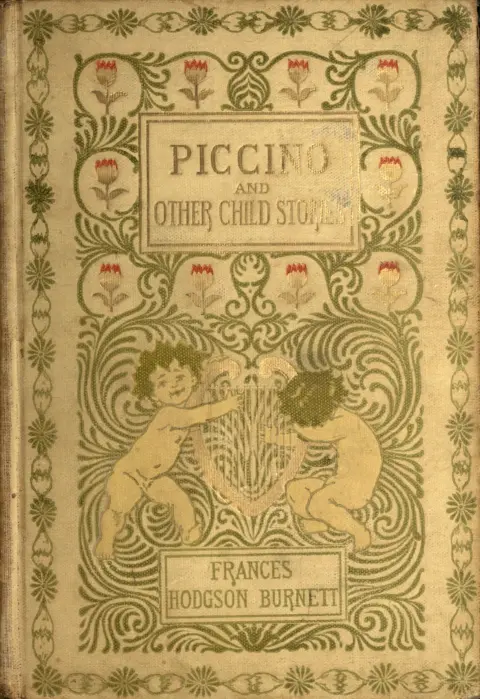
Piccino, and other child stories
Frances Hodgson Burnett
THE CLASSIC COLLECTION · 1913
"T. Tembarom" by Frances Hodgson Burnett is a novel written in the late 19th century. The story centers around a young boy named Temple Barom, affectionately nicknamed Tembarom, who faces adversity and poverty after the death of his parents. As he navigates life in Brooklyn, he demonstrates resilience, resourcefulness, and an innate optimism that gradually leads him towards ambition and opportunity in the bustling city. The opening of the novel introduces Tembarom's humble beginnings as a ten-year-old boy who is suddenly thrown into the harsh realities of life after losing his mother. Left to fend for himself, he tries a variety of odd jobs, including selling newspapers and running errands for the neighborhood. Through his spirited nature and ability to make friends, he finds small support systems among his peers and the adults in his life. As he grows older, Tembarom's journey continues as he works his way up from a newsboy to a position in a newspaper office, driven by his desire to succeed and his plainspoken charm, which draws the affection of those around him, including a young woman named Little Ann Hutchinson, who becomes an important part of his life and aspirations.
Introduction adapted from the source catalogue; source summaries may be automatically generated.
Free to read · English · 180,482 words · No account needed
MAKE TIME FOR A GOOD BOOK
On by default. Untick to stop anonymous reading totals. Each page counts after 10 seconds in view. How this works.
Anonymous counting is on unless you have switched it off.
“Well, you haven't,” she admitted, though quite without disparagement, merely with slight reservation. “But you've got one like your own. And it's a good head--when you try to think steady. Yours is a man's head, and mine's only a woman's.”
“It's Little Ann Hutchinson's, by gee!” said Tembarom, with feeling.
“Listen here, Mr. Tem--Temple Barholm,” she went on, as nearly disturbed as he had ever seen her outwardly. “It's a wonderful thing that's happened to you. It's like a novel. That splendid place, that splendid name! It seems so queer to think I should ever have talked to a Mr. Temple Barholm as I've talked to you.”
He leaned forward a little as though something drew him.
“But”--there was unsteady appeal in his voice--“you have liked me, haven't you, Little Ann?”
Her own voice seemed to drop into an extra quietness that made it remote. She looked down at her hands on her lap.
“Yes, I have liked you. I have told Father I liked you,” she answered.
He got up, and made an impetuous rush at his goal.
“Then--say, I'm going in there to wake up Mr. Hutchinson and ask him not to sail to-morrow morning.”
“You'd better not wake him up,” she answered, smiling; but he saw that her face changed and flushed. “It's not a good time to ask Father anything when he's just been waked up. And we HAVE to go. The express is coming at eight.”
“Send it away again; tell 'em you're not going. Tell 'em any old thing. Little Ann, what's the matter with you? Something's the matter. Have I made a break?”
He had felt the remoteness in her even before he had heard it in her dropped voice. It had been vaguely there even when he sat down on the trunk. Actually there was a touch of reserve about her, as though she was keeping her little place with the self-respecting propriety of a girl speaking to a man not of her own world.
“I dare say I've done some fool thing without knowing it. I don't know where I'm at, anyhow,” he said woefully.
“Don't look at me like that, Mr. Temple Barholm,” she said--“as if I was unkind. I--I'm NOT.”
“But you're different,” he implored. “I saw it the minute I came up. I ran up-stairs just crazy to talk to you,--yes, crazy to talk to you--and you--well, you were different. Why are you, if you're not mad?”
Then she rose and stood holding one of her neatly rolled packages in her hand. Her eyes were soft and clear, and appealed maternally to his reason.
“Because everything's different. You just think a bit,” she answered.
Your reading position is saved on this browser. Take it to another device with a library code. Reading pages adapt to text, rather than matching a printed edition.
Frances Hodgson Burnett
Frances Hodgson Burnett
Frances Hodgson Burnett
Frances Hodgson Burnett
BEHIND THE BOOK
This eBook is for the use of anyone anywhere in the United States and most other parts of the world at no cost and with almost no restrictions whatsoever. You may copy it, give it away or re-use it under the terms of the Project Gutenberg License included with this eBook or online at www.gutenberg.org. If you are not located in the United States, you will have to check the laws of the country where you are located before using this eBook. Read the source licence.
The original source file, including credits and licence, is retained by this library. Request an original-format copy at no charge. Please include the book title and Project Gutenberg identifier #2514.
KEEP YOUR CURIOSITY GOING
Coulson Kernahan

Maurice Baring
Frances Wright
Cécile Tormay

Frederic Jesup Stimson

W. H. P. (William Henry Pope) Jarvis