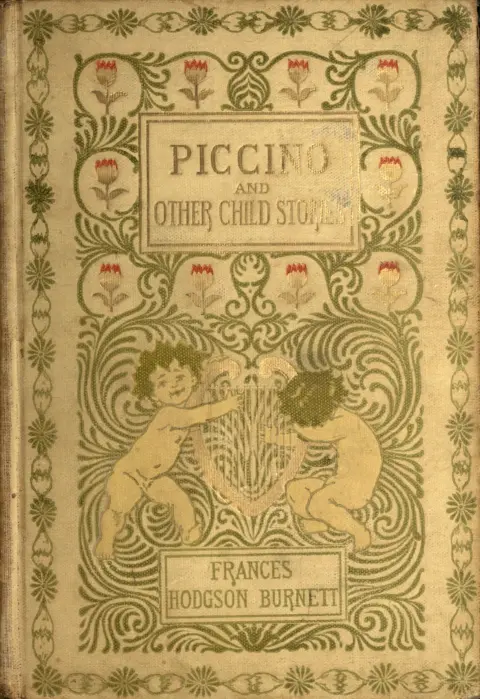
Piccino, and other child stories
Frances Hodgson Burnett
THE CLASSIC COLLECTION · 1913
"T. Tembarom" by Frances Hodgson Burnett is a novel written in the late 19th century. The story centers around a young boy named Temple Barom, affectionately nicknamed Tembarom, who faces adversity and poverty after the death of his parents. As he navigates life in Brooklyn, he demonstrates resilience, resourcefulness, and an innate optimism that gradually leads him towards ambition and opportunity in the bustling city. The opening of the novel introduces Tembarom's humble beginnings as a ten-year-old boy who is suddenly thrown into the harsh realities of life after losing his mother. Left to fend for himself, he tries a variety of odd jobs, including selling newspapers and running errands for the neighborhood. Through his spirited nature and ability to make friends, he finds small support systems among his peers and the adults in his life. As he grows older, Tembarom's journey continues as he works his way up from a newsboy to a position in a newspaper office, driven by his desire to succeed and his plainspoken charm, which draws the affection of those around him, including a young woman named Little Ann Hutchinson, who becomes an important part of his life and aspirations.
Introduction adapted from the source catalogue; source summaries may be automatically generated.
Free to read · English · 180,482 words · No account needed
MAKE TIME FOR A GOOD BOOK
On by default. Untick to stop anonymous reading totals. Each page counts after 10 seconds in view. How this works.
Anonymous counting is on unless you have switched it off.
“She will be here presently. She came down in our train, but not with
us.”
“What--what is she coming for?” faltered Miss Alicia.
“Yes,” put in the duke, “what, by the way, is she coming for?”
“I wrote and asked her to come,” was Palliser's reply. “I have reason to believe she may be able to recall something of value to the inquiry which is being made.”
“That's interesting,” said his Grace, but with no air of participating particularly. “She doesn't like him, though, does she? Wouldn't do to put her on the jury.”
He did not wait for any reply, but turned to Mr. Palford.
“All this is delightfully portentous. Do you know it reminds me of a scene in one of those numerous plays where the wrong man has murdered somebody--or hasn't murdered somebody--and the whole company must be cross-examined because the curtain cannot be brought down until the right man is unmasked. Do let us come into this, Mr. Palford; what we know seems so inadequate.”
Mr. Palford and Mr. Grimby each felt that there lurked in this manner a possibility that they were being regarded lightly. All the objections to their situation loomed annoyingly large.
“It is, of course, an extraordinary story,” Mr. Palford said, “but if we are not mistaken in our deductions, we may find ourselves involved in a cause celebre which will set all England talking.”
“I am not mistaken,” Palliser presented the comment with a short and dry
laugh.
“Tha seems pretty cock-sure!” Hutchinson thrust in.
“I am. No one knew Jem Temple Barbolm better than I did in the past. We were intimate--enemies.” And he laughed again.
“Tha says tha'll swear th' chap tha saw through th' window was him?”
said Hutchinson.
“I'd swear it,” with composure.
The duke was reflecting. He was again tapping with his cane the gaiter covering his slender, shining boot.
“If Mr. Temple Temple Barholm had remained here his actions would have seemed less suspicious?” he suggested.
It was Palliser who replied.
“Or if he hadn't whisked the other man away. He lost his head and played
the fool.”
“He didn't lose his head, that chap. It's screwed on th' right way--his head is,” grunted Hutchinson.
“The curious fellow has a number of friends,” the duke remarked to Palford and Grimby, in his impartial tone. “I am hoping you are not thinking of cross-examining me. I have always been convinced that under cross-examination I could be induced to innocently give evidence condemnatory to both sides of any case whatever. But would you mind telling me what the exact evidence is so far?”
Mr. Palford had been opening a budget of papers.
Your reading position is saved on this browser. Take it to another device with a library code. Reading pages adapt to text, rather than matching a printed edition.
Frances Hodgson Burnett
Frances Hodgson Burnett
Frances Hodgson Burnett
Frances Hodgson Burnett
BEHIND THE BOOK
This eBook is for the use of anyone anywhere in the United States and most other parts of the world at no cost and with almost no restrictions whatsoever. You may copy it, give it away or re-use it under the terms of the Project Gutenberg License included with this eBook or online at www.gutenberg.org. If you are not located in the United States, you will have to check the laws of the country where you are located before using this eBook. Read the source licence.
The original source file, including credits and licence, is retained by this library. Request an original-format copy at no charge. Please include the book title and Project Gutenberg identifier #2514.
KEEP YOUR CURIOSITY GOING
Coulson Kernahan

Maurice Baring
Frances Wright
Cécile Tormay

Frederic Jesup Stimson

W. H. P. (William Henry Pope) Jarvis