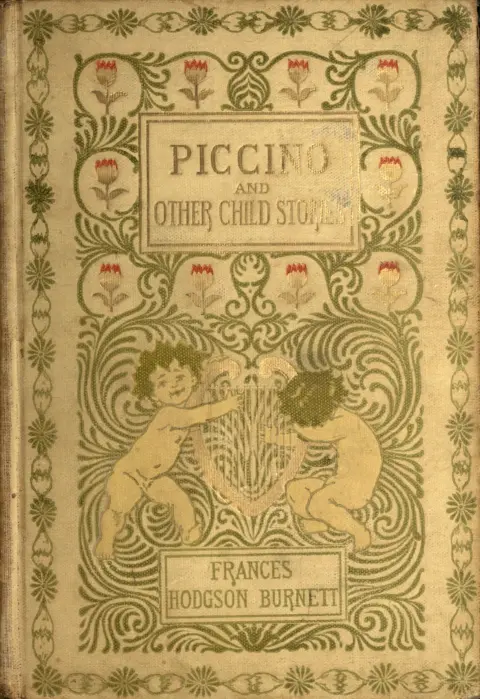
Piccino, and other child stories
Frances Hodgson Burnett
THE CLASSIC COLLECTION · 1913
"T. Tembarom" by Frances Hodgson Burnett is a novel written in the late 19th century. The story centers around a young boy named Temple Barom, affectionately nicknamed Tembarom, who faces adversity and poverty after the death of his parents. As he navigates life in Brooklyn, he demonstrates resilience, resourcefulness, and an innate optimism that gradually leads him towards ambition and opportunity in the bustling city. The opening of the novel introduces Tembarom's humble beginnings as a ten-year-old boy who is suddenly thrown into the harsh realities of life after losing his mother. Left to fend for himself, he tries a variety of odd jobs, including selling newspapers and running errands for the neighborhood. Through his spirited nature and ability to make friends, he finds small support systems among his peers and the adults in his life. As he grows older, Tembarom's journey continues as he works his way up from a newsboy to a position in a newspaper office, driven by his desire to succeed and his plainspoken charm, which draws the affection of those around him, including a young woman named Little Ann Hutchinson, who becomes an important part of his life and aspirations.
Introduction adapted from the source catalogue; source summaries may be automatically generated.
Free to read · English · 180,482 words · No account needed
MAKE TIME FOR A GOOD BOOK
On by default. Untick to stop anonymous reading totals. Each page counts after 10 seconds in view. How this works.
Anonymous counting is on unless you have switched it off.
The suggestion was so entirely within the normal order of things that it made her feel steadier, and she was able to glance at the clock.
“A cup of tea would be refreshing,” she said. “They will bring it in very soon, but before the servants come I must try to express--”
But before she could express anything further the tea appeared. Burrill and a footman brought it on splendid salvers, in massive urn and tea-pot, with chaste, sacrificial flame flickering, and wonderful, hot buttered and toasted things and wafers of bread and butter attendant. As they crossed the threshold, the sight of Miss Alicia's small form enthroned in their employer's chair was one so obviously unanticipated that Burrill made a step backward and the footman almost lost the firmness of his hold on the smaller tray. Each recovered himself in time, however, and not until the tea was arranged upon the table near the fire was any outward recognition of Miss Alicia's presence made. Then Burrill, pausing, made an announcement entirely without prejudice:
“I beg pardon, sir, but Higgins's cart has come for Miss Temple Barholm's box; he is asking when she wants the trap.”
“She doesn't want it at all,” answered Tembarom. “Carry her trunk up-stairs again. She's not going away.”
The lack of proper knowledge contained in the suggestion that Burrill should carry trunks upstairs caused Miss Alicia to quail in secret, but she spoke with outward calm.
“No, Burrill,” she said. “I am not going away.”
“Very good, Miss,” Burrill replied, and with impressive civility he prepared to leave the room. Tembarom glanced at the tea-things.
“There's only one cup here,” he said. “Bring one for me.”
Burrill's expression might perhaps have been said to start slightly.
“Very good, sir,” he said, and made his exit. Miss Alicia was fluttering
again.
“That cup was really for you, Mr. Temple Barholm,” she ventured.
“Well, now it's for you, and I've let him know it,” replied Tembarom.
“Oh, PLEASE,” she said in an outburst of feeling--“PLEASE let me tell you how GRATEFUL--how grateful I am!”
But he would not let her.
“If you do,” he said, “I'll tell you how grateful I am, and that'll be worse. No, that's all fixed up between us. It goes. We won't say any more about it.”
He took the whole situation in that way, as though he was assuming no responsibility which was not the simple, inevitable result of their drifting across each other--as though it was only what any man would have done, even as though she was a sort of delightful, unexpected happening. He turned to the tray.
Your reading position is saved on this browser. Take it to another device with a library code. Reading pages adapt to text, rather than matching a printed edition.
Frances Hodgson Burnett
Frances Hodgson Burnett

Frances Hodgson Burnett
Frances Hodgson Burnett
BEHIND THE BOOK
This eBook is for the use of anyone anywhere in the United States and most other parts of the world at no cost and with almost no restrictions whatsoever. You may copy it, give it away or re-use it under the terms of the Project Gutenberg License included with this eBook or online at www.gutenberg.org. If you are not located in the United States, you will have to check the laws of the country where you are located before using this eBook. Read the source licence.
The original source file, including credits and licence, is retained by this library. Request an original-format copy at no charge. Please include the book title and Project Gutenberg identifier #2514.
KEEP YOUR CURIOSITY GOING
Coulson Kernahan

Maurice Baring
Frances Wright
Cécile Tormay

Frederic Jesup Stimson

W. H. P. (William Henry Pope) Jarvis