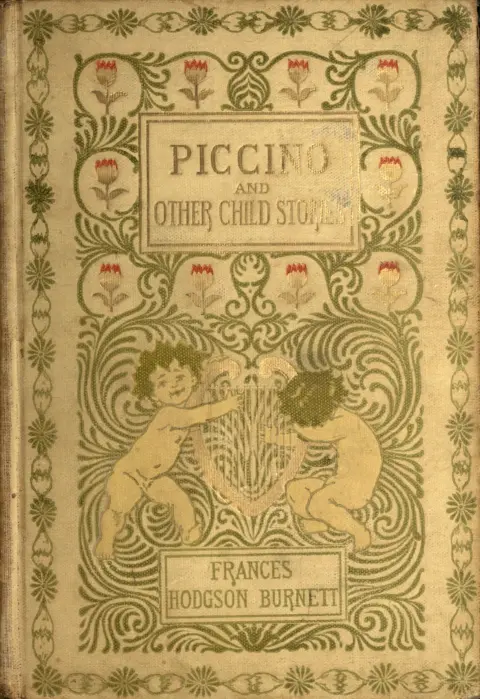
Piccino, and other child stories
Frances Hodgson Burnett
THE CLASSIC COLLECTION · 1913
"T. Tembarom" by Frances Hodgson Burnett is a novel written in the late 19th century. The story centers around a young boy named Temple Barom, affectionately nicknamed Tembarom, who faces adversity and poverty after the death of his parents. As he navigates life in Brooklyn, he demonstrates resilience, resourcefulness, and an innate optimism that gradually leads him towards ambition and opportunity in the bustling city. The opening of the novel introduces Tembarom's humble beginnings as a ten-year-old boy who is suddenly thrown into the harsh realities of life after losing his mother. Left to fend for himself, he tries a variety of odd jobs, including selling newspapers and running errands for the neighborhood. Through his spirited nature and ability to make friends, he finds small support systems among his peers and the adults in his life. As he grows older, Tembarom's journey continues as he works his way up from a newsboy to a position in a newspaper office, driven by his desire to succeed and his plainspoken charm, which draws the affection of those around him, including a young woman named Little Ann Hutchinson, who becomes an important part of his life and aspirations.
Introduction adapted from the source catalogue; source summaries may be automatically generated.
Free to read · English · 180,482 words · No account needed
MAKE TIME FOR A GOOD BOOK
On by default. Untick to stop anonymous reading totals. Each page counts after 10 seconds in view. How this works.
Anonymous counting is on unless you have switched it off.
“You do,” said Tembarom. Then picking up her scissors, which had dropped from her lap, and politely returning them, he added anxiously: “To think of you remembering Biker! I wonder, if I ever did get his job, if I could hold it down?”
“Yes,” decided Little Ann; “you could. I've noticed you're that kind of person, Mr. Tembarom.”
“Have you?” he said elatedly. “Say, honest Injun?”
“Yes.”
“I shall be getting stuck on myself if you encourage me like that,” he said, and then, his face falling, he added, “Biker graduated at Princeton.”
“I don't know much about society,” Little Ann remarked,--“I never saw any either up-town or down-town or in the country,--but I shouldn't think you'd have to have a college education to write the things you see about it in the newspaper paragraphs.”
Tembarom grinned.
“They're not real high-brow stuff, are they,” he said. “'There was a brilliant gathering on Tuesday evening at the house of Mr. Jacob Sturtburger at 79 Two Hundredth Street on the occasion of the marriage of his daughter Miss Rachel Sturtburger to Mr. Eichenstein. The bride was attired in white peau de cygne trimmed with duchess lace.'”
Little Ann took him up. “I don't know what peau de cygne is, and I daresay the bride doesn't. I've never been to anything but a village school, but I could make up paragraphs like that myself.”
“That's the up-town kind,” said Tembarom. “The down-town ones wear their mothers' point-lace wedding-veils some-times, but they're not much different. Say, I believe I could do it if I had luck.”
“So do I,” returned Little Ann.
Tembarom looked down at the carpet, thinking the thing over. Ann went on
sewing.
“That's the way with you,” he said presently: “you put things into a fellow's head. You've given me a regular boost, Little Ann.”
It is not unlikely that but for the sensible conviction in her voice he would have felt less bold when, two weeks later, Biker, having gone upon a “bust” too prolonged, was dismissed with-out benefit of clergy, and Galton desperately turned to Tembarom with anxious question in his eye.
“Do you think you could take this job?” he said.
Tembarom's heart, as he believed at the time, jumped into his throat.
“What do you think, Mr. Galton?” he asked.
“It isn't a thing to think about,” was Galton's answer. “It's a thing I must be sure of.”
“Well,” said Tembarom, “if you give it to me, I'll put up a mighty hard fight before I fall down.”
Galton considered him, scrutinizing keenly his tough, long-built body, his sharp, eager, boyish face, and especially his companionable grin.
Your reading position is saved on this browser. Take it to another device with a library code. Reading pages adapt to text, rather than matching a printed edition.
Frances Hodgson Burnett
Frances Hodgson Burnett
Frances Hodgson Burnett
Frances Hodgson Burnett
BEHIND THE BOOK
This eBook is for the use of anyone anywhere in the United States and most other parts of the world at no cost and with almost no restrictions whatsoever. You may copy it, give it away or re-use it under the terms of the Project Gutenberg License included with this eBook or online at www.gutenberg.org. If you are not located in the United States, you will have to check the laws of the country where you are located before using this eBook. Read the source licence.
The original source file, including credits and licence, is retained by this library. Request an original-format copy at no charge. Please include the book title and Project Gutenberg identifier #2514.
KEEP YOUR CURIOSITY GOING
Coulson Kernahan

Maurice Baring
Frances Wright
Cécile Tormay

Frederic Jesup Stimson

W. H. P. (William Henry Pope) Jarvis