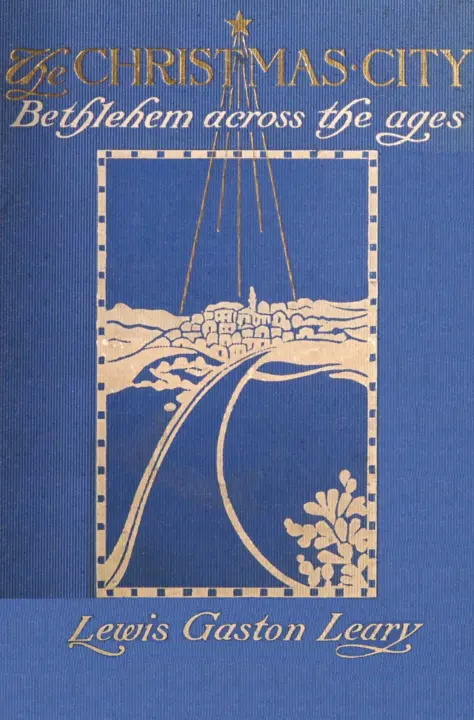
The Christmas city
Lewis Gaston Leary
THE CLASSIC COLLECTION · 1913
"Syria, the Land of Lebanon" by Lewis Gaston Leary is a historical account written in the early 20th century. The author provides an intimate exploration of the geography, culture, and history of Syria, particularly focusing on the significant region of Lebanon. The work appears to reflect Leary's personal experiences and affection for the country, exploring its natural beauty and historic landmarks while offering insights into the lives of its people. At the start of the book, Leary describes the stunning landscape of Lebanon as his ship approaches the shore, providing vivid imagery of the mountains and valleys that characterize the region. He discusses the importance of Lebanon in both biblical history and its cultural significance, outlining the various cities, mountains, and valleys that contribute to its identity. The preface further emphasizes Leary's desire to showcase Syria's rich heritage and beauty, which is often overshadowed by its more famous neighbor, Israel. Overall, the opening sets a tone of appreciation for the land and its history, prepping readers for a deep dive into the complexities and splendor of Syria.
Introduction adapted from the source catalogue; source summaries may be automatically generated.
Free to read · English · 52,174 words · No account needed
MAKE TIME FOR A GOOD BOOK
On by default. Untick to stop anonymous reading totals. Each page counts after 10 seconds in view. How this works.
Anonymous counting is on unless you have switched it off.
[54] Varius Avitus Bassanius, who took the name Heliogabalus upon his appointment as high priest of the sun-god, was born at Homs, A. D. 204, usurped the imperial throne at the death of his cousin Caracalla in 218 and, after a brief reign marked chiefly by its infamous debaucheries, was murdered by the Prætorians in 222.
[55] Edw. Robinson, Biblical Researches in Palestine, III. 517.
[56] Literally, “the stone of the pregnant woman.” Bearing in mind the meaning of the popular name, the reader will easily understand just how and why I have modified the frank, Oriental form of the story which follows.
[57] Many eminent scholars, however, follow Edward Robinson (Biblical Researches, III. 568) in identifying the “Entering In of Hamath” (Judges 3:3, I Kings 8:65, etc.), not with the northern end of the Bikaʿ, but with the east-and-west valley between the Lebanon and Nusairiyeh ranges, through which we have just come. While I incline more and more toward the view given in the text above, the question must be decided by one’s feeling as to which would be the more striking and appropriate landmark, rather than by any direct evidence. The territory included would be practically the same in either case.
[58] Heliogabalus. See foot-note, page 191.
[59] Julia Domna, wife of Septimius Severus.
Roman numerals refer to chapters, Arabic to pages
Abana River, 67-71, 88f, 106
Abila, 69
Abilene, Tetrarchy of, 69
Ain el-Beida, 130
Ain Fijeh, 70
Ain el-Wuʿul, 130
Aleih stories, 61f
Aleppo, Province of, 8
Anti-Lebanon, 7, 63, 67-71, 178, 204
Aurelian, 135-137, 205
Assassins, the, 10
Awaj River, 89n
Baalbek, XIII
Climate, 188
Great stones, 198-200
History, 189-191
Ruins, 192-197
Situation, 184f
Baal-gad (Baalbek), 189
Barada, see Abana
Bashan, Land of, 75
Bedouins, 129-131, 143
Beirut, City, 7, III
Bay, 35
Cape, 29
Caves, 31
Commerce, 36
History, 26f
Modern aspects, 37f
Name, 29
Olive orchards, 30
Political strife, 40f
Religious strife, 38f
Sand dunes, 30
Schools, 41-43
Water supply, 33
Beirut, Province of, 8
Bikaʿ, 63-65, 184f, 178, 204
Bliss, Daniel, 146-149
Bosra, 78
Butrus, Patriarch, 156-162
Byblos, 4, 7
Cathedral Rocks, 174
Cedar Mountain, 167, 176-179
Cedars of Lebanon, XII
Chrysorrhoas, see Abana
Coele-Syria, see Bikaʿ
Coffee, 107-109
Committee of Reform, 40
Cross, Festival of, 179
Damascus, VII-IX, 7, 15
Ananias, Tomb of, 119
Bargaining in, 98-101
Bazaars, 96-104
Beggars, 104
Cafés, 106f
Cemeteries, 116
Commerce, 95, 111
Dogs, 104
Dome of Victory, 88
Fame of, 90
Fertility, 92f
Gate of Allah, 115
Healthfulness, 70
History, 91
Jews, 118
Khans, 110
Kisan Gate, 117
Lepers, 117
Meidan, 114-116
Modern aspects, 91
Name, 90
Night noises, 105f
Omayyade Mosque, 89, 120-127
Population, 96n
Quarters, 118
Residences of rich, 111-113
St. Thomas’ Gate, 106
Saladin, Tomb of, 119f
Street called Straight, 118f
Street calls, 101f
Water supply, 70
Damascus, Province of, 8
Death, River of, 4
Deir el-Kamr, 17
Derʿa, 77
Diman, 164
Dog River, 4, 33-35
Caves of, 34f
Druse Massacres, 14-17, 78
Druse Mountain, 77f
Druses, 11-17, 78, 84, 115, 138
ed-Durazy, 11, 67
Earthquakes, 4, 32, 102
Eastern Mountains, see Anti-Lebanon
Edrei, 77
Emesa, see Homs
Feruzi, 152, 154-156
Fish, Sacred, 203f
George, St., 27-29, 116
Ghuta of Damascus, 93
Greek Catholic Church, 9
Greek Orthodox Church, 9
Your reading position is saved on this browser. Take it to another device with a library code. Reading pages adapt to text, rather than matching a printed edition.
Lewis Gaston Leary
BEHIND THE BOOK
This eBook is for the use of anyone anywhere in the United States and most other parts of the world at no cost and with almost no restrictions whatsoever. You may copy it, give it away or re-use it under the terms of the Project Gutenberg License included with this eBook or online at www.gutenberg.org. If you are not located in the United States, you will have to check the laws of the country where you are located before using this eBook. Read the source licence.
The original source file, including credits and licence, is retained by this library. Request an original-format copy at no charge. Please include the book title and Project Gutenberg identifier #70035.
KEEP YOUR CURIOSITY GOING
Wilfrid Scawen Blunt
Wilfrid Scawen Blunt

E. W. (Edgar Watson) Howe
Cécile Tormay

Moritz Busch
John L. Ransom