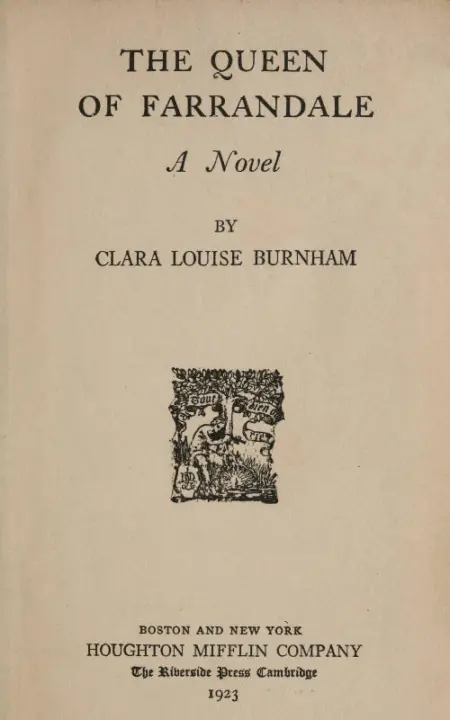
The Queen of Farrandale: A Novel
Clara Louise Burnham
THE CLASSIC COLLECTION · 1894
"Sweet Clover: A Romance of the White City" by Clara Louise Burnham is a novel written in the late 19th century. The story explores themes of love, sacrifice, and the societal dynamics of the time, centering around the characters Clover Bryant and Jack Van Tassel. Clover, caught between familial responsibilities and personal desires, faces significant challenges, while Jack navigates his transition from college life to adulthood and the complexities of relationships within a changing social environment. At the start of the narrative, Clover’s family is struggling with financial difficulties after the death of her father, resulting in Clover taking on adult responsibilities at a young age. The story introduces Clover’s strong sense of duty towards her ailing mother and three younger siblings, contrasted with Jack’s recent college graduation and the expectations placed upon him by his father. Their relationship is complicated by Jack's father, who seems to express romantic interest in Clover, creating tension as the dynamics between wealth, duty, and love begin to unfold. The opening sets the stage for a romance that intertwines with themes of class disparity and personal aspirations against the backdrop of the upcoming World’s Fair in Chicago.
Introduction adapted from the source catalogue; source summaries may be automatically generated.
Free to read · English · 95,205 words · No account needed
MAKE TIME FOR A GOOD BOOK
On by default. Untick to stop anonymous reading totals. Each page counts after 10 seconds in view. How this works.
Anonymous counting is on unless you have switched it off.
At last he spoke again. "Where did Mrs. Van Tassel say they were
going?"
It was the first time he had given his friend her title. Page observed
it.
"California," he answered sententiously.
"That doesn't tell anything."
Page smiled slightly. "Perhaps that is just what she considered," he returned, and Jack thought that Gorham was a provoking, dry sort of fellow.
"I'll tell you what I'm going to do," he said, rising. "I'm going to
Chicago."
"Are you? Well, you are that favored species of individual who can
control his own movements."
"Yes. They've ceased pulling hair out there, and have decided to locate the Fair in Jackson Park, quite near our house, you remember."
"So I observed. They have lost a good deal of time in controversy, it strikes me. They will have to scratch gravel now."
And this, if Mr. Page had only known it, was literally what had begun to be done out there in Chicago, in the unreclaimed district which bordered Jackson Park on the south.
Sand-dunes, and marshes, woodland and slough, had all to be effaced, for a new earth must be offered in time to be the foundation for those castles in the air, which were already creating in men's brains.
As the scope of the proposed work unfolded and became clear, the time began to seem nigh to hopelessly short for its accomplishment. Of public opinion in the East, the kindest expression continued patronizing, amused, and skeptical; the average, contemptuous and hostile.
But Chicago, which had formed a habit of making stepping-stones of obstacles, now said "I will" with greater doggedness of purpose than ever before, and sending steam dredges to invade the wilderness, began the patient, laborious grubbing, which was necessary to excavate in one place, and fill in in another. Meanwhile the oldest inhabitant wandered about, looking on, wondering and fascinated. The maiden, going in advance of the feller of trees, caught with her kodak a farewell glimpse of the wood-road, that had furnished a foothold amid the sand for the spring violets of her childhood. The small boy looked longingly at the sloughs, which had been first to freeze in autumn, and thought it a thousand pities that Chicago had been so brave as to deserve the Fair. The Eastern papers thought so too, and still exercised the virtue of frankness to the fullest extent; but Chicago, with all her reputation for talking, now had no time for such indulgence; but emulated Uncle Remus's famous tar-baby, who, it will be remembered, when Brer Rabbit jeered at her once and again, still "ain't sayin' nothin'." She only grubbed away, and her citizens prepared themselves for the long pull, the strong pull, and the pull all together, which should win ultimate triumph.
Your reading position is saved on this browser. Take it to another device with a library code. Reading pages adapt to text, rather than matching a printed edition.
Clara Louise Burnham
Clara Louise Burnham
Clara Louise Burnham
Clara Louise Burnham
BEHIND THE BOOK
This eBook is for the use of anyone anywhere in the United States and most other parts of the world at no cost and with almost no restrictions whatsoever. You may copy it, give it away or re-use it under the terms of the Project Gutenberg License included with this eBook or online at www.gutenberg.org. If you are not located in the United States, you will have to check the laws of the country where you are located before using this eBook. Read the source licence.
The original source file, including credits and licence, is retained by this library. Request an original-format copy at no charge. Please include the book title and Project Gutenberg identifier #54490.
KEEP YOUR CURIOSITY GOING
Coulson Kernahan

Maurice Baring
Frances Wright
Cécile Tormay

Frederic Jesup Stimson

W. H. P. (William Henry Pope) Jarvis