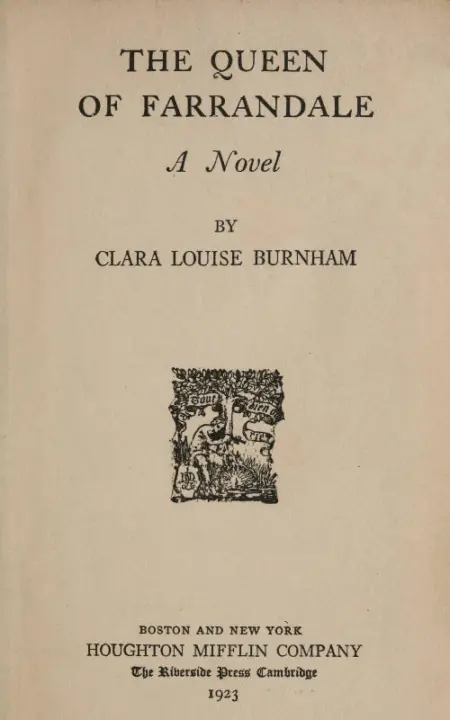
The Queen of Farrandale: A Novel
Clara Louise Burnham
THE CLASSIC COLLECTION · 1894
"Sweet Clover: A Romance of the White City" by Clara Louise Burnham is a novel written in the late 19th century. The story explores themes of love, sacrifice, and the societal dynamics of the time, centering around the characters Clover Bryant and Jack Van Tassel. Clover, caught between familial responsibilities and personal desires, faces significant challenges, while Jack navigates his transition from college life to adulthood and the complexities of relationships within a changing social environment. At the start of the narrative, Clover’s family is struggling with financial difficulties after the death of her father, resulting in Clover taking on adult responsibilities at a young age. The story introduces Clover’s strong sense of duty towards her ailing mother and three younger siblings, contrasted with Jack’s recent college graduation and the expectations placed upon him by his father. Their relationship is complicated by Jack's father, who seems to express romantic interest in Clover, creating tension as the dynamics between wealth, duty, and love begin to unfold. The opening sets the stage for a romance that intertwines with themes of class disparity and personal aspirations against the backdrop of the upcoming World’s Fair in Chicago.
Introduction adapted from the source catalogue; source summaries may be automatically generated.
Free to read · English · 95,205 words · No account needed
MAKE TIME FOR A GOOD BOOK
On by default. Untick to stop anonymous reading totals. Each page counts after 10 seconds in view. How this works.
Anonymous counting is on unless you have switched it off.
"All right," replied Page, succumbing with a sigh, and casting a glance toward the graceful branches of the tallest elm, behind which the new moon glimmered in a primrose sky. "What an evening!" he ejaculated.
"'M; dewy though," returned Miss Berry.
"I do like those old trees," said her guest slowly, continuing to gaze.
"So do the mosquitoes," replied Miss Berry inflexibly. "Come up on to
the stoop."
Page, with a smile of amusement, followed his hostess to the piazza, where she ensconced him in one rocking chair, and herself in another.
"Do the orioles still hold possession of that elm?"
"Yes."
"I'm glad of that. The rest of the world may change, and must; but I'm jealous of a hair's breadth of change in Pearfield."
"Well, I don't know. The hang-birds squabble a good deal," remarked
Miss Lovina impartially.
Her guest laughed again. The fact being that very few things in life moved him to laughter, he was enjoying himself hugely.
"You are too practical; too unsentimental, Aunt Love," he asserted
argumentatively.
"Too unsentimental, hey?" responded Miss Berry, folding her hands over the white apron that protected her striped gingham gown. "That's pretty good from you. What does it mean? Have you repented o' your singular ways, and been fallin' in love?"
"Oh, yes," responded the other, more seriously; then added simply, as though stating an undeniable fact, "I am always falling in love."
"Then why don't you get married?" asked Miss Lovina bluntly. "I haven't heard a thing about you in so long, I didn't know but what you was married, only I hadn't received any cake. I didn't believe you'd forget me."
"No," said Page. "If I could be as loyal to any girl as I am to you, Aunt Love, I should certainly ask her if she would have me."
"But if you fall in love?" asked Miss Berry, perplexed.
"The trouble is I don't stay in love," explained Page with simple sincerity. "I can't help forgetting about the young lady in a little while. It really makes me blue sometimes. Now this summer at Bar Harbor I met a girl who was remarkably pleasant. Pretty, clever, a good talker. Her tastes and mine coincided. My mind was full of her when I left the place."
"Have you heard from her since?" asked Miss Berry with interest. This certainly sounded encouraging.
"Oh yes. I have sent her candy and flowers and books from time to time," responded Page, beginning to look serious and abstracted.
"Then you write to each other?"
Your reading position is saved on this browser. Take it to another device with a library code. Reading pages adapt to text, rather than matching a printed edition.
Clara Louise Burnham
Clara Louise Burnham
Clara Louise Burnham
Clara Louise Burnham
BEHIND THE BOOK
This eBook is for the use of anyone anywhere in the United States and most other parts of the world at no cost and with almost no restrictions whatsoever. You may copy it, give it away or re-use it under the terms of the Project Gutenberg License included with this eBook or online at www.gutenberg.org. If you are not located in the United States, you will have to check the laws of the country where you are located before using this eBook. Read the source licence.
The original source file, including credits and licence, is retained by this library. Request an original-format copy at no charge. Please include the book title and Project Gutenberg identifier #54490.
KEEP YOUR CURIOSITY GOING
Coulson Kernahan

Maurice Baring
Frances Wright
Cécile Tormay

Frederic Jesup Stimson

W. H. P. (William Henry Pope) Jarvis