THE CLASSIC COLLECTION✦Tirzah Ann’s summer trip, and other sketchesCLASSIC FREE BOOKS
Tirzah Ann’s summer trip, and other sketches
Marietta Holley
THE CLASSIC COLLECTION · 1885
"Sweet Cicely — or Josiah Allen as a Politician" by Marietta Holley is a novel likely written during the late 19th century. The story centers on the character of Cicely and explores themes of love, family, and the struggles of navigating societal expectations and personal dilemmas, particularly in the realm of political involvement and maternal devotion. At the start of the novel, the opening introduces Josiah Allen and his wife, Samantha, who are excitedly expecting a visit from their niece Cicely, whom they adore. The narrative quickly draws readers into Cicely's past, recounting her delicate upbringing and deep connection with her late mother. As the couple reminisces about Cicely's beauty and the profound love they have for her, they reveal their concerns over her tumultuous relationship with her husband, Paul Slide, who battles alcohol addiction. The emotional complexity of their family ties is set against a backdrop highlighting societal issues related to alcoholism and women's rights, establishing an engaging foundation for the unfolding narrative about Cicely's attempts to safeguard her son from the same fate.
Introduction adapted from the source catalogue; source summaries may be automatically generated.
Free to read · English · 89,517 words · No account needed
MAKE TIME FOR A GOOD BOOK
On by default. Untick to stop anonymous reading totals. Each page counts after 10 seconds in view. How this works.
Anonymous counting is on unless you have switched it off.
“I know it,” says I. “I told Dorlesky it would. But she feels jest so, and I promised to do her errent; and I am a doin' it.”
Agin he rubbed his brow in deep thought, and agin he says,--
“I don't think Dorlesky is unreasonable in her demands, only in the length of time she has set.”
Says I, “That is jest what I told Dorlesky. I didn't believe you could do her errents this week. But you can see for yourself that she is right, only in the time she has sot.”
“Yes,” he said. “He see she wuz.” And says he, “I wish the 3 could be
reconciled.”
“What 3?” says I.
Says he, “The liquor traffic, liberty, and Dorlesky.”
And then come the very hardest part of my errent. But I had to do it, I
had to.
Says I, in the deep, solemn tones befitting the threat, for I wuzn't the woman to cheat Dorlesky when she was out of sight, and use the wrong tones at the wrong times--no, I used my deepest and most skairful one--says I, “Dorlesky told me to tell you that if you didn't do her errent, you should not be the next President of the United States.”
He turned pale. He looked agitated, fearful agitated.
I s'pose it was not only my words and tone that skairt him, but my mean. I put on my noblest mean; and I s'pose I have got a very noble, high-headed mean at times. I got it, I think, in the first place, by overlookin' Josiah's faults. I always said a wife ort to overlook her husband's faults; and I have to overlook so many, that it has made me about as high-headed, sometimes, as a warlike gander, but more sort o' meller-lookin', and sublime, kinder.
He stood white as a piece of a piller-case, and seemin'ly plunged down into the deepest thought. But finally he riz part way out of it, and says he,--
“I want to be on the side of Truth and Justice. I want to, awfully. And while I do not want to be President of the United States, yet at the same time I do want to be--if you'll understand that paradox,” says he.
“Yes,” says I sadly. “I understand that paradox. I have seen it myself, right in my own family.” And I sithed. And agin silence rained; and I sot quietly in the rain, thinkin' mebby good would come of it.
Finally he riz out of his revery; and says he, with a brighter look on
his linement,--
“I am not the one to go to. I am not the one to do Dorlesky's errent.”
Your reading position is saved on this browser. Take it to another device with a library code. Reading pages adapt to text, rather than matching a printed edition.
Marietta Holley
Marietta Holley
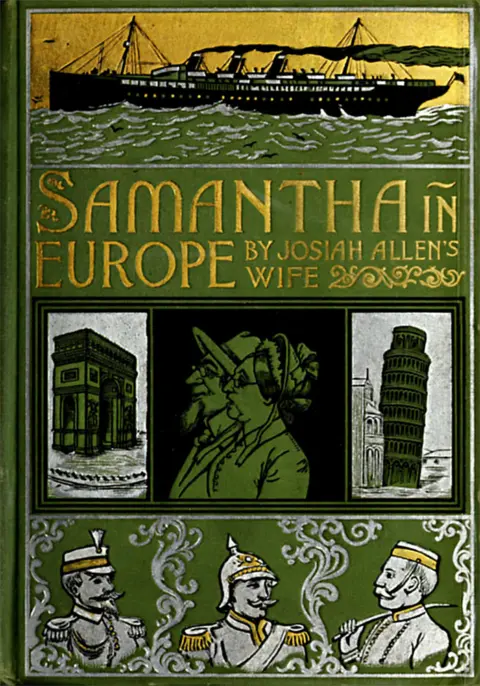
Marietta Holley
Marietta Holley
BEHIND THE BOOK
This eBook is for the use of anyone anywhere in the United States and most other parts of the world at no cost and with almost no restrictions whatsoever. You may copy it, give it away or re-use it under the terms of the Project Gutenberg License included with this eBook or online at www.gutenberg.org. If you are not located in the United States, you will have to check the laws of the country where you are located before using this eBook. Read the source licence.
The original source file, including credits and licence, is retained by this library. Request an original-format copy at no charge. Please include the book title and Project Gutenberg identifier #7251.
KEEP YOUR CURIOSITY GOING

David Patterson (Spirit) Hatch

David Patterson (Spirit) Hatch

David Patterson (Spirit) Hatch
Coulson Kernahan

Maurice Baring
Frances Wright