THE CLASSIC COLLECTION✦Tirzah Ann’s summer trip, and other sketchesCLASSIC FREE BOOKS
Tirzah Ann’s summer trip, and other sketches
Marietta Holley
THE CLASSIC COLLECTION · 1885
"Sweet Cicely — or Josiah Allen as a Politician" by Marietta Holley is a novel likely written during the late 19th century. The story centers on the character of Cicely and explores themes of love, family, and the struggles of navigating societal expectations and personal dilemmas, particularly in the realm of political involvement and maternal devotion. At the start of the novel, the opening introduces Josiah Allen and his wife, Samantha, who are excitedly expecting a visit from their niece Cicely, whom they adore. The narrative quickly draws readers into Cicely's past, recounting her delicate upbringing and deep connection with her late mother. As the couple reminisces about Cicely's beauty and the profound love they have for her, they reveal their concerns over her tumultuous relationship with her husband, Paul Slide, who battles alcohol addiction. The emotional complexity of their family ties is set against a backdrop highlighting societal issues related to alcoholism and women's rights, establishing an engaging foundation for the unfolding narrative about Cicely's attempts to safeguard her son from the same fate.
Introduction adapted from the source catalogue; source summaries may be automatically generated.
Free to read · English · 89,517 words · No account needed
MAKE TIME FOR A GOOD BOOK
On by default. Untick to stop anonymous reading totals. Each page counts after 10 seconds in view. How this works.
Anonymous counting is on unless you have switched it off.
“Oh! Dorlesky!” says he, a comin' up out of his deep reveryin', but polite,--a politer demeanerd, gentlemanly appeariner man I don't want to see. “Ah, yes! I would be glad, Josiah Allen's wife, to do her errent. I think Dorlesky is justified in asking to have the Ring destroyed. But I am not the one to go to--I am not the one to do her errent.”
Says I, “Who is the man, or men?”
Says he, “James G. Blaine.”
Says I, “Is that so? I will go right to James G. Blaineses.”
So I spoke to the boy. He had been all engaged lookin' out of the winders, but he was willin' to go.
And the President took the boy upon his knee, wantin' to do something agreeable, I s'pose, seein' he couldn't do the errent. And he says, jest to make himself pleasant to the boy,--
“Well, my little man, are you a Republican, or Democrat?”
“I am a Epispocal.”
And seein' the boy seemed to be headed onto theoligy instead of politics, and wantin' to kinder show him off, I says,--
“Tell the gentleman who made you.”
He spoke right up prompt, as if hurryin' to get through theoligy, so's to tackle sunthin' else. He answered as exhaustively as an exhauster could at a meetin',--
“I was made out of dust, and breathed into. I am made out of God and
dirt.”
Oh, how deep, how deep that child is! I never had heard him say that before. But how true it wuz! The divine and the human, linked so close together from birth till death. No philosipher that ever philosiphized could go deeper or higher.
I see the President looked impressed. But the boy branched off quick, for he seemed fairly burstin' with questions.
“Say, what is this house called the White House for? Is it because it is to help white folks, and not help the black ones, and Injins?”
I declare, I almost thought the boy had heard sunthin' about the elections in the South, and the Congressional vote for cuttin' down the money for the Indian schools. Legislative action to perpetuate the ignorance and brutality of a race.
The President said dreamily, “No, it wasn't for that.”
“Well, is it called white like the gate of the City is? Mamma said that was white,--a pearl, you know,--because every thing was pure and white inside the City. Is it because the laws that are made here are all white and good? And say”--
Here his eyes looked dark and big with excitement.
“What is George Washington up on top of that big white piller for?”
Your reading position is saved on this browser. Take it to another device with a library code. Reading pages adapt to text, rather than matching a printed edition.
Marietta Holley
Marietta Holley
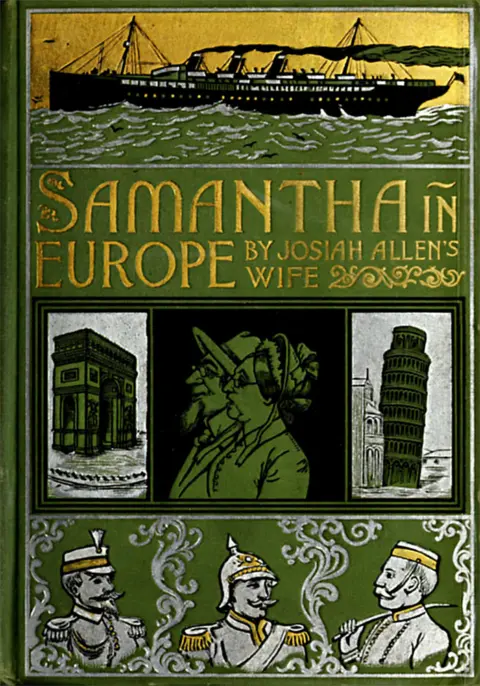
Marietta Holley
Marietta Holley
BEHIND THE BOOK
This eBook is for the use of anyone anywhere in the United States and most other parts of the world at no cost and with almost no restrictions whatsoever. You may copy it, give it away or re-use it under the terms of the Project Gutenberg License included with this eBook or online at www.gutenberg.org. If you are not located in the United States, you will have to check the laws of the country where you are located before using this eBook. Read the source licence.
The original source file, including credits and licence, is retained by this library. Request an original-format copy at no charge. Please include the book title and Project Gutenberg identifier #7251.
KEEP YOUR CURIOSITY GOING

David Patterson (Spirit) Hatch

David Patterson (Spirit) Hatch

David Patterson (Spirit) Hatch
Coulson Kernahan

Maurice Baring
Frances Wright