
Dead letters
Maurice Baring
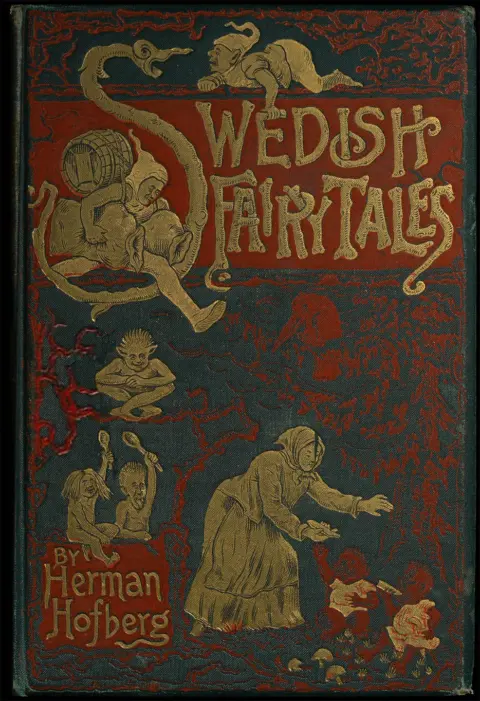
THE CLASSIC COLLECTION · 1890
"Swedish Fairy Tales" by Herman Hofberg is a collection of folkloric tales written in the late 19th century. This compilation gathers various traditional stories from Sweden, exploring themes of magic, giants, and whimsical adventures that reflect the deep-rooted culture and mythology of the Swedish people. The tales feature a range of characters, from courageous peasants to mystical creatures like trolls and sea nymphs, immersing readers in a world of fantasy and moral lessons. The opening of the collection begins with the author's preface, distinguishing between tradition and saga, and explaining the origins of these stories in Swedish folklore. The following tales introduce a variety of characters, including a boastful watchman who boasts of his marksmanship, a clever goatherd who outwits a giant, and a giant Finn who helps build a cathedral. Each story is crafted to highlight not only the enchanting elements of magical beings and heroic feats but also the moral implications and consequences of the characters' actions, setting the tone for the rich storytelling that unfolds throughout the book.
Introduction adapted from the source catalogue; source summaries may be automatically generated.
Free to read · English · 42,336 words · No account needed
MAKE TIME FOR A GOOD BOOK
On by default. Untick to stop anonymous reading totals. Each page counts after 10 seconds in view. How this works.
Anonymous counting is on unless you have switched it off.
Some years later the possessor of the cradle became sick. When he found that his case was serious he sent for the priest, and confided to him the whereabouts of his booty, and requested that as soon as he was dead the priest should dig the cradle up and restore it to the king. Hardly had the priest taken his departure when the sick man regretted his simplicity. Gathering his little remaining strength, he rose from his bed, and, with unsteady steps, crept out into the field and concealed his buried treasure in another place. As soon as the man was dead, the priest set out about fulfilling his commission. His digging was in vain, the hidden treasure was not to be found. In his dying hour the peasant had, apparently, endeavored to reveal the new hiding place, but his strength was so near exhausted that his utterances could not be understood.
To this day many of the dwellers on the island are fully persuaded that Queen Elenor’s golden cradle may be found somewhere in the Stordal cow pastures, and many have wasted much time and labor in the hope of bringing it to light.
Many years ago there died, on the estate of Sundshult, in the parish of Nafverstad, a child of illegitimate birth, which, because of this, was not christened and could not be accorded Christian burial, or a place in heaven, and whose spirit, therefore, was left to wander the earth, disturbing the rest and making night uncomfortable for the people of the neighborhood.
One time, just before Christmas, the parish shoemaker, on his rounds, was detained at the house of a patron, and, having much work before him, he was still sewing late into the night, when he was unexpectedly startled from his employment by a little child appearing before him, which said:
“Why do you sit there? Move aside.”
“For what?” asked the shoemaker.
“Because I wish to dance,” said the spectre.
“Dance away, then!” said the shoemaker.
When the child had danced some time it disappeared, but returned soon
and said:
“I will dance again, and I’ll dance your light out for you.”
“No,” said the shoemaker, “let the light alone. But who are you that you are here in this manner?”
“I live under the lower stone of the steps to the porch.”
“Who put you there?” asked the shoemaker.
“Watch when it dawns, and you will see my mother coming, wearing a red cap. But help me out of this, and I’ll never dance again.”
This the shoemaker promised to do, and the spectre vanished.
Your reading position is saved on this browser. Take it to another device with a library code. Reading pages adapt to text, rather than matching a printed edition.
BEHIND THE BOOK
This eBook is for the use of anyone anywhere in the United States and most other parts of the world at no cost and with almost no restrictions whatsoever. You may copy it, give it away or re-use it under the terms of the Project Gutenberg License included with this eBook or online at www.gutenberg.org. If you are not located in the United States, you will have to check the laws of the country where you are located before using this eBook. Read the source licence.
The original source file, including credits and licence, is retained by this library. Request an original-format copy at no charge. Please include the book title and Project Gutenberg identifier #73093.
KEEP YOUR CURIOSITY GOING
Maurice Baring
Francis Greenleaf Allinson & Anne C. E. (Anne Crosby Emery) Allinson
Stuart Dodgson Collingwood
Percy Keese Fitzhugh
Mary Macleod & Edmund Spenser

Cooke Don-Carlos