THE CLASSIC COLLECTION✦Goldsmith English Men of Letters SeriesCLASSIC FREE BOOKS
Goldsmith English Men of Letters Series
William Black
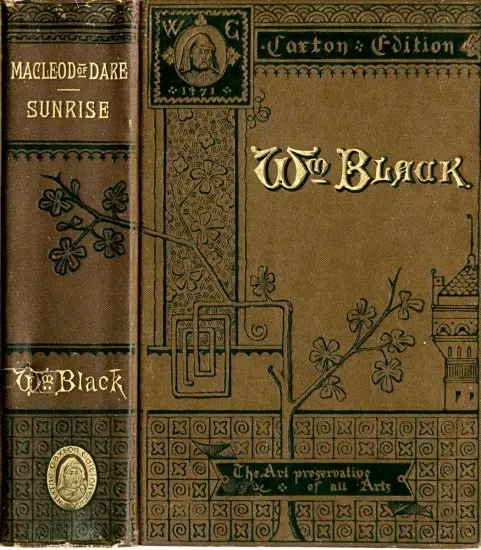
THE CLASSIC COLLECTION · 1881
"Sunrise" by William Black is a novel written in the late 19th century. The story revolves around two main characters, George Brand and Lord Evelyn, who engage in a spirited discourse while navigating a world rife with political intrigue and revolutionary ideals. Central to the narrative is their encounter with Ferdinand Lind, a mysterious figure involved in radical movements, and his daughter, Natalie, whose presence hints at deeper emotional and ideological currents. The opening of the book introduces a chilly February day in London, marking an intersection of lives set against the backdrop of political conspiracies. George Brand, a skeptic of the political fervor that surrounds them, expresses disdain for what he perceives as folly, while Lord Evelyn passionately defends their cause, revealing a divide in their ideologies. As they approach Lind's modest abode to engage in discussions that promise both intrigue and danger, the narrative sets the tone for a complex exploration of belief, loyalty, and the quest for justice. This tantalizing start invites readers into a world where personal convictions clash with societal issues, prompting the question: how far will individuals go for their beliefs?
Introduction adapted from the source catalogue; source summaries may be automatically generated.
Free to read · English · 177,226 words · No account needed
MAKE TIME FOR A GOOD BOOK
On by default. Untick to stop anonymous reading totals. Each page counts after 10 seconds in view. How this works.
Anonymous counting is on unless you have switched it off.
"Is it not strange?" she said. "'From Natalie to Natalushka:' that is, from myself to myself. What can it mean?"
"Have you not asked your father, then, about his mysterious messenger?" Brand said. He was always glad to ask this girl a question, for she looked him so straight in the face with her soft, dark eyes, as she answered,
"He has only now come home. I will directly."
"But why does your father call you Natalushka, Natalie?" asked Lord
Evelyn.
There was the slightest blush on the pale, clear face.
"It was a nickname they gave me, I am told, when I was child. They used
to make me angry."
"And now, if one were to call you Natalushka?"
"My anger would be too terrible," she said, with a smile. "Papa alone
dares to do that."
Presently her father came into the room.
"Oh, papa," said she, "I have discovered who the lady is whom you got to bring me the flowers. And see! she has given me this strange little locket. Look at the inscription--'From Natalie to Natalushka.'"
Lind only glanced at the locket. His eyes were fixed on the girl.
"Where did you see the--the lady?" he asked, coldly.
"In the Park. But she did not stay a moment, or speak; she hurried on, and Anneli thought she was crying. I almost think so too. Who was it, papa? May I speak to her, if I see her again?"
Mr. Lind turned aside for a moment. Brand, who was narrowly watching him, was convinced that the man was in a passion of rage. But when he turned again he was outwardly calm.
"You will do nothing of the kind, Natalie," he said in measured tones. "I have warned you before against making indiscriminate acquaintances; and Anneli, if she is constantly getting such stupidities into her head, must be sent about her business. I do not wish to hear anything more about it. Will you ring and ask why tea has not been sent up?"
The girl silently obeyed. Her father had never spoken to her in this cold, austere tone before. She sat down at a small table, apart.
Mr. Lind talked for a minute or two with his guests; then he said,
"Natalie, you have the zither there; why do you not play us something?"
She turned to the small instrument, and, after a second or two, played a few notes: that was all. She rose and said, "I don't think I can play this afternoon, papa;" and then she left the room.
Your reading position is saved on this browser. Take it to another device with a library code. Reading pages adapt to text, rather than matching a printed edition.
William Black
William Black
William Black
William Black
BEHIND THE BOOK
This eBook is for the use of anyone anywhere in the United States and most other parts of the world at no cost and with almost no restrictions whatsoever. You may copy it, give it away or re-use it under the terms of the Project Gutenberg License included with this eBook or online at www.gutenberg.org. If you are not located in the United States, you will have to check the laws of the country where you are located before using this eBook. Read the source licence.
The original source file, including credits and licence, is retained by this library. Request an original-format copy at no charge. Please include the book title and Project Gutenberg identifier #17308.
KEEP YOUR CURIOSITY GOING
Coulson Kernahan

Maurice Baring
Frances Wright
Cécile Tormay

Frederic Jesup Stimson

W. H. P. (William Henry Pope) Jarvis