THE CLASSIC COLLECTION✦Goldsmith English Men of Letters SeriesCLASSIC FREE BOOKS
Goldsmith English Men of Letters Series
William Black
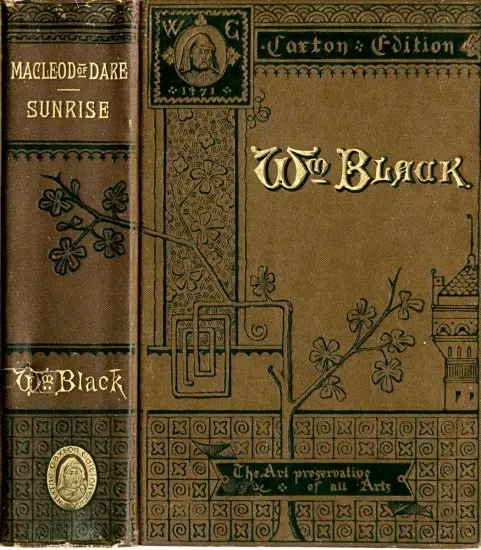
THE CLASSIC COLLECTION · 1881
"Sunrise" by William Black is a novel written in the late 19th century. The story revolves around two main characters, George Brand and Lord Evelyn, who engage in a spirited discourse while navigating a world rife with political intrigue and revolutionary ideals. Central to the narrative is their encounter with Ferdinand Lind, a mysterious figure involved in radical movements, and his daughter, Natalie, whose presence hints at deeper emotional and ideological currents. The opening of the book introduces a chilly February day in London, marking an intersection of lives set against the backdrop of political conspiracies. George Brand, a skeptic of the political fervor that surrounds them, expresses disdain for what he perceives as folly, while Lord Evelyn passionately defends their cause, revealing a divide in their ideologies. As they approach Lind's modest abode to engage in discussions that promise both intrigue and danger, the narrative sets the tone for a complex exploration of belief, loyalty, and the quest for justice. This tantalizing start invites readers into a world where personal convictions clash with societal issues, prompting the question: how far will individuals go for their beliefs?
Introduction adapted from the source catalogue; source summaries may be automatically generated.
Free to read · English · 177,226 words · No account needed
MAKE TIME FOR A GOOD BOOK
On by default. Untick to stop anonymous reading totals. Each page counts after 10 seconds in view. How this works.
Anonymous counting is on unless you have switched it off.
Well, it was about eight o'clock when he was awakened by the entrance of Waters. He jumped up, and looked around, haggard and bewildered. Then his first thought was,
"A few more nights like this, and Zaccatelli will have little to fear."
He had his bath and breakfast; all the time he was forcing himself into an indignant self-contempt. He held out his hand before him, expecting to see it tremble: but no. This reassured him somewhat.
A little before eleven he was at the house in Hans Place. He was immediately shown up-stairs. Natalie's mother was there to receive him, she did not notice he looked tired.
"Natalie is coming to you this morning?" he said.
"Oh yes; why not? It gives her pleasure, it gives me joy. But I will not keep the child always in the house; no, she must have her walk. Yesterday, after you had left, we went to a very secluded place--a church not far from here, and a cemetery behind."
"Oh, yes; I know," he said. "But you might have chosen a more cheerful
place for your walk."
"Any place is cheerful enough for me when my daughter is with me," said she, simply; "and it is quiet."
George Brand sat with his hands clinched. Every moment he thought he should hear Natalie knock at the door below.
"Madame," he said, with some little hesitation, "something has happened of serious importance--I mean, of a little importance. When Natalie comes I must tell her--"
"And you wish to see her alone, perhaps?" said the mother, lightly. "Why not? And listen--it is she herself, I believe!"
A minute afterward the door was opened, and Natalie entered, radiant, happy, with glad eyes. Then she started when she saw George Brand there, but there was no fear in her look. On the contrary, she embraced her mother; then she went to him, and said, with a pleased flush in her face,
"I had no message this morning. You did not care, then, for our little
bunch of flowers?"
He took her hand, and held it for a second.
"I thought I should see you to-day, Natalie; I have something to tell
you."
Her face grew graver.
"Is it something serious?"
"Well," said he, to gain time, for the mother was still in the room, "it is serious or not serious, as you like to take it. It does not involve the fate of a nation, for example."
"It is mysterious, at all events."
At this moment the elder woman took occasion to slip noiselessly from
the room.
"Natalie," said he, "sit down here by me."
Your reading position is saved on this browser. Take it to another device with a library code. Reading pages adapt to text, rather than matching a printed edition.
William Black
William Black
William Black
William Black
BEHIND THE BOOK
This eBook is for the use of anyone anywhere in the United States and most other parts of the world at no cost and with almost no restrictions whatsoever. You may copy it, give it away or re-use it under the terms of the Project Gutenberg License included with this eBook or online at www.gutenberg.org. If you are not located in the United States, you will have to check the laws of the country where you are located before using this eBook. Read the source licence.
The original source file, including credits and licence, is retained by this library. Request an original-format copy at no charge. Please include the book title and Project Gutenberg identifier #17308.
KEEP YOUR CURIOSITY GOING
Coulson Kernahan

Maurice Baring
Frances Wright
Cécile Tormay

Frederic Jesup Stimson

W. H. P. (William Henry Pope) Jarvis