THE CLASSIC COLLECTION✦Goldsmith English Men of Letters SeriesCLASSIC FREE BOOKS
Goldsmith English Men of Letters Series
William Black
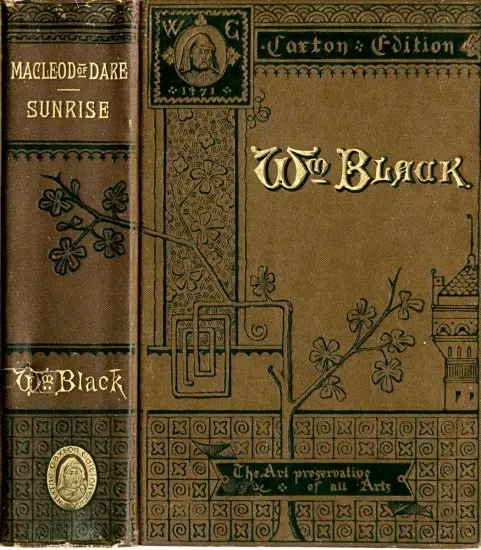
THE CLASSIC COLLECTION · 1881
"Sunrise" by William Black is a novel written in the late 19th century. The story revolves around two main characters, George Brand and Lord Evelyn, who engage in a spirited discourse while navigating a world rife with political intrigue and revolutionary ideals. Central to the narrative is their encounter with Ferdinand Lind, a mysterious figure involved in radical movements, and his daughter, Natalie, whose presence hints at deeper emotional and ideological currents. The opening of the book introduces a chilly February day in London, marking an intersection of lives set against the backdrop of political conspiracies. George Brand, a skeptic of the political fervor that surrounds them, expresses disdain for what he perceives as folly, while Lord Evelyn passionately defends their cause, revealing a divide in their ideologies. As they approach Lind's modest abode to engage in discussions that promise both intrigue and danger, the narrative sets the tone for a complex exploration of belief, loyalty, and the quest for justice. This tantalizing start invites readers into a world where personal convictions clash with societal issues, prompting the question: how far will individuals go for their beliefs?
Introduction adapted from the source catalogue; source summaries may be automatically generated.
Free to read · English · 177,226 words · No account needed
MAKE TIME FOR A GOOD BOOK
On by default. Untick to stop anonymous reading totals. Each page counts after 10 seconds in view. How this works.
Anonymous counting is on unless you have switched it off.
"Yes; and Calabressa, when he told me, implored me never to tell you. Well, perhaps he thought it would give you needless pain. But I was thinking, within the last few days, that I ought to tell you before I left for America."
"Do you hear, mother?" the girl said, in a low voice. "He is going away to America--and alone. I wished to go; he refuses."
"Now I am going away much more contented, Natalie, since you will have a constant companion with you. I presume, madame, you will remain in England?"
The elder woman looked up with rather a frightened air.
"Alas, monsieur, I do not know! When at last I found myself free--when I knew I could come and speak to my child--that was all I thought of."
"But you wish to remain in England: is it not so?"
"What have I in the world now but this beautiful child--whose heart is not cold, though her mother comes so late to claim her?"
"Then be satisfied, madame. It is simple. No one can interfere with you. But I will provide you, if you will allow me, with better lodgings than these. I have a few days' idleness still before me."
"That is his way, mother," Natalie said, in a still lower voice. "It is always about others he is thinking--how to do one a kindness."
"I presume," he said, in quite a matter-of-fact way, "that you do not wish your being in London to become known?"
She looked up timidly, but in truth she could hardly take her attention away from this newly-found daughter of hers for a single second. She still continued stroking the soft hair and rounded cheek as she said,
"If that is possible."
"It would not be long possible in an open thoroughfare like this," he said; "But I think I could find you a small old-fashioned house down about Brompton, with a garden and a high wall. I have passed such places occasionally. There Natalie could come to see you, and walk with you. There is another thing," he said, in a matter-of-fact way, taking out his watch. "It is now nearly two o'clock. Now, dear madame, Natalie is in the habit of having luncheon at one. You would not like to see your child starve before your eyes?"
The elder woman rose instantly; then she colored somewhat.
"No doubt you did not expect visitors," George Brand said, quickly. "Well, what do you say to this? Let us get into a four-wheeled cab, and drive down to my chambers. I have an indefatigable fellow, who could get something for us in the desert of Saharra."
"What do you say, child?"
Your reading position is saved on this browser. Take it to another device with a library code. Reading pages adapt to text, rather than matching a printed edition.
William Black
William Black
William Black
William Black
BEHIND THE BOOK
This eBook is for the use of anyone anywhere in the United States and most other parts of the world at no cost and with almost no restrictions whatsoever. You may copy it, give it away or re-use it under the terms of the Project Gutenberg License included with this eBook or online at www.gutenberg.org. If you are not located in the United States, you will have to check the laws of the country where you are located before using this eBook. Read the source licence.
The original source file, including credits and licence, is retained by this library. Request an original-format copy at no charge. Please include the book title and Project Gutenberg identifier #17308.
KEEP YOUR CURIOSITY GOING
Coulson Kernahan

Maurice Baring
Frances Wright
Cécile Tormay

Frederic Jesup Stimson

W. H. P. (William Henry Pope) Jarvis