THE CLASSIC COLLECTION✦Goldsmith English Men of Letters SeriesCLASSIC FREE BOOKS
Goldsmith English Men of Letters Series
William Black
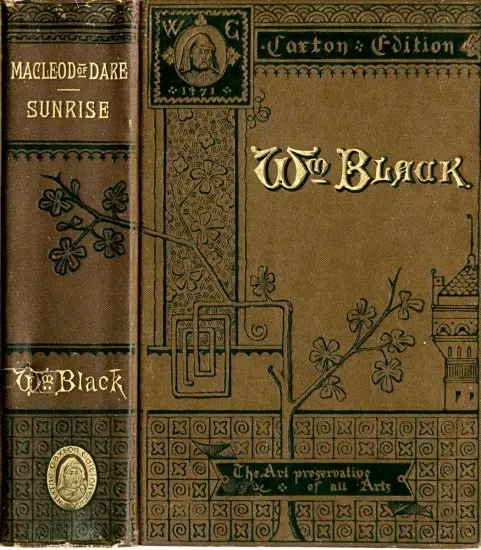
THE CLASSIC COLLECTION · 1881
"Sunrise" by William Black is a novel written in the late 19th century. The story revolves around two main characters, George Brand and Lord Evelyn, who engage in a spirited discourse while navigating a world rife with political intrigue and revolutionary ideals. Central to the narrative is their encounter with Ferdinand Lind, a mysterious figure involved in radical movements, and his daughter, Natalie, whose presence hints at deeper emotional and ideological currents. The opening of the book introduces a chilly February day in London, marking an intersection of lives set against the backdrop of political conspiracies. George Brand, a skeptic of the political fervor that surrounds them, expresses disdain for what he perceives as folly, while Lord Evelyn passionately defends their cause, revealing a divide in their ideologies. As they approach Lind's modest abode to engage in discussions that promise both intrigue and danger, the narrative sets the tone for a complex exploration of belief, loyalty, and the quest for justice. This tantalizing start invites readers into a world where personal convictions clash with societal issues, prompting the question: how far will individuals go for their beliefs?
Introduction adapted from the source catalogue; source summaries may be automatically generated.
Free to read · English · 177,226 words · No account needed
MAKE TIME FOR A GOOD BOOK
On by default. Untick to stop anonymous reading totals. Each page counts after 10 seconds in view. How this works.
Anonymous counting is on unless you have switched it off.
Here he easily found the entrance to an ordinary sort of grotto--a narrow cave winding inward and ending in a piece of fancy rockwork down which the water was heard to trickle. But he did not go to the end--he stopped about half-way and listened. There was no sound whatever in the dark, except the plash of the tiny water-fall.
Then there was a heavy grating noise, and in the black wall before him appeared a vertical line of orange light. This sudden gleam was so bewildering to the eyes that Calabressa could not see who it was that come out to him; he only knew that the stranger waited for him to pass on into the outer air.
"It is cooler here. To your business, friend Calabressa."
The moment Calabressa recognized this tall, military-looking man, with the closely cropped bullet-head and long silver-white mustache, he whipped off his cap, and said, anxiously,
"A thousand pardons, Excellency! a thousand pardons! Do I interrupt? May
not I see Fossati?"
"It is unnecessary. There is much business to-night. One must breathe
the air sometimes."
Calabressa for once had completely lost his sang-froid. He could not
speak for stammering.
"I assure you, your Excellency, it is death to me to think that I
interrupt you."
"But why did you come, then, my friend? To the point."
"Zaccatelli," the other managed to get out.
"Well?"
"There was a proposal. Some days ago I saw Granaglia."
"Well?"
"Pardon me, Excellency. If I had known, not for worlds would I have
called you--"
"Come, come my Calabressa," said the other, good-naturedly. "No more apologies. What is it you have to say?--the proposal made by the Cardinal? Yes; we know about that."
"And it has not been accepted?--the decree remains?"
"You waste your breath, my friend. The decree remains, certainly. We are not children; we do not play. What more, my Calabressa?"
But Calabressa had to collect his thoughts. Then he said, slowly,
"It occurred to me when I was in England--there was a poor devil there who would have thrown away his life in a useless act of revenge--well--"
"Well, you brought him over here," said the other, interrupting him. "Your object? Ah, Lind and you being old comrades; and Lind appearing to you to be in a difficulty. But did Lind approve?"
"Not quite," said Calabressa, still hesitating. "He allowed us to try.
He was doubtful himself."
Your reading position is saved on this browser. Take it to another device with a library code. Reading pages adapt to text, rather than matching a printed edition.
William Black
William Black
William Black
William Black
BEHIND THE BOOK
This eBook is for the use of anyone anywhere in the United States and most other parts of the world at no cost and with almost no restrictions whatsoever. You may copy it, give it away or re-use it under the terms of the Project Gutenberg License included with this eBook or online at www.gutenberg.org. If you are not located in the United States, you will have to check the laws of the country where you are located before using this eBook. Read the source licence.
The original source file, including credits and licence, is retained by this library. Request an original-format copy at no charge. Please include the book title and Project Gutenberg identifier #17308.
KEEP YOUR CURIOSITY GOING
Coulson Kernahan

Maurice Baring
Frances Wright
Cécile Tormay

Frederic Jesup Stimson

W. H. P. (William Henry Pope) Jarvis