THE CLASSIC COLLECTION✦Andersonville diaryCLASSIC FREE BOOKS
Andersonville diary
John L. Ransom
THE CLASSIC COLLECTION · 1897
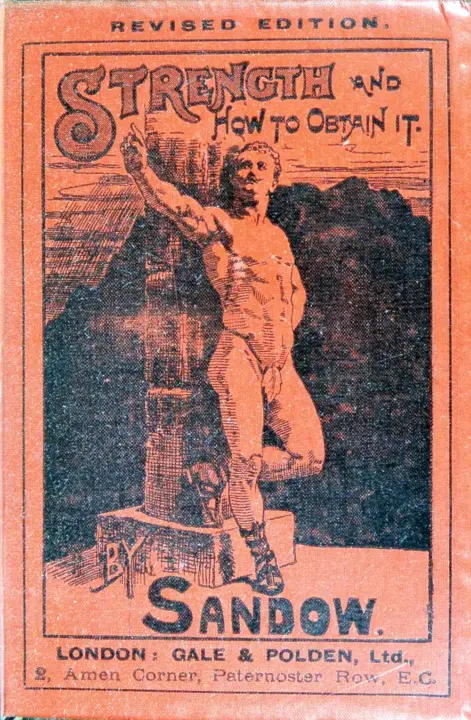
"Strength and How to Obtain It" by Eugen Sandow is a guide on physical culture and strength training written in the late 19th century. This work focuses on the philosophy and practical strategies for developing strength and overall health through systematic exercise and attention to bodily well-being. Sandow aims to make the principles of physical culture accessible to all, asserting that anyone, regardless of their starting point, can achieve a strong and healthy body by following his methods. The opening of the book establishes Sandow's belief in the universal desire for strength among people of all ages and conditions. He stresses that strength encompasses not just muscular size but health, vitality, and well-being, and underscores the idea that physical culture is distinct from mere athletics. Sandow discusses the public's evolving perception of physical training and positions his system as a holistic approach to improving one’s body and life. He provides personal anecdotes and outlines the necessity of willpower in both physical training and the broader quest for personal development, setting the stage for the detailed exercise regimen and principles that follow in the subsequent chapters of the book.
Introduction adapted from the source catalogue; source summaries may be automatically generated.
Free to read · English · 29,845 words · No account needed
MAKE TIME FOR A GOOD BOOK
On by default. Untick to stop anonymous reading totals. Each page counts after 10 seconds in view. How this works.
Anonymous counting is on unless you have switched it off.
I do not think I can conclude this chapter better than by reprinting some remarks on the subject which I wrote in the first number of “Physical Culture,” my monthly magazine. The article was carefully thought out, and I do not think there is any need for me to add to it. “For after all, why should not a man feel some pride in a healthy and well-cared-for body? Though I contend that it in itself is emphatically a good thing, that is not to say the effects of physical culture are confined to the body. In bringing the body to its highest pitch of perfection, various moral qualities, the value of which it would be difficult to over-estimate, must necessarily be brought into play. The first essential to success is the power of concentrating the will upon the work. Muscles are not developed by muscular action alone. Physical exertion, however arduous and long continued, will not make a man strong, or the day labourer and the blacksmith would be the strongest of men. Mechanical and desultory exertion will never materially increase a man’s strength. He must first learn the great secret, which ought to be no secret at all. He must use his mind. He may not be able to add a cubit to his stature, but by taking thought a man can most assuredly increase the size of his muscles, strengthen all his organs, and add to his general vitality. But he must put his mind, as well as his muscles, into the work. And by exercise and practice the will-power is greatly increased, until, in course of time, the whole organism is so absolutely under its control that the muscles can be kept in perfect condition even without what, in ordinary language, is called “exercise.” That is to say, that without violent exertion, but merely by the exertion of the will, the muscles can be exercised almost to any extent. Can it for a moment be supposed that this cultivation of the will-power is not of great value to an individual, no matter what sort of task or work he may be engaged in? Is it not largely by the exercise of will-power that most things are achieved? Take two men of equal talents; give them equal opportunities; but let one’s will-power and power of concentration be relatively much greater than his fellow’s. Then set them to perform the same task. Which will succeed best? No person endowed with ordinary intelligence can be in doubt for a moment. Will-power is a mighty factor--perhaps the mightiest--in all that goes to make up the sum of human success or failure. But the strengthening of will--though perhaps the chief--is not by a long way the only benefit which physical culture confers. The man who means to make his body as nearly perfect as possible must perforce cultivate habits of self-control and of temperance. Not the temperance which consists of rigidly abstaining from all the ‘pleasant vices,’ but the real temperance which teaches a man to say ‘No,’ which teaches him to indulge in all that is conducive to happiness without being in danger of that overstepping of the boundary line which leads to misery. The man who has cultivated his body has also cultivated self-respect. He has learned the virtue and the happiness of rigid personal cleanliness; his views of life are sane and wholesome. Respecting himself he learns to respect others. He is gentle, and only uses his powers against his fellowmen when called upon to do so in the defence of the oppressed and helpless. It is your weakling who is generally a bully and a tyrant. To take a few men who are exceptionally endowed by Nature, to make them extraordinarily strong, and to then train them to perform particular feats, is not a thing very difficult of accomplishment. But that is not the aim of physical culture. Its ultimate object is to raise the average standard of the race as a whole. That is, no doubt, a stupendous task, and one which it may take many lifetimes to accomplish. But everything must have its beginning, and unless we set about improving the physique of the present generation, we cannot hope to benefit those who come after us. Healthier and more perfect men and women will beget children with better constitutions and more free from hereditary taint. They in their turn, if the principles and the duty of physical culture are early instilled into them, will grow up more perfect types of men and women than were their mothers and fathers. So the happy progression will go on, until, who knows, if in the days to come there will not be a race of mortals walking this earth of ours even surpassing those who, according to the old myth, were the offspring of the union of the sons of the gods with the daughters of men! That is, perhaps, an almost impossible ideal, but it is well to set one’s ideals high. Surely what has been done for the horse and the dog cannot be impossible of accomplishment in the case of man. At all events, it is worth trying.”
Your reading position is saved on this browser. Take it to another device with a library code. Reading pages adapt to text, rather than matching a printed edition.
BEHIND THE BOOK
This eBook is for the use of anyone anywhere in the United States and most other parts of the world at no cost and with almost no restrictions whatsoever. You may copy it, give it away or re-use it under the terms of the Project Gutenberg License included with this eBook or online at www.gutenberg.org. If you are not located in the United States, you will have to check the laws of the country where you are located before using this eBook. Read the source licence.
The original source file, including credits and licence, is retained by this library. Request an original-format copy at no charge. Please include the book title and Project Gutenberg identifier #65987.
KEEP YOUR CURIOSITY GOING
John L. Ransom

Herman W. Mudgett

Harriet Monroe
Daniel Dulany Addison
Charles Lanman

Harold Rosher